

7
1.4.1 Open-Loop Recycling Process
Open-loop recycling process (glass-to-lead recycling) uses recycled cathode-ray
tube glass to manufacture new glass products. Obtaining raw cathode-ray tube glass
during the open-loop process is not recommended because of various unknown
compositions (Mueller et al. 2012). The applications of the raw cathode-ray tube in
new products are considered as a barrier (Lee et al. 2012) as it requires the understanding of the composition of the raw cathode-ray tube (Lairaksa et al. 2013)
unless the lead does not go beyond the standards (Yot and Mear 2011). Keeping in
view this constraint of using funnel glass, open-loop process uses panel glass only
for new glass products because of its constant and known composition (Iniaghe
et al. 2013).
1.4.2 Closed-Loop Recycling Process
Closed-loop recycling process (glass-to-glass recycling) recycles old cathode-ray
tube in the manufacturing of new cathode-ray tube. Both funnel and panel glass is
broken into small pieces without any segregation in closed-loop process (Ertug and
Unlu 2012). The closed-loop process was suitable when there was enough old
cathode- ray tube available to meet the ongoing market demand (Lairaksa et al.
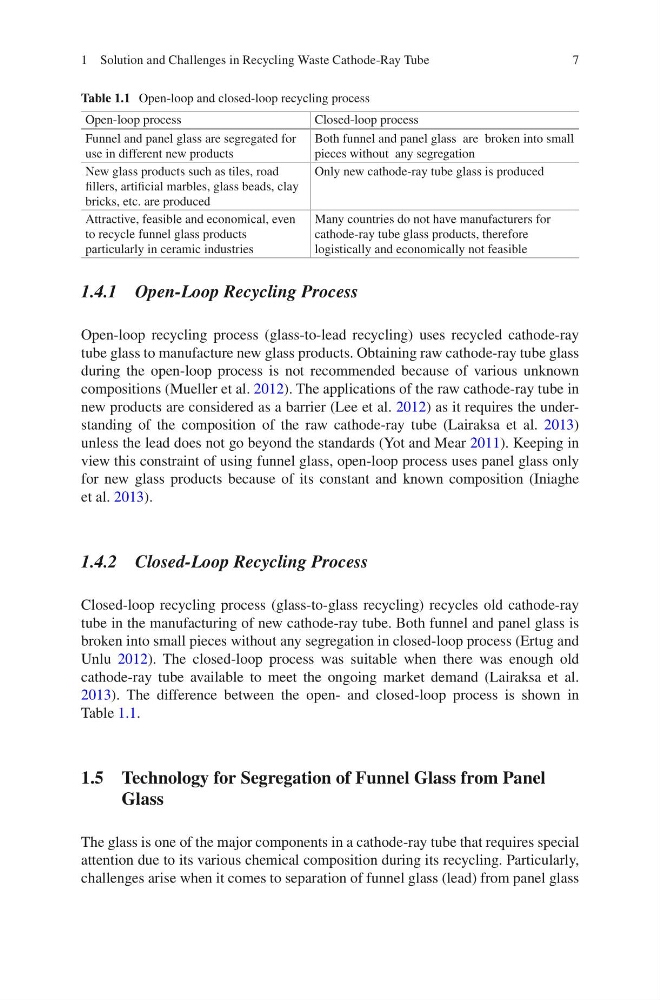
2013). The difference between the open- and closed-loop process is shown in
Table 1.1.
1.5 Technology for Segregation of Funnel Glass from Panel
Glass
The glass is one of the major components in a cathode-ray tube that requires special
attention due to its various chemical composition during its recycling. Particularly,
challenges arise when it comes to separation of funnel glass (lead) from panel glass
Table 1.1 Open-loop and closed-loop recycling process
Open-loop process
Closed-loop process
Funnel and panel glass are segregated for
use in different new products
Both funnel and panel glass are broken into small
pieces without any segregation
New glass products such as tiles, road
fillers, artificial marbles, glass beads, clay
bricks, etc. are produced
Only new cathode-ray tube glass is produced
Attractive, feasible and economical, even
to recycle funnel glass products
particularly in ceramic industries
Many countries do not have manufacturers for
cathode-ray tube glass products, therefore
logistically and economically not feasible
1 Solution and Challenges in Recycling Waste Cathode-Ray Tube
1.4.1 Open-Loop Recycling Process
Open-loop recycling process (glass-to-lead recycling) uses recycled cathode-ray
tube glass to manufacture new glass products. Obtaining raw cathode-ray tube glass
during the open-loop process is not recommended because of various unknown
compositions (Mueller et al. 2012). The applications of the raw cathode-ray tube in
new products are considered as a barrier (Lee et al. 2012) as it requires the understanding of the composition of the raw cathode-ray tube (Lairaksa et al. 2013)
unless the lead does not go beyond the standards (Yot and Mear 2011). Keeping in
view this constraint of using funnel glass, open-loop process uses panel glass only
for new glass products because of its constant and known composition (Iniaghe
et al. 2013).
1.4.2 Closed-Loop Recycling Process
Closed-loop recycling process (glass-to-glass recycling) recycles old cathode-ray
tube in the manufacturing of new cathode-ray tube. Both funnel and panel glass is
broken into small pieces without any segregation in closed-loop process (Ertug and
Unlu 2012). The closed-loop process was suitable when there was enough old
cathode- ray tube available to meet the ongoing market demand (Lairaksa et al.
2013). The difference between the open- and closed-loop process is shown in
Table 1.1.
1.5 Technology for Segregation of Funnel Glass from Panel
Glass
The glass is one of the major components in a cathode-ray tube that requires special
attention due to its various chemical composition during its recycling. Particularly,
challenges arise when it comes to separation of funnel glass (lead) from panel glass
Table 1.1 Open-loop and closed-loop recycling process
Open-loop process
Closed-loop process
Funnel and panel glass are segregated for
use in different new products
Both funnel and panel glass are broken into small
pieces without any segregation
New glass products such as tiles, road
fillers, artificial marbles, glass beads, clay
bricks, etc. are produced
Only new cathode-ray tube glass is produced
Attractive, feasible and economical, even
to recycle funnel glass products
particularly in ceramic industries
Many countries do not have manufacturers for
cathode-ray tube glass products, therefore
logistically and economically not feasible
1 Solution and Challenges in Recycling Waste Cathode-Ray Tube