

101
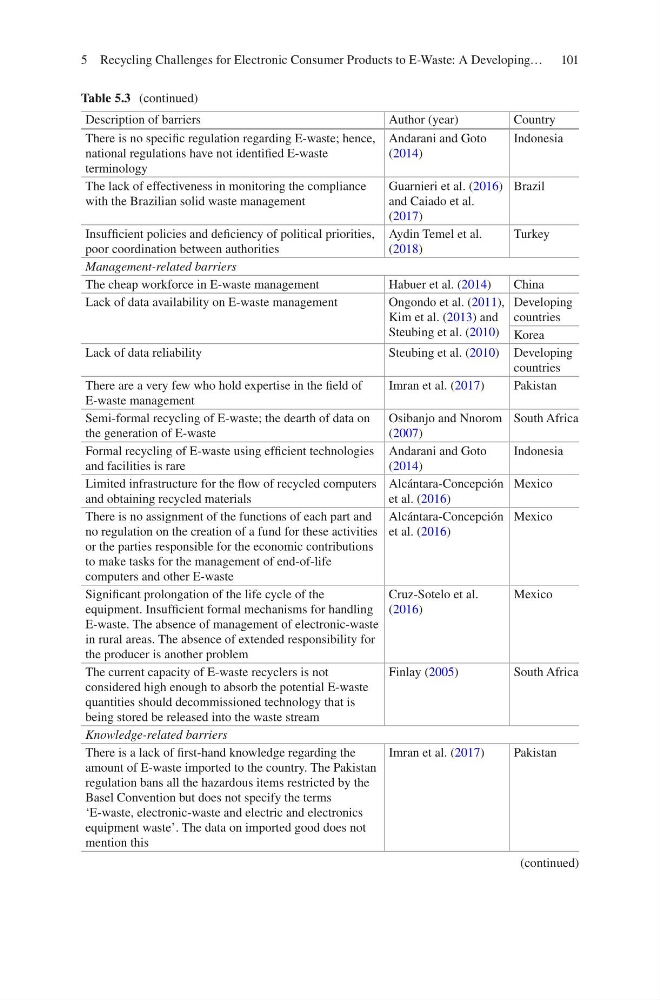
Table 5.3 (continued)
Description of barriers
Author (year)
Country
There is no specific regulation regarding E-waste; hence,
national regulations have not identified E-waste
terminology
Andarani and Goto
(2014)
Indonesia
The lack of effectiveness in monitoring the compliance
with the Brazilian solid waste management
Guarnieri et al. (2016)
and Caiado et al.
(2017)
Brazil
Insufficient policies and deficiency of political priorities,
poor coordination between authorities
Aydin Temel et al.
(2018)
Turkey
Management-related barriers
The cheap workforce in E-waste management
Habuer et al. (2014)
China
Lack of data availability on E-waste management
Ongondo et al. (2011),
Kim et al. (2013) and
Steubing et al. (2010)
Developing
countries
Korea
Lack of data reliability
Steubing et al. (2010) Developing
countries
There are a very few who hold expertise in the field of
E-waste management
Imran et al. (2017)
Pakistan
Semi-formal recycling of E-waste; the dearth of data on
the generation of E-waste
Osibanjo and Nnorom
(2007)
South Africa
Formal recycling of E-waste using efficient technologies
and facilities is rare
Andarani and Goto
(2014)
Indonesia
Limited infrastructure for the flow of recycled computers
and obtaining recycled materials
Alcántara-Concepción
et al. (2016)
Mexico
There is no assignment of the functions of each part and
no regulation on the creation of a fund for these activities
or the parties responsible for the economic contributions
to make tasks for the management of end-of-life
computers and other E-waste
Alcántara-Concepción
et al. (2016)
Mexico
Significant prolongation of the life cycle of the
equipment. Insufficient formal mechanisms for handling
E-waste. The absence of management of electronic-waste
in rural areas. The absence of extended responsibility for
the producer is another problem
Cruz-Sotelo et al.
(2016)
Mexico
The current capacity of E-waste recyclers is not
considered high enough to absorb the potential E-waste
quantities should decommissioned technology that is
being stored be released into the waste stream
Finlay (2005)
South Africa
Knowledge-related barriers
There is a lack of first-hand knowledge regarding the
amount of E-waste imported to the country. The Pakistan
regulation bans all the hazardous items restricted by the
Basel Convention but does not specify the terms
‘E-waste, electronic-waste and electric and electronics
equipment waste’. The data on imported good does not
mention this
Imran et al. (2017)
Pakistan
(continued)
5 Recycling Challenges for Electronic Consumer Products to E-Waste: A Developing…
Table 5.3 (continued)
Description of barriers
Author (year)
Country
There is no specific regulation regarding E-waste; hence,
national regulations have not identified E-waste
terminology
Andarani and Goto
(2014)
Indonesia
The lack of effectiveness in monitoring the compliance
with the Brazilian solid waste management
Guarnieri et al. (2016)
and Caiado et al.
(2017)
Brazil
Insufficient policies and deficiency of political priorities,
poor coordination between authorities
Aydin Temel et al.
(2018)
Turkey
Management-related barriers
The cheap workforce in E-waste management
Habuer et al. (2014)
China
Lack of data availability on E-waste management
Ongondo et al. (2011),
Kim et al. (2013) and
Steubing et al. (2010)
Developing
countries
Korea
Lack of data reliability
Steubing et al. (2010) Developing
countries
There are a very few who hold expertise in the field of
E-waste management
Imran et al. (2017)
Pakistan
Semi-formal recycling of E-waste; the dearth of data on
the generation of E-waste
Osibanjo and Nnorom
(2007)
South Africa
Formal recycling of E-waste using efficient technologies
and facilities is rare
Andarani and Goto
(2014)
Indonesia
Limited infrastructure for the flow of recycled computers
and obtaining recycled materials
Alcántara-Concepción
et al. (2016)
Mexico
There is no assignment of the functions of each part and
no regulation on the creation of a fund for these activities
or the parties responsible for the economic contributions
to make tasks for the management of end-of-life
computers and other E-waste
Alcántara-Concepción
et al. (2016)
Mexico
Significant prolongation of the life cycle of the
equipment. Insufficient formal mechanisms for handling
E-waste. The absence of management of electronic-waste
in rural areas. The absence of extended responsibility for
the producer is another problem
Cruz-Sotelo et al.
(2016)
Mexico
The current capacity of E-waste recyclers is not
considered high enough to absorb the potential E-waste
quantities should decommissioned technology that is
being stored be released into the waste stream
Finlay (2005)
South Africa
Knowledge-related barriers
There is a lack of first-hand knowledge regarding the
amount of E-waste imported to the country. The Pakistan
regulation bans all the hazardous items restricted by the
Basel Convention but does not specify the terms
‘E-waste, electronic-waste and electric and electronics
equipment waste’. The data on imported good does not
mention this
Imran et al. (2017)
Pakistan
(continued)
5 Recycling Challenges for Electronic Consumer Products to E-Waste: A Developing…