

102
found in this research. They categorize barriers as legal, organizational, economic,
management, technological, infrastructural and market-related barriers.
Bouzon et al. (2016), studying the context of Brazil, identified 36 barriers to the
implementation of reverse logistics, which were categorized as (i) technology- and
infrastructure-related issues, (ii) governance- and supply chain process-related
issues, (iii) economic-related issues, (iv) knowledge-related issues, (v) policyrelated issues, (vi) market- and competitor-related issues and (vii) managementrelated issues. It is important to emphasize that the authors also used a multicriteria
decision aid method to prioritize the barriers.
On the other hand, Prakash and Barua (2015) applied a multicriteria decision aid
method, in order to find alternatives that can overcome these barriers. They found
20 solutions gathered from relevant literature and expert views, which can be viewed
in Table 5.4.
Guarnieri et al. (2016) studied the problem of implementation of E-waste reverse
logistics in Brazil, through a problem structuring method, called Strategic Options
and Development Analysis. Similarly to Bouzon et al. (2016), these authors found
some actions that can be implemented in order to overcome some barriers, which
are presented in Fig. 5.1
So, some developing countries are being able to propose measures to overcome
these barriers. One of them could be pointed out; the Global E-waste Monitor 2017
found that, although the E-waste challenge is on the rise, a growing number of countries are adopting E-waste legislation. Baldé et al. (2017) state that 66% of the world
population is covered by national E-waste management laws, which means an
increase from 44% that were covered in 2014. The authors state that the main challenge with sustainable E-waste management in Latin America is the acceleration of
all legislation processes. It is important to highlight that, considering the countries
approached in this research, only Brazil in Latin America has a legislation, which is
the Brazilian Policy of Solid Waste (Brazil 2010, Law. 12,305/2010).
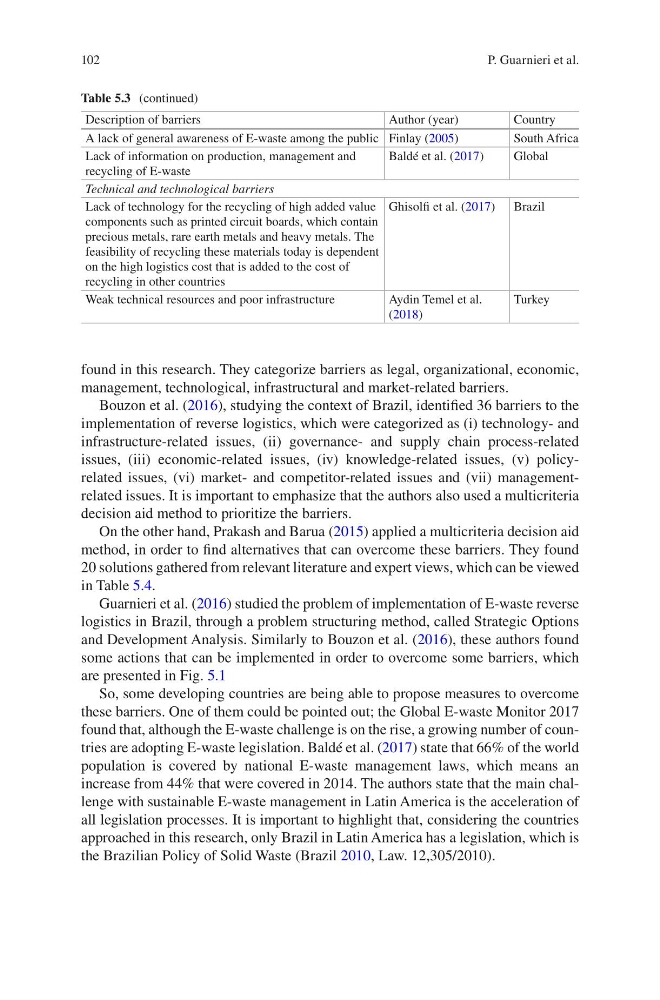
Table 5.3 (continued)
Description of barriers
Author (year)
Country
A lack of general awareness of E-waste among the public Finlay (2005)
South Africa
Lack of information on production, management and
recycling of E-waste
Baldé et al. (2017)
Global
Technical and technological barriers
Lack of technology for the recycling of high added value
components such as printed circuit boards, which contain
precious metals, rare earth metals and heavy metals. The
feasibility of recycling these materials today is dependent
on the high logistics cost that is added to the cost of
recycling in other countries
Ghisolfi et al. (2017) Brazil
Weak technical resources and poor infrastructure
Aydin Temel et al.
(2018)
Turkey
P. Guarnieri et al.
found in this research. They categorize barriers as legal, organizational, economic,
management, technological, infrastructural and market-related barriers.
Bouzon et al. (2016), studying the context of Brazil, identified 36 barriers to the
implementation of reverse logistics, which were categorized as (i) technology- and
infrastructure-related issues, (ii) governance- and supply chain process-related
issues, (iii) economic-related issues, (iv) knowledge-related issues, (v) policyrelated issues, (vi) market- and competitor-related issues and (vii) managementrelated issues. It is important to emphasize that the authors also used a multicriteria
decision aid method to prioritize the barriers.
On the other hand, Prakash and Barua (2015) applied a multicriteria decision aid
method, in order to find alternatives that can overcome these barriers. They found
20 solutions gathered from relevant literature and expert views, which can be viewed
in Table 5.4.
Guarnieri et al. (2016) studied the problem of implementation of E-waste reverse
logistics in Brazil, through a problem structuring method, called Strategic Options
and Development Analysis. Similarly to Bouzon et al. (2016), these authors found
some actions that can be implemented in order to overcome some barriers, which
are presented in Fig. 5.1
So, some developing countries are being able to propose measures to overcome
these barriers. One of them could be pointed out; the Global E-waste Monitor 2017
found that, although the E-waste challenge is on the rise, a growing number of countries are adopting E-waste legislation. Baldé et al. (2017) state that 66% of the world
population is covered by national E-waste management laws, which means an
increase from 44% that were covered in 2014. The authors state that the main challenge with sustainable E-waste management in Latin America is the acceleration of
all legislation processes. It is important to highlight that, considering the countries
approached in this research, only Brazil in Latin America has a legislation, which is
the Brazilian Policy of Solid Waste (Brazil 2010, Law. 12,305/2010).
Table 5.3 (continued)
Description of barriers
Author (year)
Country
A lack of general awareness of E-waste among the public Finlay (2005)
South Africa
Lack of information on production, management and
recycling of E-waste
Baldé et al. (2017)
Global
Technical and technological barriers
Lack of technology for the recycling of high added value
components such as printed circuit boards, which contain
precious metals, rare earth metals and heavy metals. The
feasibility of recycling these materials today is dependent
on the high logistics cost that is added to the cost of
recycling in other countries
Ghisolfi et al. (2017) Brazil
Weak technical resources and poor infrastructure
Aydin Temel et al.
(2018)
Turkey
P. Guarnieri et al.