

100
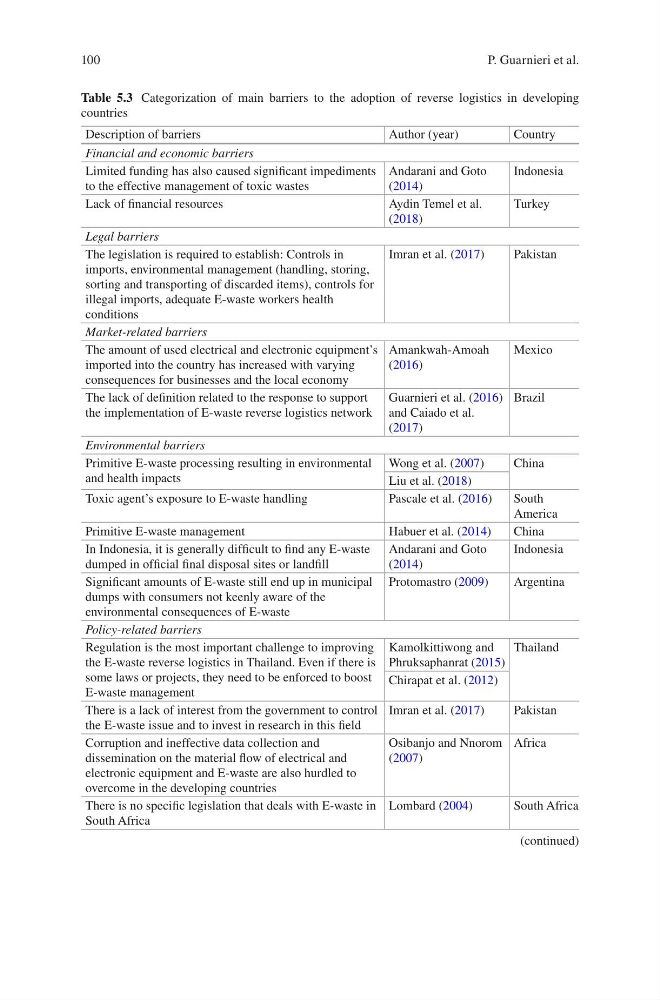
Table 5.3 Categorization of main barriers to the adoption of reverse logistics in developing
countries
Description of barriers
Author (year)
Country
Financial and economic barriers
Limited funding has also caused significant impediments
to the effective management of toxic wastes
Andarani and Goto
(2014)
Indonesia
Lack of financial resources
Aydin Temel et al.
(2018)
Turkey
Legal barriers
The legislation is required to establish: Controls in
imports, environmental management (handling, storing,
sorting and transporting of discarded items), controls for
illegal imports, adequate E-waste workers health
conditions
Imran et al. (2017)
Pakistan
Market-related barriers
The amount of used electrical and electronic equipment’s
imported into the country has increased with varying
consequences for businesses and the local economy
Amankwah-Amoah
(2016)
Mexico
The lack of definition related to the response to support
the implementation of E-waste reverse logistics network
Guarnieri et al. (2016)
and Caiado et al.
(2017)
Brazil
Environmental barriers
Primitive E-waste processing resulting in environmental
and health impacts
Wong et al. (2007)
China
Liu et al. (2018)
Toxic agent’s exposure to E-waste handling
Pascale et al. (2016)
South
America
Primitive E-waste management
Habuer et al. (2014)
China
In Indonesia, it is generally difficult to find any E-waste
dumped in official final disposal sites or landfill
Andarani and Goto
(2014)
Indonesia
Significant amounts of E-waste still end up in municipal
dumps with consumers not keenly aware of the
environmental consequences of E-waste
Protomastro (2009)
Argentina
Policy-related barriers
Regulation is the most important challenge to improving
the E-waste reverse logistics in Thailand. Even if there is
some laws or projects, they need to be enforced to boost
E-waste management
Kamolkittiwong and
Phruksaphanrat (2015)
Thailand
Chirapat et al. (2012)
There is a lack of interest from the government to control
the E-waste issue and to invest in research in this field
Imran et al. (2017)
Pakistan
Corruption and ineffective data collection and
dissemination on the material flow of electrical and
electronic equipment and E-waste are also hurdled to
overcome in the developing countries
Osibanjo and Nnorom
(2007)
Africa
There is no specific legislation that deals with E-waste in
South Africa
Lombard (2004)
South Africa
(continued)
P. Guarnieri et al.
Table 5.3 Categorization of main barriers to the adoption of reverse logistics in developing
countries
Description of barriers
Author (year)
Country
Financial and economic barriers
Limited funding has also caused significant impediments
to the effective management of toxic wastes
Andarani and Goto
(2014)
Indonesia
Lack of financial resources
Aydin Temel et al.
(2018)
Turkey
Legal barriers
The legislation is required to establish: Controls in
imports, environmental management (handling, storing,
sorting and transporting of discarded items), controls for
illegal imports, adequate E-waste workers health
conditions
Imran et al. (2017)
Pakistan
Market-related barriers
The amount of used electrical and electronic equipment’s
imported into the country has increased with varying
consequences for businesses and the local economy
Amankwah-Amoah
(2016)
Mexico
The lack of definition related to the response to support
the implementation of E-waste reverse logistics network
Guarnieri et al. (2016)
and Caiado et al.
(2017)
Brazil
Environmental barriers
Primitive E-waste processing resulting in environmental
and health impacts
Wong et al. (2007)
China
Liu et al. (2018)
Toxic agent’s exposure to E-waste handling
Pascale et al. (2016)
South
America
Primitive E-waste management
Habuer et al. (2014)
China
In Indonesia, it is generally difficult to find any E-waste
dumped in official final disposal sites or landfill
Andarani and Goto
(2014)
Indonesia
Significant amounts of E-waste still end up in municipal
dumps with consumers not keenly aware of the
environmental consequences of E-waste
Protomastro (2009)
Argentina
Policy-related barriers
Regulation is the most important challenge to improving
the E-waste reverse logistics in Thailand. Even if there is
some laws or projects, they need to be enforced to boost
E-waste management
Kamolkittiwong and
Phruksaphanrat (2015)
Thailand
Chirapat et al. (2012)
There is a lack of interest from the government to control
the E-waste issue and to invest in research in this field
Imran et al. (2017)
Pakistan
Corruption and ineffective data collection and
dissemination on the material flow of electrical and
electronic equipment and E-waste are also hurdled to
overcome in the developing countries
Osibanjo and Nnorom
(2007)
Africa
There is no specific legislation that deals with E-waste in
South Africa
Lombard (2004)
South Africa
(continued)
P. Guarnieri et al.