

86
4 Mathematical Models of the Interaction of Laser Radiation with Turbid Media
0
0.05
0.1
0.15
0.2
0.25
0.3
0.35
0
0.05
0.1
0.15
0.2
0.25
0.3
0.35
0.4
0.45
v, cm/c
I, W/cm
2
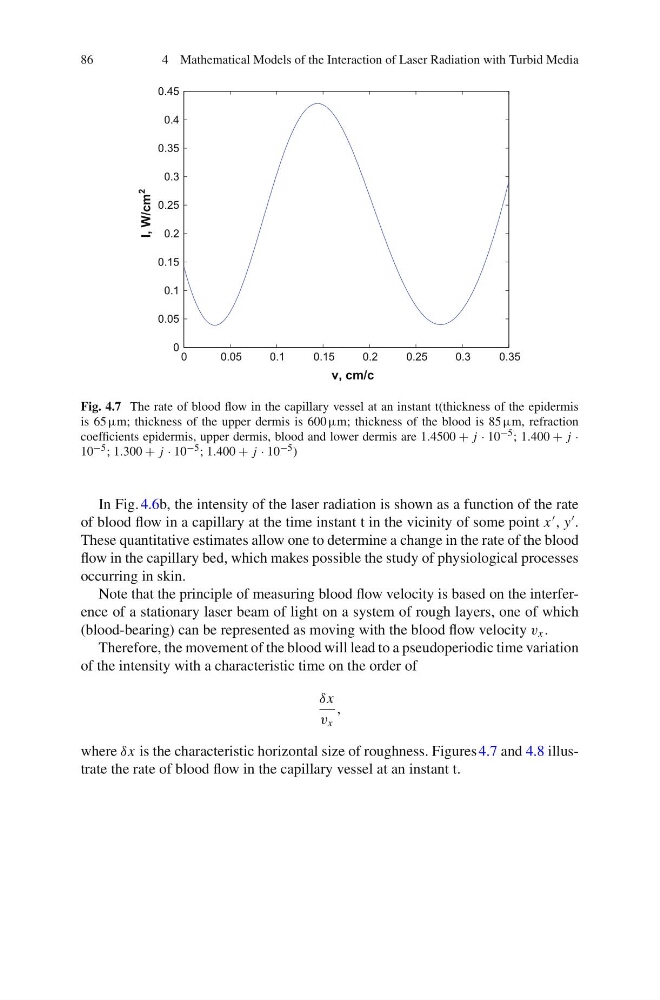
Fig. 4.7 The rate of blood flow in the capillary vessel at an instant t(thickness of the epidermis
is 65 µm; thickness of the upper dermis is 600 µm; thickness of the blood is 85 µm, refraction
coefficients epidermis, upper dermis, blood and lower dermis are 1.4500 + j · 10 −5 ; 1.400 + j ·
10 −5 ; 1.300 + j · 10 −5 ; 1.400 + j · 10 −5 )
In Fig. 4.6b, the intensity of the laser radiation is shown as a function of the rate
of blood flow in a capillary at the time instant t in the vicinity of some point x
, y
.
These quantitative estimates allow one to determine a change in the rate of the blood
flow in the capillary bed, which makes possible the study of physiological processes
occurring in skin.
Note that the principle of measuring blood flow velocity is based on the interference of a stationary laser beam of light on a system of rough layers, one of which
(blood-bearing) can be represented as moving with the blood flow velocity v x .
Therefore, the movement of the blood will lead to a pseudoperiodic time variation
of the intensity with a characteristic time on the order of
δx
v x
,
where δx is the characteristic horizontal size of roughness. Figures 4.7 and 4.8 illustrate the rate of blood flow in the capillary vessel at an instant t.
4 Mathematical Models of the Interaction of Laser Radiation with Turbid Media
0
0.05
0.1
0.15
0.2
0.25
0.3
0.35
0
0.05
0.1
0.15
0.2
0.25
0.3
0.35
0.4
0.45
v, cm/c
I, W/cm
2
Fig. 4.7 The rate of blood flow in the capillary vessel at an instant t(thickness of the epidermis
is 65 µm; thickness of the upper dermis is 600 µm; thickness of the blood is 85 µm, refraction
coefficients epidermis, upper dermis, blood and lower dermis are 1.4500 + j · 10 −5 ; 1.400 + j ·
10 −5 ; 1.300 + j · 10 −5 ; 1.400 + j · 10 −5 )
In Fig. 4.6b, the intensity of the laser radiation is shown as a function of the rate
of blood flow in a capillary at the time instant t in the vicinity of some point x
, y
.
These quantitative estimates allow one to determine a change in the rate of the blood
flow in the capillary bed, which makes possible the study of physiological processes
occurring in skin.
Note that the principle of measuring blood flow velocity is based on the interference of a stationary laser beam of light on a system of rough layers, one of which
(blood-bearing) can be represented as moving with the blood flow velocity v x .
Therefore, the movement of the blood will lead to a pseudoperiodic time variation
of the intensity with a characteristic time on the order of
δx
v x
,
where δx is the characteristic horizontal size of roughness. Figures 4.7 and 4.8 illustrate the rate of blood flow in the capillary vessel at an instant t.