

4.7 Numerical Calculations for a Model Medium and Conclusions
87
0
0.05
0.1
0.15
0.2
0.25
0.3
0.35
0
0.1
0.2
0.3
0.4
0.5
0.6
0.7
0.8
v, cm/c
I, W/cm
2
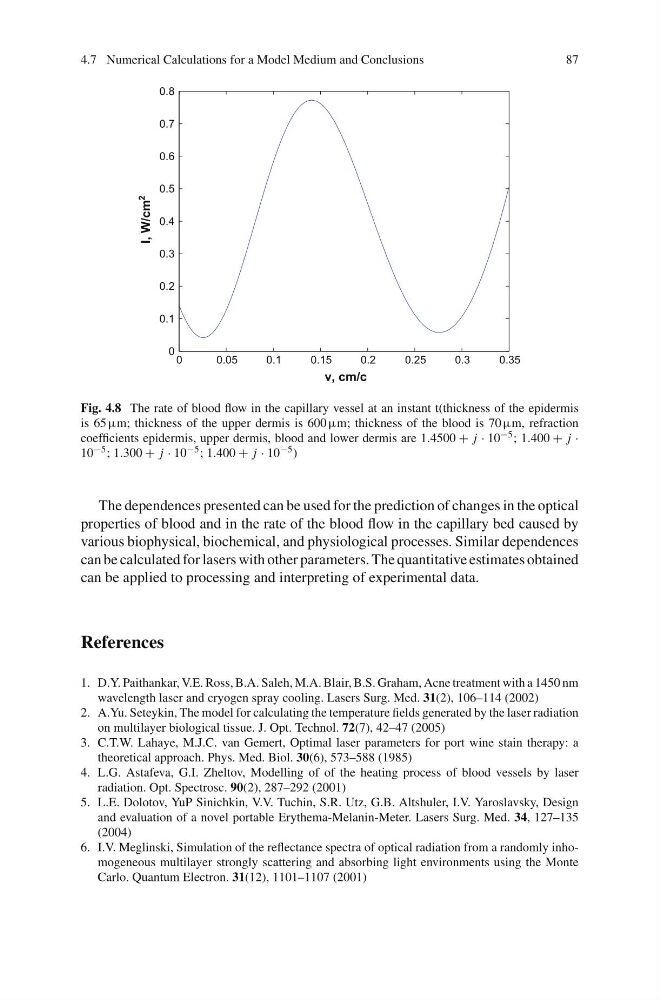
Fig. 4.8 The rate of blood flow in the capillary vessel at an instant t(thickness of the epidermis
is 65 µm; thickness of the upper dermis is 600 µm; thickness of the blood is 70 µm, refraction
coefficients epidermis, upper dermis, blood and lower dermis are 1.4500 + j · 10 −5 ; 1.400 + j ·
10 −5 ; 1.300 + j · 10 −5 ; 1.400 + j · 10 −5 )
The dependences presented can be used for the prediction of changes in the optical
properties of blood and in the rate of the blood flow in the capillary bed caused by
various biophysical, biochemical, and physiological processes. Similar dependences
can be calculated for lasers with other parameters. The quantitative estimates obtained
can be applied to processing and interpreting of experimental data.
References
1. D.Y. Paithankar, V.E. Ross, B.A. Saleh, M.A. Blair, B.S. Graham, Acne treatment with a 1450 nm
wavelength laser and cryogen spray cooling. Lasers Surg. Med. 31(2), 106–114 (2002)
2. A.Yu. Seteykin, The model for calculating the temperature fields generated by the laser radiation
on multilayer biological tissue. J. Opt. Technol. 72(7), 42–47 (2005)
3. C.T.W. Lahaye, M.J.C. van Gemert, Optimal laser parameters for port wine stain therapy: a
theoretical approach. Phys. Med. Biol. 30(6), 573–588 (1985)
4. L.G. Astafeva, G.I. Zheltov, Modelling of of the heating process of blood vessels by laser
radiation. Opt. Spectrosc. 90(2), 287–292 (2001)
5. L.E. Dolotov, YuP Sinichkin, V.V. Tuchin, S.R. Utz, G.B. Altshuler, I.V. Yaroslavsky, Design
and evaluation of a novel portable Erythema-Melanin-Meter. Lasers Surg. Med. 34, 127–135
(2004)
6. I.V. Meglinski, Simulation of the reflectance spectra of optical radiation from a randomly inhomogeneous multilayer strongly scattering and absorbing light environments using the Monte
Carlo. Quantum Electron. 31(12), 1101–1107 (2001)
87
0
0.05
0.1
0.15
0.2
0.25
0.3
0.35
0
0.1
0.2
0.3
0.4
0.5
0.6
0.7
0.8
v, cm/c
I, W/cm
2
Fig. 4.8 The rate of blood flow in the capillary vessel at an instant t(thickness of the epidermis
is 65 µm; thickness of the upper dermis is 600 µm; thickness of the blood is 70 µm, refraction
coefficients epidermis, upper dermis, blood and lower dermis are 1.4500 + j · 10 −5 ; 1.400 + j ·
10 −5 ; 1.300 + j · 10 −5 ; 1.400 + j · 10 −5 )
The dependences presented can be used for the prediction of changes in the optical
properties of blood and in the rate of the blood flow in the capillary bed caused by
various biophysical, biochemical, and physiological processes. Similar dependences
can be calculated for lasers with other parameters. The quantitative estimates obtained
can be applied to processing and interpreting of experimental data.
References
1. D.Y. Paithankar, V.E. Ross, B.A. Saleh, M.A. Blair, B.S. Graham, Acne treatment with a 1450 nm
wavelength laser and cryogen spray cooling. Lasers Surg. Med. 31(2), 106–114 (2002)
2. A.Yu. Seteykin, The model for calculating the temperature fields generated by the laser radiation
on multilayer biological tissue. J. Opt. Technol. 72(7), 42–47 (2005)
3. C.T.W. Lahaye, M.J.C. van Gemert, Optimal laser parameters for port wine stain therapy: a
theoretical approach. Phys. Med. Biol. 30(6), 573–588 (1985)
4. L.G. Astafeva, G.I. Zheltov, Modelling of of the heating process of blood vessels by laser
radiation. Opt. Spectrosc. 90(2), 287–292 (2001)
5. L.E. Dolotov, YuP Sinichkin, V.V. Tuchin, S.R. Utz, G.B. Altshuler, I.V. Yaroslavsky, Design
and evaluation of a novel portable Erythema-Melanin-Meter. Lasers Surg. Med. 34, 127–135
(2004)
6. I.V. Meglinski, Simulation of the reflectance spectra of optical radiation from a randomly inhomogeneous multilayer strongly scattering and absorbing light environments using the Monte
Carlo. Quantum Electron. 31(12), 1101–1107 (2001)