

4.7 Numerical Calculations for a Model Medium and Conclusions
85
(a)
(b)
0.4
0.2
0
0.6
1
0 0
0.5
0.5
1
0.8
1
x
y
y
x
0
0.4
0.2
0.6
0.5
0.2
0.4
0.6
0.8
0 0
1
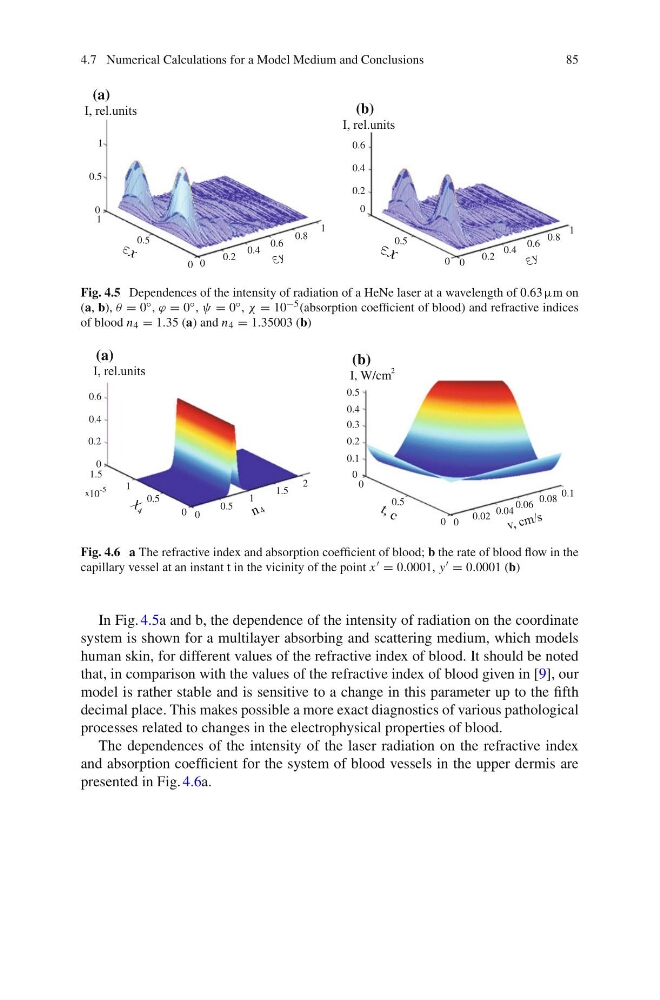
Fig. 4.5 Dependences of the intensity of radiation of a HeNe laser at a wavelength of 0.63 µm on
(a, b), θ = 0 ◦ , ϕ = 0 ◦ , ψ = 0 ◦ , χ = 10 −5 (absorption coefficient of blood) and refractive indices
of blood n 4 = 1.35 (a) and n 4 = 1.35003 (b)
I, W/cm
0.5
0.4
0.3
0.2
0.1
0
0
0.5
0 0
0.04
0.02
0.06
0.08
0.1
2
0.4
0.2
0
0.6
1.5
1
0.5
0 0
0.5
1
1.5
2
10
x
4
n 4
(a)
(b)
-5
Fig. 4.6 a The refractive index and absorption coefficient of blood; b the rate of blood flow in the
capillary vessel at an instant t in the vicinity of the point x = 0.0001, y = 0.0001 (b)
In Fig. 4.5a and b, the dependence of the intensity of radiation on the coordinate
system is shown for a multilayer absorbing and scattering medium, which models
human skin, for different values of the refractive index of blood. It should be noted
that, in comparison with the values of the refractive index of blood given in [9], our
model is rather stable and is sensitive to a change in this parameter up to the fifth
decimal place. This makes possible a more exact diagnostics of various pathological
processes related to changes in the electrophysical properties of blood.
The dependences of the intensity of the laser radiation on the refractive index
and absorption coefficient for the system of blood vessels in the upper dermis are
presented in Fig. 4.6a.
85
(a)
(b)
0.4
0.2
0
0.6
1
0 0
0.5
0.5
1
0.8
1
x
y
y
x
0
0.4
0.2
0.6
0.5
0.2
0.4
0.6
0.8
0 0
1
Fig. 4.5 Dependences of the intensity of radiation of a HeNe laser at a wavelength of 0.63 µm on
(a, b), θ = 0 ◦ , ϕ = 0 ◦ , ψ = 0 ◦ , χ = 10 −5 (absorption coefficient of blood) and refractive indices
of blood n 4 = 1.35 (a) and n 4 = 1.35003 (b)
I, W/cm
0.5
0.4
0.3
0.2
0.1
0
0
0.5
0 0
0.04
0.02
0.06
0.08
0.1
2
0.4
0.2
0
0.6
1.5
1
0.5
0 0
0.5
1
1.5
2
10
x
4
n 4
(a)
(b)
-5
Fig. 4.6 a The refractive index and absorption coefficient of blood; b the rate of blood flow in the
capillary vessel at an instant t in the vicinity of the point x = 0.0001, y = 0.0001 (b)
In Fig. 4.5a and b, the dependence of the intensity of radiation on the coordinate
system is shown for a multilayer absorbing and scattering medium, which models
human skin, for different values of the refractive index of blood. It should be noted
that, in comparison with the values of the refractive index of blood given in [9], our
model is rather stable and is sensitive to a change in this parameter up to the fifth
decimal place. This makes possible a more exact diagnostics of various pathological
processes related to changes in the electrophysical properties of blood.
The dependences of the intensity of the laser radiation on the refractive index
and absorption coefficient for the system of blood vessels in the upper dermis are
presented in Fig. 4.6a.