

84
4 Mathematical Models of the Interaction of Laser Radiation with Turbid Media
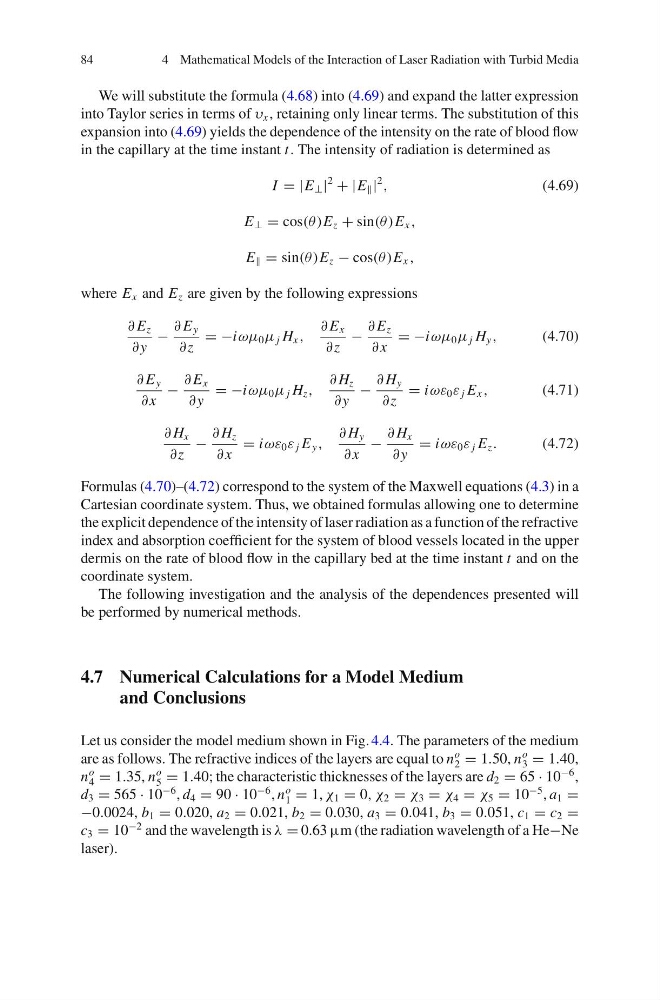
We will substitute the formula (4.68) into (4.69) and expand the latter expression
into Taylor series in terms of υ x , retaining only linear terms. The substitution of this
expansion into (4.69) yields the dependence of the intensity on the rate of blood flow
in the capillary at the time instant t. The intensity of radiation is determined as
I = |E ⊥ |
2
+ |E |
2
,
(4.69)
E ⊥ = cos(θ )E z + sin(θ )E x ,
E = sin(θ )E z − cos(θ )E x ,
where E x and E z are given by the following expressions
∂ E z
∂ y
−
∂ E y
∂z
= −iωμ 0 μ j H x ,
∂ E x
∂z
−
∂ E z
∂ x
= −iωμ 0 μ j H y ,
(4.70)
∂ E y
∂ x
−
∂ E x
∂ y
= −iωμ 0 μ j H z ,
∂ H z
∂ y
−
∂ H y
∂z
= iωε 0 ε j E x ,
(4.71)
∂ H x
∂z
−
∂ H z
∂ x
= iωε 0 ε j E y ,
∂ H y
∂ x
−
∂ H x
∂ y
= iωε 0 ε j E z .
(4.72)
Formulas (4.70)–(4.72) correspond to the system of the Maxwell equations (4.3) in a
Cartesian coordinate system. Thus, we obtained formulas allowing one to determine
the explicit dependence of the intensity of laser radiation as a function of the refractive
index and absorption coefficient for the system of blood vessels located in the upper
dermis on the rate of blood flow in the capillary bed at the time instant t and on the
coordinate system.
The following investigation and the analysis of the dependences presented will
be performed by numerical methods.
4.7 Numerical Calculations for a Model Medium
and Conclusions
Let us consider the model medium shown in Fig. 4.4. The parameters of the medium
are as follows. The refractive indices of the layers are equal to n
o
2 = 1.50, n
o
3 = 1.40,
n
o
4 = 1.35, n
o
5 = 1.40; the characteristic thicknesses of the layers are d 2 = 65 · 10
−6 ,
d 3 = 565 · 10
−6 , d 4 = 90 · 10
−6 , n
o
1 = 1, χ 1 = 0, χ 2 = χ 3 = χ 4 = χ 5 = 10
−5 , a 1 =
−0.0024, b 1 = 0.020, a 2 = 0.021, b 2 = 0.030, a 3 = 0.041, b 3 = 0.051, c 1 = c 2 =
c 3 = 10
−2 and the wavelength is λ = 0.63 µm (the radiation wavelength of a He−Ne
laser).
4 Mathematical Models of the Interaction of Laser Radiation with Turbid Media
We will substitute the formula (4.68) into (4.69) and expand the latter expression
into Taylor series in terms of υ x , retaining only linear terms. The substitution of this
expansion into (4.69) yields the dependence of the intensity on the rate of blood flow
in the capillary at the time instant t. The intensity of radiation is determined as
I = |E ⊥ |
2
+ |E |
2
,
(4.69)
E ⊥ = cos(θ )E z + sin(θ )E x ,
E = sin(θ )E z − cos(θ )E x ,
where E x and E z are given by the following expressions
∂ E z
∂ y
−
∂ E y
∂z
= −iωμ 0 μ j H x ,
∂ E x
∂z
−
∂ E z
∂ x
= −iωμ 0 μ j H y ,
(4.70)
∂ E y
∂ x
−
∂ E x
∂ y
= −iωμ 0 μ j H z ,
∂ H z
∂ y
−
∂ H y
∂z
= iωε 0 ε j E x ,
(4.71)
∂ H x
∂z
−
∂ H z
∂ x
= iωε 0 ε j E y ,
∂ H y
∂ x
−
∂ H x
∂ y
= iωε 0 ε j E z .
(4.72)
Formulas (4.70)–(4.72) correspond to the system of the Maxwell equations (4.3) in a
Cartesian coordinate system. Thus, we obtained formulas allowing one to determine
the explicit dependence of the intensity of laser radiation as a function of the refractive
index and absorption coefficient for the system of blood vessels located in the upper
dermis on the rate of blood flow in the capillary bed at the time instant t and on the
coordinate system.
The following investigation and the analysis of the dependences presented will
be performed by numerical methods.
4.7 Numerical Calculations for a Model Medium
and Conclusions
Let us consider the model medium shown in Fig. 4.4. The parameters of the medium
are as follows. The refractive indices of the layers are equal to n
o
2 = 1.50, n
o
3 = 1.40,
n
o
4 = 1.35, n
o
5 = 1.40; the characteristic thicknesses of the layers are d 2 = 65 · 10
−6 ,
d 3 = 565 · 10
−6 , d 4 = 90 · 10
−6 , n
o
1 = 1, χ 1 = 0, χ 2 = χ 3 = χ 4 = χ 5 = 10
−5 , a 1 =
−0.0024, b 1 = 0.020, a 2 = 0.021, b 2 = 0.030, a 3 = 0.041, b 3 = 0.051, c 1 = c 2 =
c 3 = 10
−2 and the wavelength is λ = 0.63 µm (the radiation wavelength of a He−Ne
laser).