

4.5 The Reflected Field
83
−
ε y k o
y
ikn 1 α
∂ A
oo (ξ ∼
1 + ξ ∼
2 , k 1y , k 1x )
∂k 1x
+
∂ A
oo (ξ ∼
1 + ξ ∼
2 , k 1y , k 1x )
∂k 1y
∂Φ(ξ
1 , ξ
2 )
∂ξ
2
+
+O(ε
2
).
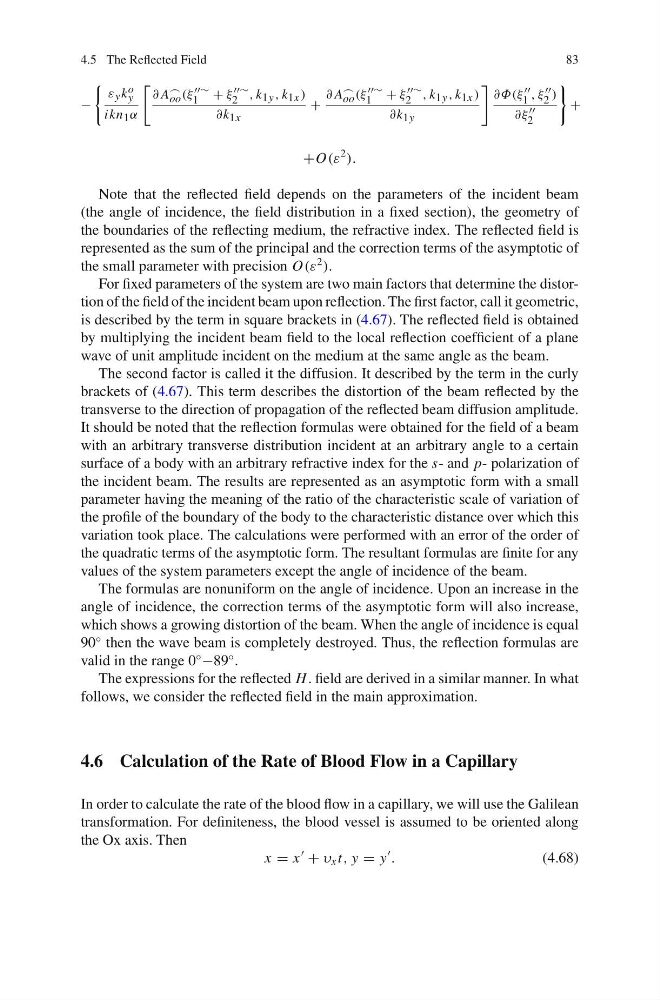
Note that the reflected field depends on the parameters of the incident beam
(the angle of incidence, the field distribution in a fixed section), the geometry of
the boundaries of the reflecting medium, the refractive index. The reflected field is
represented as the sum of the principal and the correction terms of the asymptotic of
the small parameter with precision O(ε
2
).
For fixed parameters of the system are two main factors that determine the distortion of the field of the incident beam upon reflection. The first factor, call it geometric,
is described by the term in square brackets in (4.67). The reflected field is obtained
by multiplying the incident beam field to the local reflection coefficient of a plane
wave of unit amplitude incident on the medium at the same angle as the beam.
The second factor is called it the diffusion. It described by the term in the curly
brackets of (4.67). This term describes the distortion of the beam reflected by the
transverse to the direction of propagation of the reflected beam diffusion amplitude.
It should be noted that the reflection formulas were obtained for the field of a beam
with an arbitrary transverse distribution incident at an arbitrary angle to a certain
surface of a body with an arbitrary refractive index for the s- and p- polarization of
the incident beam. The results are represented as an asymptotic form with a small
parameter having the meaning of the ratio of the characteristic scale of variation of
the profile of the boundary of the body to the characteristic distance over which this
variation took place. The calculations were performed with an error of the order of
the quadratic terms of the asymptotic form. The resultant formulas are finite for any
values of the system parameters except the angle of incidence of the beam.
The formulas are nonuniform on the angle of incidence. Upon an increase in the
angle of incidence, the correction terms of the asymptotic form will also increase,
which shows a growing distortion of the beam. When the angle of incidence is equal
90
◦ then the wave beam is completely destroyed. Thus, the reflection formulas are
valid in the range 0
◦
−89
◦ .
The expressions for the reflected H . field are derived in a similar manner. In what
follows, we consider the reflected field in the main approximation.
4.6 Calculation of the Rate of Blood Flow in a Capillary
In order to calculate the rate of the blood flow in a capillary, we will use the Galilean
transformation. For definiteness, the blood vessel is assumed to be oriented along
the Ox axis. Then
x = x
+ υ x t, y = y
.
(4.68)
83
−
ε y k o
y
ikn 1 α
∂ A
oo (ξ ∼
1 + ξ ∼
2 , k 1y , k 1x )
∂k 1x
+
∂ A
oo (ξ ∼
1 + ξ ∼
2 , k 1y , k 1x )
∂k 1y
∂Φ(ξ
1 , ξ
2 )
∂ξ
2
+
+O(ε
2
).
Note that the reflected field depends on the parameters of the incident beam
(the angle of incidence, the field distribution in a fixed section), the geometry of
the boundaries of the reflecting medium, the refractive index. The reflected field is
represented as the sum of the principal and the correction terms of the asymptotic of
the small parameter with precision O(ε
2
).
For fixed parameters of the system are two main factors that determine the distortion of the field of the incident beam upon reflection. The first factor, call it geometric,
is described by the term in square brackets in (4.67). The reflected field is obtained
by multiplying the incident beam field to the local reflection coefficient of a plane
wave of unit amplitude incident on the medium at the same angle as the beam.
The second factor is called it the diffusion. It described by the term in the curly
brackets of (4.67). This term describes the distortion of the beam reflected by the
transverse to the direction of propagation of the reflected beam diffusion amplitude.
It should be noted that the reflection formulas were obtained for the field of a beam
with an arbitrary transverse distribution incident at an arbitrary angle to a certain
surface of a body with an arbitrary refractive index for the s- and p- polarization of
the incident beam. The results are represented as an asymptotic form with a small
parameter having the meaning of the ratio of the characteristic scale of variation of
the profile of the boundary of the body to the characteristic distance over which this
variation took place. The calculations were performed with an error of the order of
the quadratic terms of the asymptotic form. The resultant formulas are finite for any
values of the system parameters except the angle of incidence of the beam.
The formulas are nonuniform on the angle of incidence. Upon an increase in the
angle of incidence, the correction terms of the asymptotic form will also increase,
which shows a growing distortion of the beam. When the angle of incidence is equal
90
◦ then the wave beam is completely destroyed. Thus, the reflection formulas are
valid in the range 0
◦
−89
◦ .
The expressions for the reflected H . field are derived in a similar manner. In what
follows, we consider the reflected field in the main approximation.
4.6 Calculation of the Rate of Blood Flow in a Capillary
In order to calculate the rate of the blood flow in a capillary, we will use the Galilean
transformation. For definiteness, the blood vessel is assumed to be oriented along
the Ox axis. Then
x = x
+ υ x t, y = y
.
(4.68)