

3.8 Numerical Calculations for the Resonator with a Simulated …
57
A mathematical model was constructed and the respective software was devised
that allowed us to perform a numerical experiment at different parameters of the
problem. Some of the results are presented below.
Consider a layer of spherical particles in an optical resonator cavity. Its parameters
are the following: the mirror distance is L = 11 cm; the radii of mirrors M 1 and M 2
are 100.0 and 46.3 cm, respectively; the radiation wavelength of a helium-neon laser
is λ = 0.63 µm; z 1 = 6000λ; and z 2 = 6005λ. Thickness ρ of the layer is set equal
to the diameter of the particles, the distance between which in the plane orthogonal
to the optical axis of the cavity is taken to be equal to 10λ, From formula (3.84),
one can calculate the refractive index of the particles, n
0
(λ) + iχ(λ) at given cavity
frequency ω n . In the given case, we put n = 0, so that ω 0 is the frequency of the
fundamental mode.
Experiments were carried out with spherulated particles containing a nonconcentric inclusion. The number of spherulated particles was set equal to five. Let the
parameters of the spherulated particles be the following: the nucleus diameter is 4
× 10
−6 m; the diameter of the cytoplasm is 6 × 10
−6 m; and the refractive indices of
the nucleus, cytoplasm, and blood plasma are, respectively 1.31 + j0.0001, 1.32 +
j0.0001, and 1.52.
Some of the hemocytes have a nucleus. The nucleus is not always placed at the
center. It may be spherical, ovoid, etc. It seems topical to study the spectral response of
various biological samples to a change in the nucleus position under laser irradiation.
540
550
560
570
580
590
600
610
620
630
640
1.24
1.242
1.244
1.246
1.248
1.25
1.252
1.254
1.256
x10
-4
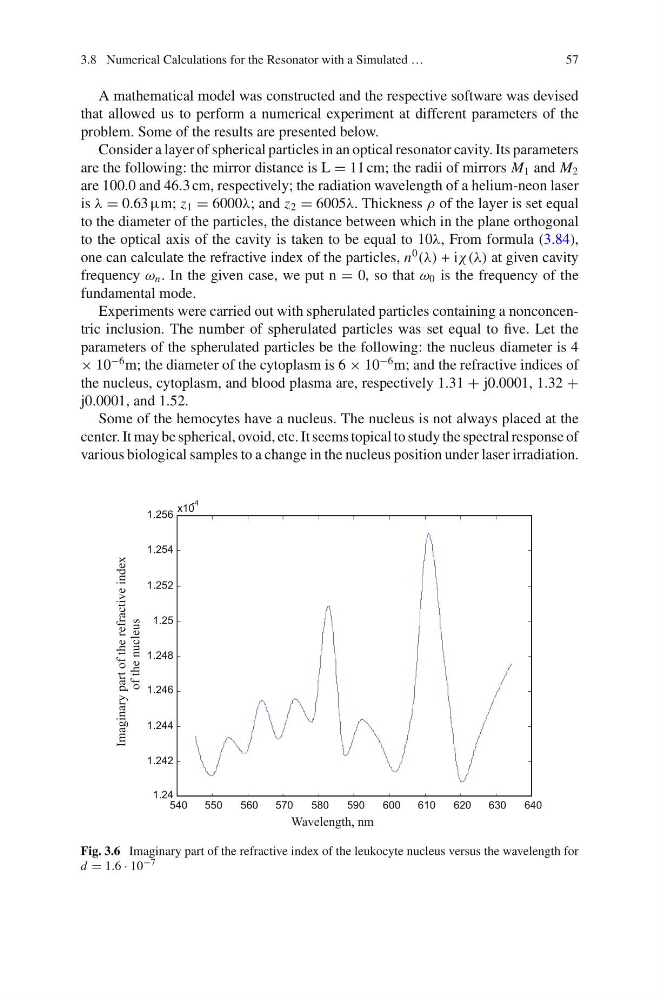
Fig. 3.6 Imaginary part of the refractive index of the leukocyte nucleus versus the wavelength for
d = 1.6 · 10 −7
57
A mathematical model was constructed and the respective software was devised
that allowed us to perform a numerical experiment at different parameters of the
problem. Some of the results are presented below.
Consider a layer of spherical particles in an optical resonator cavity. Its parameters
are the following: the mirror distance is L = 11 cm; the radii of mirrors M 1 and M 2
are 100.0 and 46.3 cm, respectively; the radiation wavelength of a helium-neon laser
is λ = 0.63 µm; z 1 = 6000λ; and z 2 = 6005λ. Thickness ρ of the layer is set equal
to the diameter of the particles, the distance between which in the plane orthogonal
to the optical axis of the cavity is taken to be equal to 10λ, From formula (3.84),
one can calculate the refractive index of the particles, n
0
(λ) + iχ(λ) at given cavity
frequency ω n . In the given case, we put n = 0, so that ω 0 is the frequency of the
fundamental mode.
Experiments were carried out with spherulated particles containing a nonconcentric inclusion. The number of spherulated particles was set equal to five. Let the
parameters of the spherulated particles be the following: the nucleus diameter is 4
× 10
−6 m; the diameter of the cytoplasm is 6 × 10
−6 m; and the refractive indices of
the nucleus, cytoplasm, and blood plasma are, respectively 1.31 + j0.0001, 1.32 +
j0.0001, and 1.52.
Some of the hemocytes have a nucleus. The nucleus is not always placed at the
center. It may be spherical, ovoid, etc. It seems topical to study the spectral response of
various biological samples to a change in the nucleus position under laser irradiation.
540
550
560
570
580
590
600
610
620
630
640
1.24
1.242
1.244
1.246
1.248
1.25
1.252
1.254
1.256
x10
-4
Fig. 3.6 Imaginary part of the refractive index of the leukocyte nucleus versus the wavelength for
d = 1.6 · 10 −7