

3.7 Eigenmodes of the Optical Cavity Containing a Cell of Spherical Particles
55
R 1 = S(0) exp
−
i
z 11
+
1
2
x
2
1
z
2
11
, R 2 = S(π ) exp
i
z 22
−
1
2
x
2
1
z
2
22
,
(3.83)
x 1 =
√
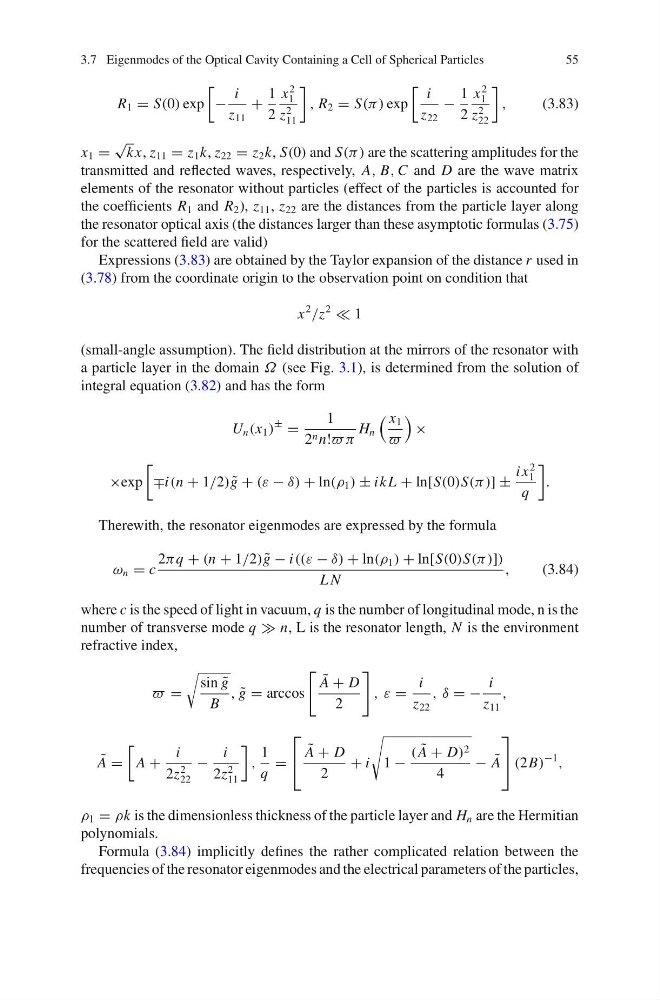
kx, z 11 = z 1 k, z 22 = z 2 k, S(0) and S(π ) are the scattering amplitudes for the
transmitted and reflected waves, respectively, A, B, C and D are the wave matrix
elements of the resonator without particles (effect of the particles is accounted for
the coefficients R 1 and R 2 ), z 11 , z 22 are the distances from the particle layer along
the resonator optical axis (the distances larger than these asymptotic formulas (3.75)
for the scattered field are valid)
Expressions (3.83) are obtained by the Taylor expansion of the distance r used in
(3.78) from the coordinate origin to the observation point on condition that
x
2
/z
2
1
(small-angle assumption). The field distribution at the mirrors of the resonator with
a particle layer in the domain Ω (see Fig. 3.1), is determined from the solution of
integral equation (3.82) and has the form
U n (x 1 )
±
=
1
2 n n! π
H n
x 1
×
×exp
∓i(n + 1/2) ˜
g + (ε − δ) + ln(ρ 1 ) ± ik L + ln[S(0)S(π )] ±
i x
2
1
q
.
Therewith, the resonator eigenmodes are expressed by the formula
ω n = c
2πq + (n + 1/2) ˜
g − i((ε − δ) + ln(ρ 1 ) + ln[S(0)S(π )])
L N
,
(3.84)
where c is the speed of light in vacuum, q is the number of longitudinal mode, n is the
number of transverse mode q n, L is the resonator length, N is the environment
refractive index,
=
sin ˜
g
B
, ˜
g = arccos
˜
A + D
2
, ε =
i
z 22
, δ = −
i
z 11
,
˜
A =
A +
i
2z
2
22
−
i
2z
2
11
,
1
q
=
⎡
⎣
˜
A + D
2
+ i
1 −
( ˜
A + D) 2
4
− ˜
A
⎤
⎦ (2B)
−1
,
ρ 1 = ρk is the dimensionless thickness of the particle layer and H n are the Hermitian
polynomials.
Formula (3.84) implicitly defines the rather complicated relation between the
frequencies of the resonator eigenmodes and the electrical parameters of the particles,
55
R 1 = S(0) exp
−
i
z 11
+
1
2
x
2
1
z
2
11
, R 2 = S(π ) exp
i
z 22
−
1
2
x
2
1
z
2
22
,
(3.83)
x 1 =
√
kx, z 11 = z 1 k, z 22 = z 2 k, S(0) and S(π ) are the scattering amplitudes for the
transmitted and reflected waves, respectively, A, B, C and D are the wave matrix
elements of the resonator without particles (effect of the particles is accounted for
the coefficients R 1 and R 2 ), z 11 , z 22 are the distances from the particle layer along
the resonator optical axis (the distances larger than these asymptotic formulas (3.75)
for the scattered field are valid)
Expressions (3.83) are obtained by the Taylor expansion of the distance r used in
(3.78) from the coordinate origin to the observation point on condition that
x
2
/z
2
1
(small-angle assumption). The field distribution at the mirrors of the resonator with
a particle layer in the domain Ω (see Fig. 3.1), is determined from the solution of
integral equation (3.82) and has the form
U n (x 1 )
±
=
1
2 n n! π
H n
x 1
×
×exp
∓i(n + 1/2) ˜
g + (ε − δ) + ln(ρ 1 ) ± ik L + ln[S(0)S(π )] ±
i x
2
1
q
.
Therewith, the resonator eigenmodes are expressed by the formula
ω n = c
2πq + (n + 1/2) ˜
g − i((ε − δ) + ln(ρ 1 ) + ln[S(0)S(π )])
L N
,
(3.84)
where c is the speed of light in vacuum, q is the number of longitudinal mode, n is the
number of transverse mode q n, L is the resonator length, N is the environment
refractive index,
=
sin ˜
g
B
, ˜
g = arccos
˜
A + D
2
, ε =
i
z 22
, δ = −
i
z 11
,
˜
A =
A +
i
2z
2
22
−
i
2z
2
11
,
1
q
=
⎡
⎣
˜
A + D
2
+ i
1 −
( ˜
A + D) 2
4
− ˜
A
⎤
⎦ (2B)
−1
,
ρ 1 = ρk is the dimensionless thickness of the particle layer and H n are the Hermitian
polynomials.
Formula (3.84) implicitly defines the rather complicated relation between the
frequencies of the resonator eigenmodes and the electrical parameters of the particles,