

54
3 Study of Electrophysical Characteristics of Blood …
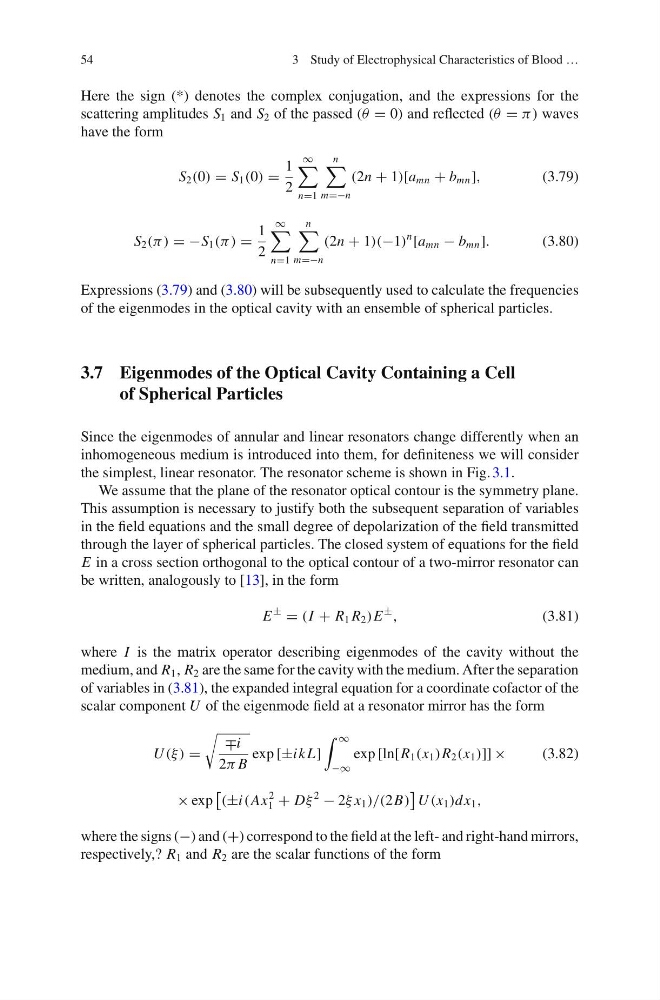
Here the sign (*) denotes the complex conjugation, and the expressions for the
scattering amplitudes S 1 and S 2 of the passed (θ = 0) and reflected (θ = π) waves
have the form
S 2 (0) = S 1 (0) =
1
2
∞
n=1
n
m=−n
(2n + 1)[a mn + b mn ],
(3.79)
S 2 (π ) = −S 1 (π ) =
1
2
∞
n=1
n
m=−n
(2n + 1)(−1)
n
[a mn − b mn ].
(3.80)
Expressions (3.79) and (3.80) will be subsequently used to calculate the frequencies
of the eigenmodes in the optical cavity with an ensemble of spherical particles.
3.7 Eigenmodes of the Optical Cavity Containing a Cell
of Spherical Particles
Since the eigenmodes of annular and linear resonators change differently when an
inhomogeneous medium is introduced into them, for definiteness we will consider
the simplest, linear resonator. The resonator scheme is shown in Fig. 3.1.
We assume that the plane of the resonator optical contour is the symmetry plane.
This assumption is necessary to justify both the subsequent separation of variables
in the field equations and the small degree of depolarization of the field transmitted
through the layer of spherical particles. The closed system of equations for the field
E in a cross section orthogonal to the optical contour of a two-mirror resonator can
be written, analogously to [13], in the form
E
±
= (I + R 1 R 2 )E
±
,
(3.81)
where I is the matrix operator describing eigenmodes of the cavity without the
medium, and R 1 , R 2 are the same for the cavity with the medium. After the separation
of variables in (3.81), the expanded integral equation for a coordinate cofactor of the
scalar component U of the eigenmode field at a resonator mirror has the form
U (ξ ) =
∓i
2π B
exp [±ik L]
∞
−∞
exp [ln[R 1 (x 1 )R 2 (x 1 )]] ×
(3.82)
× exp
(±i(Ax
2
1 + Dξ
2
− 2ξ x 1 )/(2B)
U (x 1 )dx 1 ,
where the signs (−) and (+) correspond to the field at the left- and right-hand mirrors,
respectively,? R 1 and R 2 are the scalar functions of the form
3 Study of Electrophysical Characteristics of Blood …
Here the sign (*) denotes the complex conjugation, and the expressions for the
scattering amplitudes S 1 and S 2 of the passed (θ = 0) and reflected (θ = π) waves
have the form
S 2 (0) = S 1 (0) =
1
2
∞
n=1
n
m=−n
(2n + 1)[a mn + b mn ],
(3.79)
S 2 (π ) = −S 1 (π ) =
1
2
∞
n=1
n
m=−n
(2n + 1)(−1)
n
[a mn − b mn ].
(3.80)
Expressions (3.79) and (3.80) will be subsequently used to calculate the frequencies
of the eigenmodes in the optical cavity with an ensemble of spherical particles.
3.7 Eigenmodes of the Optical Cavity Containing a Cell
of Spherical Particles
Since the eigenmodes of annular and linear resonators change differently when an
inhomogeneous medium is introduced into them, for definiteness we will consider
the simplest, linear resonator. The resonator scheme is shown in Fig. 3.1.
We assume that the plane of the resonator optical contour is the symmetry plane.
This assumption is necessary to justify both the subsequent separation of variables
in the field equations and the small degree of depolarization of the field transmitted
through the layer of spherical particles. The closed system of equations for the field
E in a cross section orthogonal to the optical contour of a two-mirror resonator can
be written, analogously to [13], in the form
E
±
= (I + R 1 R 2 )E
±
,
(3.81)
where I is the matrix operator describing eigenmodes of the cavity without the
medium, and R 1 , R 2 are the same for the cavity with the medium. After the separation
of variables in (3.81), the expanded integral equation for a coordinate cofactor of the
scalar component U of the eigenmode field at a resonator mirror has the form
U (ξ ) =
∓i
2π B
exp [±ik L]
∞
−∞
exp [ln[R 1 (x 1 )R 2 (x 1 )]] ×
(3.82)
× exp
(±i(Ax
2
1 + Dξ
2
− 2ξ x 1 )/(2B)
U (x 1 )dx 1 ,
where the signs (−) and (+) correspond to the field at the left- and right-hand mirrors,
respectively,? R 1 and R 2 are the scalar functions of the form