

52
3 Study of Electrophysical Characteristics of Blood …
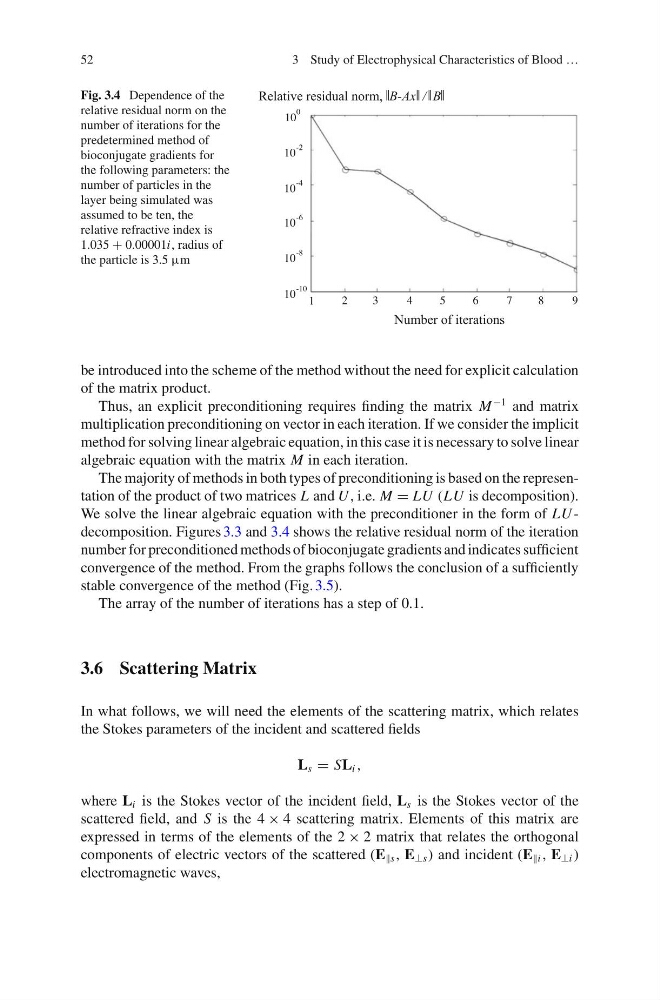
Fig. 3.4 Dependence of the
relative residual norm on the
number of iterations for the
predetermined method of
bioconjugate gradients for
the following parameters: the
number of particles in the
layer being simulated was
assumed to be ten, the
relative refractive index is
1.035 + 0.00001i, radius of
the particle is 3.5 µm
1
2
3
4
5
6
7
8
9
10
-2
10
0
10
-4
10
-6
10
-8
10
-10
be introduced into the scheme of the method without the need for explicit calculation
of the matrix product.
Thus, an explicit preconditioning requires finding the matrix M
−1 and matrix
multiplication preconditioning on vector in each iteration. If we consider the implicit
method for solving linear algebraic equation, in this case it is necessary to solve linear
algebraic equation with the matrix M in each iteration.
The majority of methods in both types of preconditioning is based on the representation of the product of two matrices L and U , i.e. M = LU (LU is decomposition).
We solve the linear algebraic equation with the preconditioner in the form of LU -
decomposition. Figures 3.3 and 3.4 shows the relative residual norm of the iteration
number for preconditioned methods of bioconjugate gradients and indicates sufficient
convergence of the method. From the graphs follows the conclusion of a sufficiently
stable convergence of the method (Fig. 3.5).
The array of the number of iterations has a step of 0.1.
3.6 Scattering Matrix
In what follows, we will need the elements of the scattering matrix, which relates
the Stokes parameters of the incident and scattered fields
L s = SL i ,
where L i is the Stokes vector of the incident field, L s is the Stokes vector of the
scattered field, and S is the 4 × 4 scattering matrix. Elements of this matrix are
expressed in terms of the elements of the 2 × 2 matrix that relates the orthogonal
components of electric vectors of the scattered (E s , E ⊥s ) and incident (E i , E ⊥i )
electromagnetic waves,
3 Study of Electrophysical Characteristics of Blood …
Fig. 3.4 Dependence of the
relative residual norm on the
number of iterations for the
predetermined method of
bioconjugate gradients for
the following parameters: the
number of particles in the
layer being simulated was
assumed to be ten, the
relative refractive index is
1.035 + 0.00001i, radius of
the particle is 3.5 µm
1
2
3
4
5
6
7
8
9
10
-2
10
0
10
-4
10
-6
10
-8
10
-10
be introduced into the scheme of the method without the need for explicit calculation
of the matrix product.
Thus, an explicit preconditioning requires finding the matrix M
−1 and matrix
multiplication preconditioning on vector in each iteration. If we consider the implicit
method for solving linear algebraic equation, in this case it is necessary to solve linear
algebraic equation with the matrix M in each iteration.
The majority of methods in both types of preconditioning is based on the representation of the product of two matrices L and U , i.e. M = LU (LU is decomposition).
We solve the linear algebraic equation with the preconditioner in the form of LU -
decomposition. Figures 3.3 and 3.4 shows the relative residual norm of the iteration
number for preconditioned methods of bioconjugate gradients and indicates sufficient
convergence of the method. From the graphs follows the conclusion of a sufficiently
stable convergence of the method (Fig. 3.5).
The array of the number of iterations has a step of 0.1.
3.6 Scattering Matrix
In what follows, we will need the elements of the scattering matrix, which relates
the Stokes parameters of the incident and scattered fields
L s = SL i ,
where L i is the Stokes vector of the incident field, L s is the Stokes vector of the
scattered field, and S is the 4 × 4 scattering matrix. Elements of this matrix are
expressed in terms of the elements of the 2 × 2 matrix that relates the orthogonal
components of electric vectors of the scattered (E s , E ⊥s ) and incident (E i , E ⊥i )
electromagnetic waves,