

3.5 Numerical Study of the Algebraic Equations
51
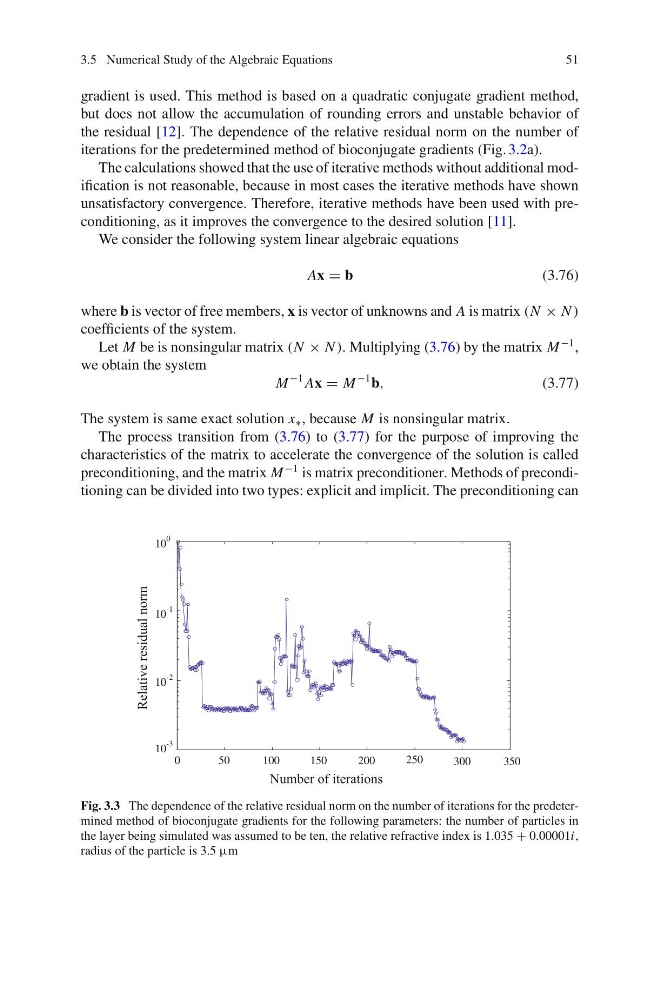
gradient is used. This method is based on a quadratic conjugate gradient method,
but does not allow the accumulation of rounding errors and unstable behavior of
the residual [12]. The dependence of the relative residual norm on the number of
iterations for the predetermined method of bioconjugate gradients (Fig. 3.2a).
The calculations showed that the use of iterative methods without additional modification is not reasonable, because in most cases the iterative methods have shown
unsatisfactory convergence. Therefore, iterative methods have been used with preconditioning, as it improves the convergence to the desired solution [11].
We consider the following system linear algebraic equations
Ax = b
(3.76)
where b is vector of free members, x is vector of unknowns and A is matrix (N × N )
coefficients of the system.
Let M be is nonsingular matrix (N × N ). Multiplying (3.76) by the matrix M
−1 ,
we obtain the system
M
−1 Ax = M
−1 b,
(3.77)
The system is same exact solution x ∗ , because M is nonsingular matrix.
The process transition from (3.76) to (3.77) for the purpose of improving the
characteristics of the matrix to accelerate the convergence of the solution is called
preconditioning, and the matrix M
−1 is matrix preconditioner. Methods of preconditioning can be divided into two types: explicit and implicit. The preconditioning can
0
50
100
150
200
250
300
350
10
-3
10
-2
10
-1
10
0
Fig. 3.3 The dependence of the relative residual norm on the number of iterations for the predetermined method of bioconjugate gradients for the following parameters: the number of particles in
the layer being simulated was assumed to be ten, the relative refractive index is 1.035 + 0.00001i,
radius of the particle is 3.5 µm
51
gradient is used. This method is based on a quadratic conjugate gradient method,
but does not allow the accumulation of rounding errors and unstable behavior of
the residual [12]. The dependence of the relative residual norm on the number of
iterations for the predetermined method of bioconjugate gradients (Fig. 3.2a).
The calculations showed that the use of iterative methods without additional modification is not reasonable, because in most cases the iterative methods have shown
unsatisfactory convergence. Therefore, iterative methods have been used with preconditioning, as it improves the convergence to the desired solution [11].
We consider the following system linear algebraic equations
Ax = b
(3.76)
where b is vector of free members, x is vector of unknowns and A is matrix (N × N )
coefficients of the system.
Let M be is nonsingular matrix (N × N ). Multiplying (3.76) by the matrix M
−1 ,
we obtain the system
M
−1 Ax = M
−1 b,
(3.77)
The system is same exact solution x ∗ , because M is nonsingular matrix.
The process transition from (3.76) to (3.77) for the purpose of improving the
characteristics of the matrix to accelerate the convergence of the solution is called
preconditioning, and the matrix M
−1 is matrix preconditioner. Methods of preconditioning can be divided into two types: explicit and implicit. The preconditioning can
0
50
100
150
200
250
300
350
10
-3
10
-2
10
-1
10
0
Fig. 3.3 The dependence of the relative residual norm on the number of iterations for the predetermined method of bioconjugate gradients for the following parameters: the number of particles in
the layer being simulated was assumed to be ten, the relative refractive index is 1.035 + 0.00001i,
radius of the particle is 3.5 µm