

50
3 Study of Electrophysical Characteristics of Blood …
component differs from zero in the far-field zone. Note that we consider a part of the
scattered field inside the cavity.
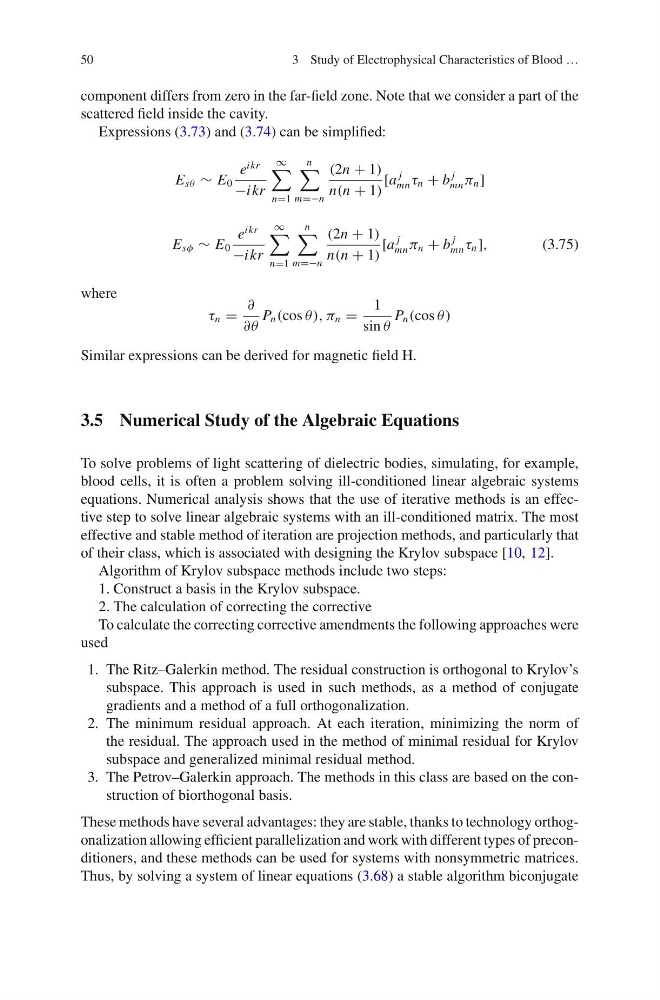
Expressions (3.73) and (3.74) can be simplified:
E sθ ∼ E 0
e
ikr
−ikr
∞
n=1
n
m=−n
(2n + 1)
n(n + 1)
[a
j
mn τ n + b
j
mn π n ]
E sφ ∼ E 0
e
ikr
−ikr
∞
n=1
n
m=−n
(2n + 1)
n(n + 1)
[a
j
mn π n + b
j
mn τ n ],
(3.75)
where
τ n =
∂
∂θ
P n (cos θ), π n =
1
sin θ
P n (cos θ)
Similar expressions can be derived for magnetic field H.
3.5 Numerical Study of the Algebraic Equations
To solve problems of light scattering of dielectric bodies, simulating, for example,
blood cells, it is often a problem solving ill-conditioned linear algebraic systems
equations. Numerical analysis shows that the use of iterative methods is an effective step to solve linear algebraic systems with an ill-conditioned matrix. The most
effective and stable method of iteration are projection methods, and particularly that
of their class, which is associated with designing the Krylov subspace [10, 12].
Algorithm of Krylov subspace methods include two steps:
1. Construct a basis in the Krylov subspace.
2. The calculation of correcting the corrective
To calculate the correcting corrective amendments the following approaches were
used
1. The Ritz–Galerkin method. The residual construction is orthogonal to Krylov’s
subspace. This approach is used in such methods, as a method of conjugate
gradients and a method of a full orthogonalization.
2. The minimum residual approach. At each iteration, minimizing the norm of
the residual. The approach used in the method of minimal residual for Krylov
subspace and generalized minimal residual method.
3. The Petrov–Galerkin approach. The methods in this class are based on the construction of biorthogonal basis.
These methods have several advantages: they are stable, thanks to technology orthogonalization allowing efficient parallelization and work with different types of preconditioners, and these methods can be used for systems with nonsymmetric matrices.
Thus, by solving a system of linear equations (3.68) a stable algorithm biconjugate
3 Study of Electrophysical Characteristics of Blood …
component differs from zero in the far-field zone. Note that we consider a part of the
scattered field inside the cavity.
Expressions (3.73) and (3.74) can be simplified:
E sθ ∼ E 0
e
ikr
−ikr
∞
n=1
n
m=−n
(2n + 1)
n(n + 1)
[a
j
mn τ n + b
j
mn π n ]
E sφ ∼ E 0
e
ikr
−ikr
∞
n=1
n
m=−n
(2n + 1)
n(n + 1)
[a
j
mn π n + b
j
mn τ n ],
(3.75)
where
τ n =
∂
∂θ
P n (cos θ), π n =
1
sin θ
P n (cos θ)
Similar expressions can be derived for magnetic field H.
3.5 Numerical Study of the Algebraic Equations
To solve problems of light scattering of dielectric bodies, simulating, for example,
blood cells, it is often a problem solving ill-conditioned linear algebraic systems
equations. Numerical analysis shows that the use of iterative methods is an effective step to solve linear algebraic systems with an ill-conditioned matrix. The most
effective and stable method of iteration are projection methods, and particularly that
of their class, which is associated with designing the Krylov subspace [10, 12].
Algorithm of Krylov subspace methods include two steps:
1. Construct a basis in the Krylov subspace.
2. The calculation of correcting the corrective
To calculate the correcting corrective amendments the following approaches were
used
1. The Ritz–Galerkin method. The residual construction is orthogonal to Krylov’s
subspace. This approach is used in such methods, as a method of conjugate
gradients and a method of a full orthogonalization.
2. The minimum residual approach. At each iteration, minimizing the norm of
the residual. The approach used in the method of minimal residual for Krylov
subspace and generalized minimal residual method.
3. The Petrov–Galerkin approach. The methods in this class are based on the construction of biorthogonal basis.
These methods have several advantages: they are stable, thanks to technology orthogonalization allowing efficient parallelization and work with different types of preconditioners, and these methods can be used for systems with nonsymmetric matrices.
Thus, by solving a system of linear equations (3.68) a stable algorithm biconjugate