

30
3 Study of Electrophysical Characteristics of Blood …
then we obtain
∇
2 M + k
2 M = ∇ × (r(∇
2
ψ + k
2
ψ)).
(3.1)
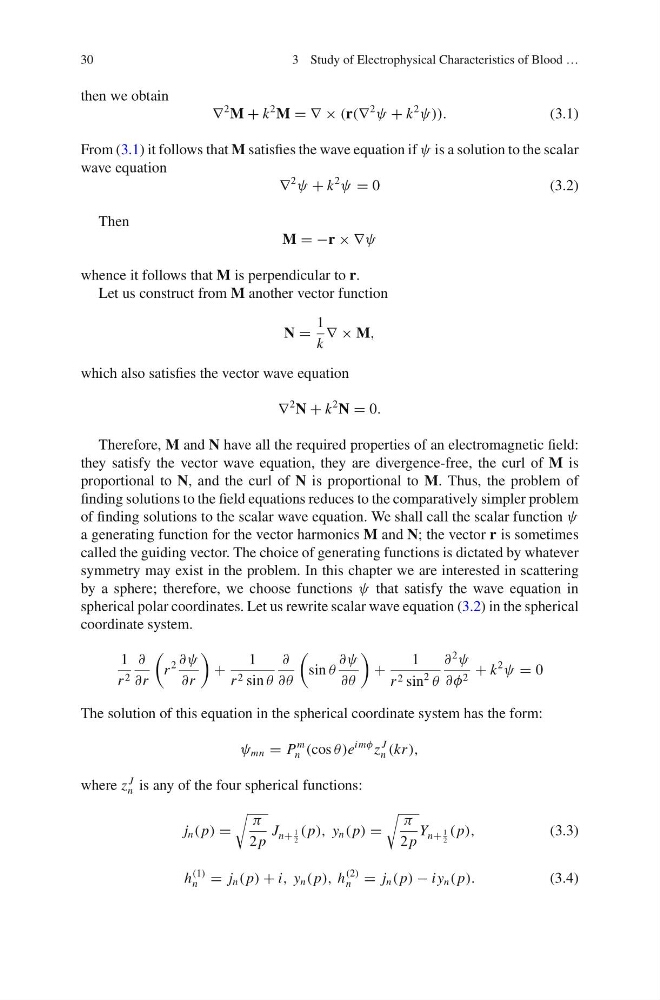
From (3.1) it follows that M satisfies the wave equation if ψ is a solution to the scalar
wave equation
∇
2
ψ + k
2
ψ = 0
( 3 . 2 )
Then
M = −r × ∇ψ
whence it follows that M is perpendicular to r.
Let us construct from M another vector function
N =
1
k
∇ × M,
which also satisfies the vector wave equation
∇
2 N + k
2 N = 0.
Therefore, M and N have all the required properties of an electromagnetic field:
they satisfy the vector wave equation, they are divergence-free, the curl of M is
proportional to N, and the curl of N is proportional to M. Thus, the problem of
finding solutions to the field equations reduces to the comparatively simpler problem
of finding solutions to the scalar wave equation. We shall call the scalar function ψ
a generating function for the vector harmonics M and N; the vector r is sometimes
called the guiding vector. The choice of generating functions is dictated by whatever
symmetry may exist in the problem. In this chapter we are interested in scattering
by a sphere; therefore, we choose functions ψ that satisfy the wave equation in
spherical polar coordinates. Let us rewrite scalar wave equation (3.2) in the spherical
coordinate system.
1
r 2
∂
∂r
r
2 ∂ψ
∂r
+
1
r 2 sin θ
∂
∂θ
sin θ
∂ψ
∂θ
+
1
r 2 sin
2
θ
∂
2
ψ
∂φ 2 + k
2
ψ = 0
The solution of this equation in the spherical coordinate system has the form:
ψ mn = P
m
n (cos θ)e
imφ z
J
n (kr),
where z
J
n is any of the four spherical functions:
j n ( p) =
π
2 p
J n+
1
2
( p), y n ( p) =
π
2 p
Y n+
1
2
( p),
(3.3)
h
(1)
n = j n ( p) + i, y n ( p), h
(2)
n = j n ( p) − iy n ( p).
(3.4)
3 Study of Electrophysical Characteristics of Blood …
then we obtain
∇
2 M + k
2 M = ∇ × (r(∇
2
ψ + k
2
ψ)).
(3.1)
From (3.1) it follows that M satisfies the wave equation if ψ is a solution to the scalar
wave equation
∇
2
ψ + k
2
ψ = 0
( 3 . 2 )
Then
M = −r × ∇ψ
whence it follows that M is perpendicular to r.
Let us construct from M another vector function
N =
1
k
∇ × M,
which also satisfies the vector wave equation
∇
2 N + k
2 N = 0.
Therefore, M and N have all the required properties of an electromagnetic field:
they satisfy the vector wave equation, they are divergence-free, the curl of M is
proportional to N, and the curl of N is proportional to M. Thus, the problem of
finding solutions to the field equations reduces to the comparatively simpler problem
of finding solutions to the scalar wave equation. We shall call the scalar function ψ
a generating function for the vector harmonics M and N; the vector r is sometimes
called the guiding vector. The choice of generating functions is dictated by whatever
symmetry may exist in the problem. In this chapter we are interested in scattering
by a sphere; therefore, we choose functions ψ that satisfy the wave equation in
spherical polar coordinates. Let us rewrite scalar wave equation (3.2) in the spherical
coordinate system.
1
r 2
∂
∂r
r
2 ∂ψ
∂r
+
1
r 2 sin θ
∂
∂θ
sin θ
∂ψ
∂θ
+
1
r 2 sin
2
θ
∂
2
ψ
∂φ 2 + k
2
ψ = 0
The solution of this equation in the spherical coordinate system has the form:
ψ mn = P
m
n (cos θ)e
imφ z
J
n (kr),
where z
J
n is any of the four spherical functions:
j n ( p) =
π
2 p
J n+
1
2
( p), y n ( p) =
π
2 p
Y n+
1
2
( p),
(3.3)
h
(1)
n = j n ( p) + i, y n ( p), h
(2)
n = j n ( p) − iy n ( p).
(3.4)