

3.1 Introduction
29
At the third stage, we investigate the numerical problem of optical characteristics
for an ensemble of spherical particles with a non concentric inclusion that are placed
in a resonator cavity.
Chapter is based on the results of the [3, 4].
3.2 Vector Spherical Harmonics
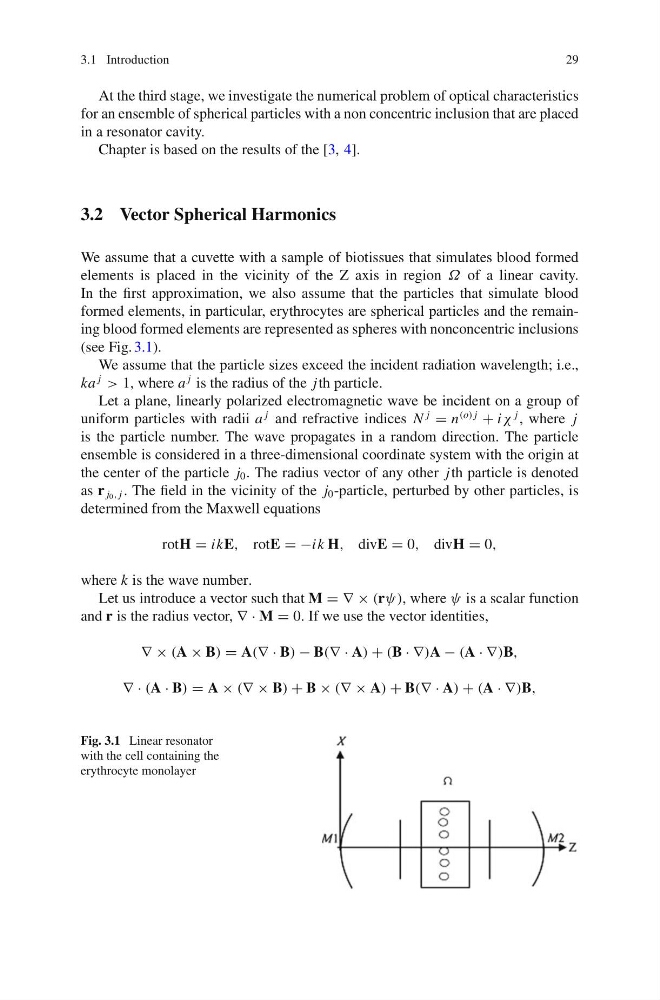
We assume that a cuvette with a sample of biotissues that simulates blood formed
elements is placed in the vicinity of the Z axis in region Ω of a linear cavity.
In the first approximation, we also assume that the particles that simulate blood
formed elements, in particular, erythrocytes are spherical particles and the remaining blood formed elements are represented as spheres with nonconcentric inclusions
(see Fig. 3.1).
We assume that the particle sizes exceed the incident radiation wavelength; i.e.,
ka
j
> 1, where a
j is the radius of the jth particle.
Let a plane, linearly polarized electromagnetic wave be incident on a group of
uniform particles with radii a
j and refractive indices N
j
= n
(o) j
+ iχ
j , where j
is the particle number. The wave propagates in a random direction. The particle
ensemble is considered in a three-dimensional coordinate system with the origin at
the center of the particle j 0 . The radius vector of any other jth particle is denoted
as r j 0 , j . The field in the vicinity of the j 0 -particle, perturbed by other particles, is
determined from the Maxwell equations
rotH = ikE, rotE = −ik H, divE = 0, divH = 0,
where k is the wave number.
Let us introduce a vector such that M = ∇ × (rψ), where ψ is a scalar function
and r is the radius vector, ∇ · M = 0. If we use the vector identities,
∇ × (A × B) = A(∇ · B) − B(∇ · A) + (B · ∇)A − (A · ∇)B,
∇ · (A · B) = A × (∇ × B) + B × (∇ × A) + B(∇ · A) + (A · ∇)B,
Fig. 3.1 Linear resonator
with the cell containing the
erythrocyte monolayer
29
At the third stage, we investigate the numerical problem of optical characteristics
for an ensemble of spherical particles with a non concentric inclusion that are placed
in a resonator cavity.
Chapter is based on the results of the [3, 4].
3.2 Vector Spherical Harmonics
We assume that a cuvette with a sample of biotissues that simulates blood formed
elements is placed in the vicinity of the Z axis in region Ω of a linear cavity.
In the first approximation, we also assume that the particles that simulate blood
formed elements, in particular, erythrocytes are spherical particles and the remaining blood formed elements are represented as spheres with nonconcentric inclusions
(see Fig. 3.1).
We assume that the particle sizes exceed the incident radiation wavelength; i.e.,
ka
j
> 1, where a
j is the radius of the jth particle.
Let a plane, linearly polarized electromagnetic wave be incident on a group of
uniform particles with radii a
j and refractive indices N
j
= n
(o) j
+ iχ
j , where j
is the particle number. The wave propagates in a random direction. The particle
ensemble is considered in a three-dimensional coordinate system with the origin at
the center of the particle j 0 . The radius vector of any other jth particle is denoted
as r j 0 , j . The field in the vicinity of the j 0 -particle, perturbed by other particles, is
determined from the Maxwell equations
rotH = ikE, rotE = −ik H, divE = 0, divH = 0,
where k is the wave number.
Let us introduce a vector such that M = ∇ × (rψ), where ψ is a scalar function
and r is the radius vector, ∇ · M = 0. If we use the vector identities,
∇ × (A × B) = A(∇ · B) − B(∇ · A) + (B · ∇)A − (A · ∇)B,
∇ · (A · B) = A × (∇ × B) + B × (∇ × A) + B(∇ · A) + (A · ∇)B,
Fig. 3.1 Linear resonator
with the cell containing the
erythrocyte monolayer