

3.2 Vector Spherical Harmonics
31
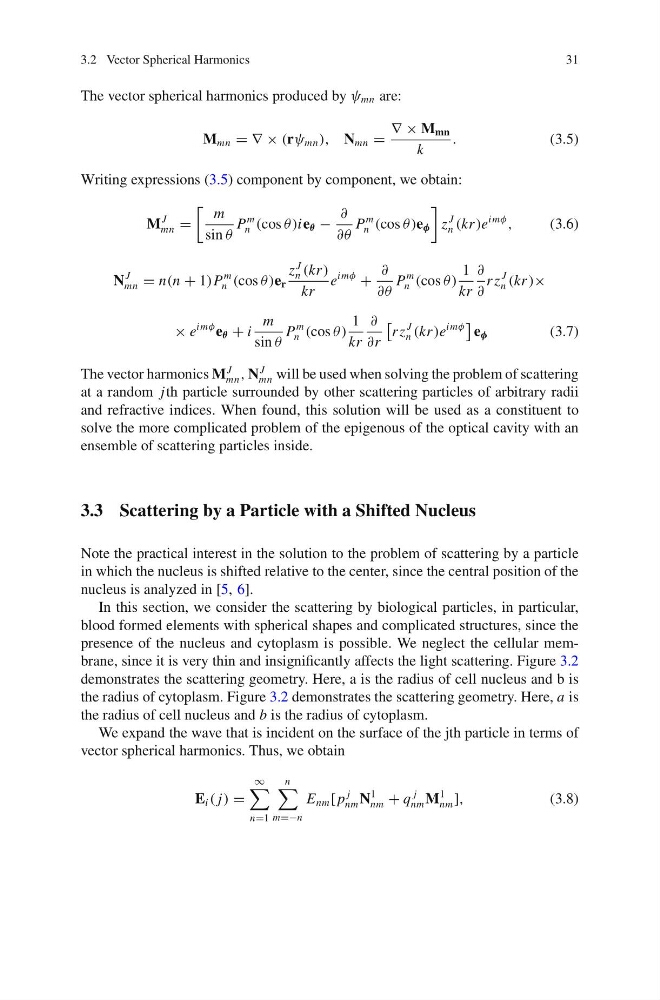
The vector spherical harmonics produced by ψ mn are:
M mn = ∇ × (rψ mn ), N mn =
∇ × M mn
k
.
(3.5)
Writing expressions (3.5) component by component, we obtain:
M
J
mn =
m
sin θ
P
m
n (cos θ)ie θ −
∂
∂θ
P
m
n (cos θ)e φ
z
J
n (kr)e
imφ
,
(3.6)
N
J
mn = n(n + 1)P
m
n (cos θ)e r
z
J
n (kr)
kr
e
imφ
+
∂
∂θ
P
m
n (cos θ)
1
kr
∂
∂
r z
J
n (kr)×
× e
imφ e θ + i
m
sin θ
P
m
n (cos θ)
1
kr
∂
∂r
r z
J
n (kr)e
imφ
e φ
(3.7)
The vector harmonics M
J
mn , N
J
mn will be used when solving the problem of scattering
at a random jth particle surrounded by other scattering particles of arbitrary radii
and refractive indices. When found, this solution will be used as a constituent to
solve the more complicated problem of the epigenous of the optical cavity with an
ensemble of scattering particles inside.
3.3 Scattering by a Particle with a Shifted Nucleus
Note the practical interest in the solution to the problem of scattering by a particle
in which the nucleus is shifted relative to the center, since the central position of the
nucleus is analyzed in [5, 6].
In this section, we consider the scattering by biological particles, in particular,
blood formed elements with spherical shapes and complicated structures, since the
presence of the nucleus and cytoplasm is possible. We neglect the cellular membrane, since it is very thin and insignificantly affects the light scattering. Figure 3.2
demonstrates the scattering geometry. Here, a is the radius of cell nucleus and b is
the radius of cytoplasm. Figure 3.2 demonstrates the scattering geometry. Here, a is
the radius of cell nucleus and b is the radius of cytoplasm.
We expand the wave that is incident on the surface of the jth particle in terms of
vector spherical harmonics. Thus, we obtain
E i ( j) =
∞
n=1
n
m=−n
E nm [ p
j
nm N
1
nm + q
j
nm M
1
nm ],
(3.8)
31
The vector spherical harmonics produced by ψ mn are:
M mn = ∇ × (rψ mn ), N mn =
∇ × M mn
k
.
(3.5)
Writing expressions (3.5) component by component, we obtain:
M
J
mn =
m
sin θ
P
m
n (cos θ)ie θ −
∂
∂θ
P
m
n (cos θ)e φ
z
J
n (kr)e
imφ
,
(3.6)
N
J
mn = n(n + 1)P
m
n (cos θ)e r
z
J
n (kr)
kr
e
imφ
+
∂
∂θ
P
m
n (cos θ)
1
kr
∂
∂
r z
J
n (kr)×
× e
imφ e θ + i
m
sin θ
P
m
n (cos θ)
1
kr
∂
∂r
r z
J
n (kr)e
imφ
e φ
(3.7)
The vector harmonics M
J
mn , N
J
mn will be used when solving the problem of scattering
at a random jth particle surrounded by other scattering particles of arbitrary radii
and refractive indices. When found, this solution will be used as a constituent to
solve the more complicated problem of the epigenous of the optical cavity with an
ensemble of scattering particles inside.
3.3 Scattering by a Particle with a Shifted Nucleus
Note the practical interest in the solution to the problem of scattering by a particle
in which the nucleus is shifted relative to the center, since the central position of the
nucleus is analyzed in [5, 6].
In this section, we consider the scattering by biological particles, in particular,
blood formed elements with spherical shapes and complicated structures, since the
presence of the nucleus and cytoplasm is possible. We neglect the cellular membrane, since it is very thin and insignificantly affects the light scattering. Figure 3.2
demonstrates the scattering geometry. Here, a is the radius of cell nucleus and b is
the radius of cytoplasm. Figure 3.2 demonstrates the scattering geometry. Here, a is
the radius of cell nucleus and b is the radius of cytoplasm.
We expand the wave that is incident on the surface of the jth particle in terms of
vector spherical harmonics. Thus, we obtain
E i ( j) =
∞
n=1
n
m=−n
E nm [ p
j
nm N
1
nm + q
j
nm M
1
nm ],
(3.8)