

2.5 The Nonstationary Theory of Radiative Transfer
21
if μ a = 0 the diffusion equation is equivalent to the heat conduction equation.
The solution of the diffusion equation (2.17) for media with constrained geometry
requires that the source function of the boundary conditions were set as follows [21,
24]:
1. During the sensing medium directional beam radiation source of the diffuse
component is not localized on the surface of the medium, but at a certain depth.
2. Boundary condition for the classical diffusion problem can be written as
U (r, t)| r=Ω = 0,
where Ω is surface bounding the region of space where the diffusion takes place.
In the case of diffusion of radiation, this condition must be modified to account
for the influence of the light reflection at the boundary.
Solution of the diffusion of radiation in bounded regions space can be obtained
using standard techniques of solving boundary-value problems, for example in the
areas in the form of a half-space [25]. Note that the important question is of the
influence of absorption on the transport properties of the scattering medium. The
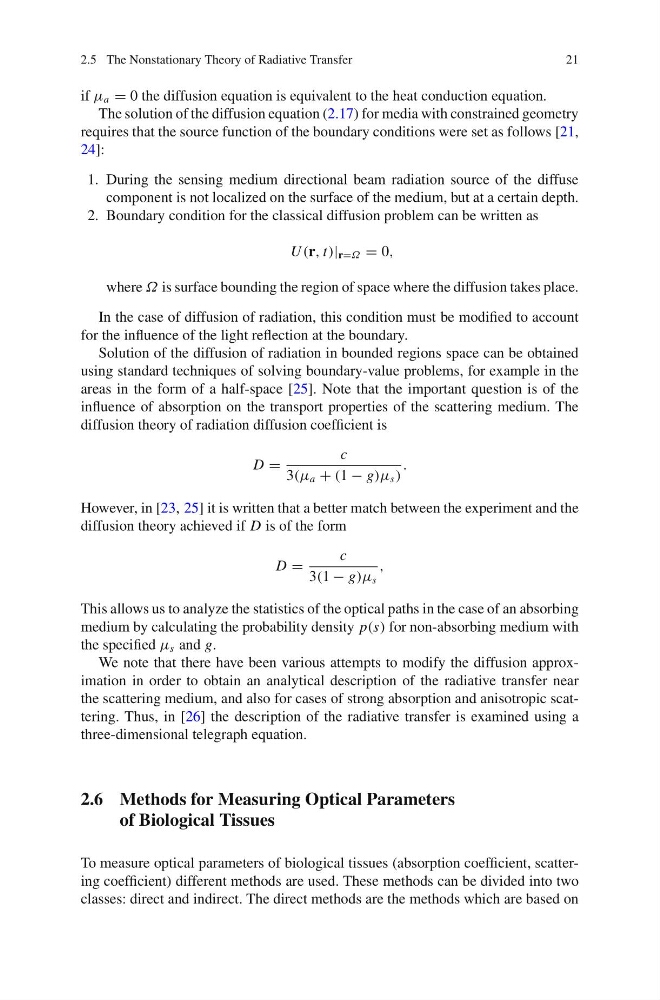
diffusion theory of radiation diffusion coefficient is
D =
c
3(μ a + (1 − g)μ s )
.
However, in [23, 25] it is written that a better match between the experiment and the
diffusion theory achieved if D is of the form
D =
c
3(1 − g)μ s
,
This allows us to analyze the statistics of the optical paths in the case of an absorbing
medium by calculating the probability density p(s) for non-absorbing medium with
the specified μ s and g.
We note that there have been various attempts to modify the diffusion approximation in order to obtain an analytical description of the radiative transfer near
the scattering medium, and also for cases of strong absorption and anisotropic scattering. Thus, in [26] the description of the radiative transfer is examined using a
three-dimensional telegraph equation.
2.6 Methods for Measuring Optical Parameters
of Biological Tissues
To measure optical parameters of biological tissues (absorption coefficient, scattering coefficient) different methods are used. These methods can be divided into two
classes: direct and indirect. The direct methods are the methods which are based on
21
if μ a = 0 the diffusion equation is equivalent to the heat conduction equation.
The solution of the diffusion equation (2.17) for media with constrained geometry
requires that the source function of the boundary conditions were set as follows [21,
24]:
1. During the sensing medium directional beam radiation source of the diffuse
component is not localized on the surface of the medium, but at a certain depth.
2. Boundary condition for the classical diffusion problem can be written as
U (r, t)| r=Ω = 0,
where Ω is surface bounding the region of space where the diffusion takes place.
In the case of diffusion of radiation, this condition must be modified to account
for the influence of the light reflection at the boundary.
Solution of the diffusion of radiation in bounded regions space can be obtained
using standard techniques of solving boundary-value problems, for example in the
areas in the form of a half-space [25]. Note that the important question is of the
influence of absorption on the transport properties of the scattering medium. The
diffusion theory of radiation diffusion coefficient is
D =
c
3(μ a + (1 − g)μ s )
.
However, in [23, 25] it is written that a better match between the experiment and the
diffusion theory achieved if D is of the form
D =
c
3(1 − g)μ s
,
This allows us to analyze the statistics of the optical paths in the case of an absorbing
medium by calculating the probability density p(s) for non-absorbing medium with
the specified μ s and g.
We note that there have been various attempts to modify the diffusion approximation in order to obtain an analytical description of the radiative transfer near
the scattering medium, and also for cases of strong absorption and anisotropic scattering. Thus, in [26] the description of the radiative transfer is examined using a
three-dimensional telegraph equation.
2.6 Methods for Measuring Optical Parameters
of Biological Tissues
To measure optical parameters of biological tissues (absorption coefficient, scattering coefficient) different methods are used. These methods can be divided into two
classes: direct and indirect. The direct methods are the methods which are based on