

22
2 Overview of Theoretical Approaches to the Analysis of Light Scattering
the basic concepts and definitions, such as Bouguer law:
I (z) = (1 − R)I o exp(−μ t z),
(2.18)
where R is the reflection coefficient, I o is the intensity of the incident light, μ t is the
absorption coefficient and z is depth.
The measured parameters are the scattering function or lighting inside the volume
of the medium. The advantages of these methods include the comparative simplicity
of analytical expressions that are used in data processing. The disadvantages of
direct methods are related to the need of strict implementation of the experimental
conditions, the relevant models: the single scattering for thin samples, the refraction
of light on the edges of of the cuvette.
Indirect methods involve solving the inverse scattering problem using specific
theoretical model of light propagation in the medium. Indirect methods are divided
into iterative and noniterative. Noniterative methods use the equations in which the
optical properties are determined by the parameters associated with the measured
values. Note, in case in vitro measurements of the parameters of samples of biological tissues we can use method of integrating the two spheres combined with
measurements of the collimated transmission.
It consists of consistent or simultaneous measurement of three parameters: the
collimated transmission, diffuse transmission T d and diffuse reflection R d . For determining the optical parameters of the tissue from these measurements one can use various theoretical equations or numerical methods (two-and multi-flux model, inverse
Monte-Carlo method), which establish the relationship between the absorption coefficient, the scattering coefficient with the measured parameters. In the simplest case,
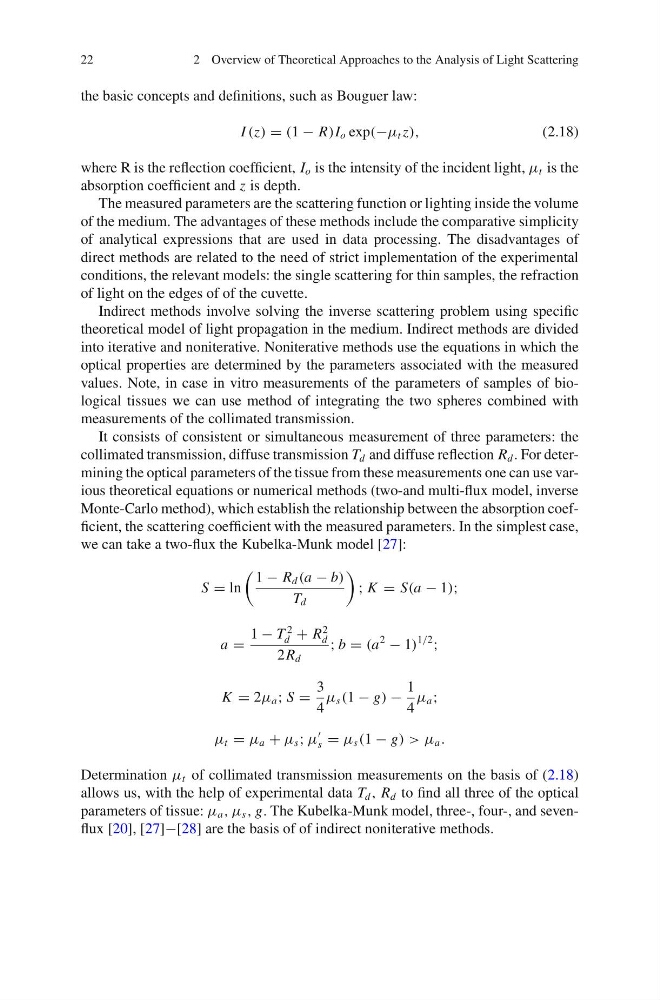
we can take a two-flux the Kubelka-Munk model [27]:
S = ln
1 − R d (a − b)
T d
; K = S(a − 1);
a =
1 − T
2
d + R
2
d
2R d
; b = (a
2
− 1)
1/2
;
K = 2μ a ; S =
3
4
μ s (1 − g) −
1
4
μ a ;
μ t = μ a + μ s ; μ
s = μ s (1 − g) > μ a .
Determination μ t of collimated transmission measurements on the basis of (2.18)
allows us, with the help of experimental data T d , R d to find all three of the optical
parameters of tissue: μ a , μ s , g. The Kubelka-Munk model, three-, four-, and sevenflux [20], [27]−[28] are the basis of of indirect noniterative methods.
2 Overview of Theoretical Approaches to the Analysis of Light Scattering
the basic concepts and definitions, such as Bouguer law:
I (z) = (1 − R)I o exp(−μ t z),
(2.18)
where R is the reflection coefficient, I o is the intensity of the incident light, μ t is the
absorption coefficient and z is depth.
The measured parameters are the scattering function or lighting inside the volume
of the medium. The advantages of these methods include the comparative simplicity
of analytical expressions that are used in data processing. The disadvantages of
direct methods are related to the need of strict implementation of the experimental
conditions, the relevant models: the single scattering for thin samples, the refraction
of light on the edges of of the cuvette.
Indirect methods involve solving the inverse scattering problem using specific
theoretical model of light propagation in the medium. Indirect methods are divided
into iterative and noniterative. Noniterative methods use the equations in which the
optical properties are determined by the parameters associated with the measured
values. Note, in case in vitro measurements of the parameters of samples of biological tissues we can use method of integrating the two spheres combined with
measurements of the collimated transmission.
It consists of consistent or simultaneous measurement of three parameters: the
collimated transmission, diffuse transmission T d and diffuse reflection R d . For determining the optical parameters of the tissue from these measurements one can use various theoretical equations or numerical methods (two-and multi-flux model, inverse
Monte-Carlo method), which establish the relationship between the absorption coefficient, the scattering coefficient with the measured parameters. In the simplest case,
we can take a two-flux the Kubelka-Munk model [27]:
S = ln
1 − R d (a − b)
T d
; K = S(a − 1);
a =
1 − T
2
d + R
2
d
2R d
; b = (a
2
− 1)
1/2
;
K = 2μ a ; S =
3
4
μ s (1 − g) −
1
4
μ a ;
μ t = μ a + μ s ; μ
s = μ s (1 − g) > μ a .
Determination μ t of collimated transmission measurements on the basis of (2.18)
allows us, with the help of experimental data T d , R d to find all three of the optical
parameters of tissue: μ a , μ s , g. The Kubelka-Munk model, three-, four-, and sevenflux [20], [27]−[28] are the basis of of indirect noniterative methods.