

20
2 Overview of Theoretical Approaches to the Analysis of Light Scattering
z = z 0 + L cos θ,
where x 0 , y 0 , z 0 are the old coordinates of photon. If the photon is absorbed,
then we start the next one. Next, all the coordinates are translated in the original
coordinates. Calculation continues as long as the photon is not absorbed or leaves
the detector. At the boundaries of the medium-to-air total internal reflection is:
θ = sin
−1
1
n
,
where n is refractive index of medium. Note that the use of Monte-Carlo method is
based on the use of macroscopic optical properties of the medium which are assumed
to be homogeneous within small volumes of tissue and simulation by the Monte-Carlo
method does not account for details of the energy distribution of radiation inside an
individual cell.
2.5 The Nonstationary Theory of Radiative Transfer
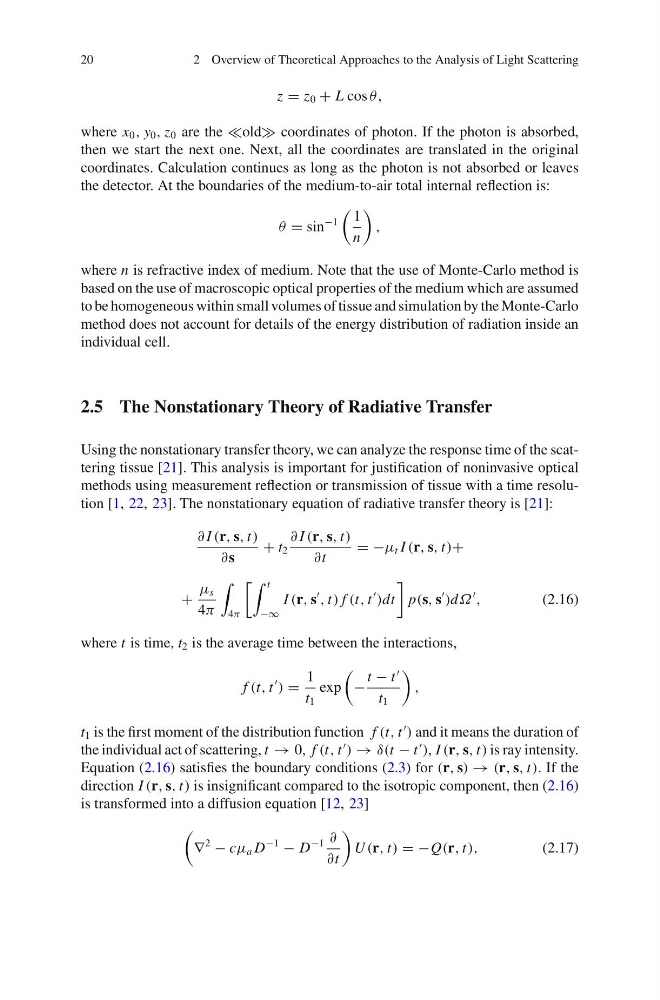
Using the nonstationary transfer theory, we can analyze the response time of the scattering tissue [21]. This analysis is important for justification of noninvasive optical
methods using measurement reflection or transmission of tissue with a time resolution [1, 22, 23]. The nonstationary equation of radiative transfer theory is [21]:
∂ I (r, s, t)
∂s
+ t 2
∂ I (r, s, t)
∂t
= −μ t I (r, s, t)+
+
μ s
4π
4π
t
−∞
I (r, s
, t) f (t, t
)dt
p(s, s
)dΩ
,
(2.16)
where t is time, t 2 is the average time between the interactions,
f (t, t
) =
1
t 1
exp
−
t − t
t 1
,
t 1 is the first moment of the distribution function f (t, t
) and it means the duration of
the individual act of scattering, t → 0, f (t, t
) → δ(t − t
), I (r, s, t) is ray intensity.
Equation (2.16) satisfies the boundary conditions (2.3) for (r, s) → (r, s, t). If the
direction I (r, s, t) is insignificant compared to the isotropic component, then (2.16)
is transformed into a diffusion equation [12, 23]
∇
2
− cμ a D
−1
− D
−1 ∂
∂t
U (r, t) = −Q(r, t),
(2.17)
2 Overview of Theoretical Approaches to the Analysis of Light Scattering
z = z 0 + L cos θ,
where x 0 , y 0 , z 0 are the old coordinates of photon. If the photon is absorbed,
then we start the next one. Next, all the coordinates are translated in the original
coordinates. Calculation continues as long as the photon is not absorbed or leaves
the detector. At the boundaries of the medium-to-air total internal reflection is:
θ = sin
−1
1
n
,
where n is refractive index of medium. Note that the use of Monte-Carlo method is
based on the use of macroscopic optical properties of the medium which are assumed
to be homogeneous within small volumes of tissue and simulation by the Monte-Carlo
method does not account for details of the energy distribution of radiation inside an
individual cell.
2.5 The Nonstationary Theory of Radiative Transfer
Using the nonstationary transfer theory, we can analyze the response time of the scattering tissue [21]. This analysis is important for justification of noninvasive optical
methods using measurement reflection or transmission of tissue with a time resolution [1, 22, 23]. The nonstationary equation of radiative transfer theory is [21]:
∂ I (r, s, t)
∂s
+ t 2
∂ I (r, s, t)
∂t
= −μ t I (r, s, t)+
+
μ s
4π
4π
t
−∞
I (r, s
, t) f (t, t
)dt
p(s, s
)dΩ
,
(2.16)
where t is time, t 2 is the average time between the interactions,
f (t, t
) =
1
t 1
exp
−
t − t
t 1
,
t 1 is the first moment of the distribution function f (t, t
) and it means the duration of
the individual act of scattering, t → 0, f (t, t
) → δ(t − t
), I (r, s, t) is ray intensity.
Equation (2.16) satisfies the boundary conditions (2.3) for (r, s) → (r, s, t). If the
direction I (r, s, t) is insignificant compared to the isotropic component, then (2.16)
is transformed into a diffusion equation [12, 23]
∇
2
− cμ a D
−1
− D
−1 ∂
∂t
U (r, t) = −Q(r, t),
(2.17)