

14
2 Overview of Theoretical Approaches to the Analysis of Light Scattering
and ρ is the total number of particles per unit volume. Note that the solution to
the first-order approximation is valid for optically thin and weakly scattering media
(τ < 1, Λ < 0.5) when the intensity of the transmitted wave (coherent component)
is described by the Bouguer law. In the case of a very sharp incident beam (eg, laser
light) first order approximation is valid for more dense tissues (τ < 1, Λ < 0.5),
where Λ = μ s /μ t − is the single scattering albedo.
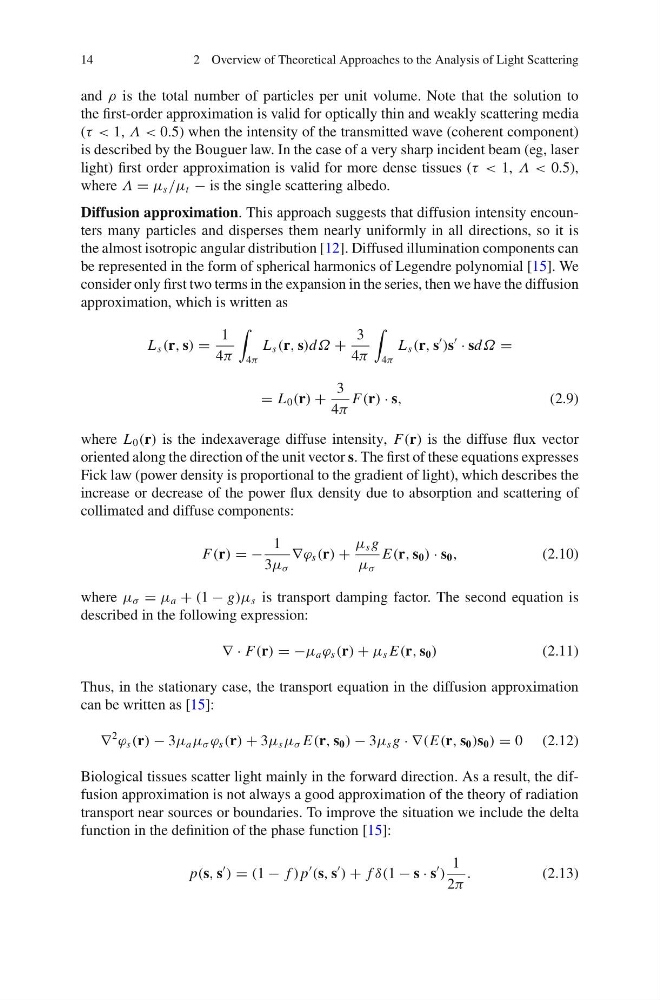
Diffusion approximation. This approach suggests that diffusion intensity encounters many particles and disperses them nearly uniformly in all directions, so it is
the almost isotropic angular distribution [12]. Diffused illumination components can
be represented in the form of spherical harmonics of Legendre polynomial [15]. We
consider only first two terms in the expansion in the series, then we have the diffusion
approximation, which is written as
L s (r, s) =
1
4π
4π
L s (r, s)dΩ +
3
4π
4π
L s (r, s
)s
· sdΩ =
= L 0 (r) +
3
4π
F(r) · s,
(2.9)
where L 0 (r) is the indexaverage diffuse intensity, F(r) is the diffuse flux vector
oriented along the direction of the unit vector s. The first of these equations expresses
Fick law (power density is proportional to the gradient of light), which describes the
increase or decrease of the power flux density due to absorption and scattering of
collimated and diffuse components:
F(r) = −
1
3μ σ
∇ϕ s (r) +
μ s g
μ σ
E(r, s 0 ) · s 0 ,
(2.10)
where μ σ = μ a + (1 − g)μ s is transport damping factor. The second equation is
described in the following expression:
∇ · F(r) = −μ a ϕ s (r) + μ s E(r, s 0 )
(2.11)
Thus, in the stationary case, the transport equation in the diffusion approximation
can be written as [15]:
∇
2
ϕ s (r) − 3μ a μ σ ϕ s (r) + 3μ s μ σ E(r, s 0 ) − 3μ s g · ∇(E(r, s 0 )s 0 ) = 0 (2.12)
Biological tissues scatter light mainly in the forward direction. As a result, the diffusion approximation is not always a good approximation of the theory of radiation
transport near sources or boundaries. To improve the situation we include the delta
function in the definition of the phase function [15]:
p(s, s
) = (1 − f ) p
(s, s
) + f δ(1 − s · s
)
1
2π
.
(2.13)
2 Overview of Theoretical Approaches to the Analysis of Light Scattering
and ρ is the total number of particles per unit volume. Note that the solution to
the first-order approximation is valid for optically thin and weakly scattering media
(τ < 1, Λ < 0.5) when the intensity of the transmitted wave (coherent component)
is described by the Bouguer law. In the case of a very sharp incident beam (eg, laser
light) first order approximation is valid for more dense tissues (τ < 1, Λ < 0.5),
where Λ = μ s /μ t − is the single scattering albedo.
Diffusion approximation. This approach suggests that diffusion intensity encounters many particles and disperses them nearly uniformly in all directions, so it is
the almost isotropic angular distribution [12]. Diffused illumination components can
be represented in the form of spherical harmonics of Legendre polynomial [15]. We
consider only first two terms in the expansion in the series, then we have the diffusion
approximation, which is written as
L s (r, s) =
1
4π
4π
L s (r, s)dΩ +
3
4π
4π
L s (r, s
)s
· sdΩ =
= L 0 (r) +
3
4π
F(r) · s,
(2.9)
where L 0 (r) is the indexaverage diffuse intensity, F(r) is the diffuse flux vector
oriented along the direction of the unit vector s. The first of these equations expresses
Fick law (power density is proportional to the gradient of light), which describes the
increase or decrease of the power flux density due to absorption and scattering of
collimated and diffuse components:
F(r) = −
1
3μ σ
∇ϕ s (r) +
μ s g
μ σ
E(r, s 0 ) · s 0 ,
(2.10)
where μ σ = μ a + (1 − g)μ s is transport damping factor. The second equation is
described in the following expression:
∇ · F(r) = −μ a ϕ s (r) + μ s E(r, s 0 )
(2.11)
Thus, in the stationary case, the transport equation in the diffusion approximation
can be written as [15]:
∇
2
ϕ s (r) − 3μ a μ σ ϕ s (r) + 3μ s μ σ E(r, s 0 ) − 3μ s g · ∇(E(r, s 0 )s 0 ) = 0 (2.12)
Biological tissues scatter light mainly in the forward direction. As a result, the diffusion approximation is not always a good approximation of the theory of radiation
transport near sources or boundaries. To improve the situation we include the delta
function in the definition of the phase function [15]:
p(s, s
) = (1 − f ) p
(s, s
) + f δ(1 − s · s
)
1
2π
.
(2.13)