

2.4 Approximate Methods for Solving the Transport Equation
15
This representation is called the Delta-Eddington approximation.
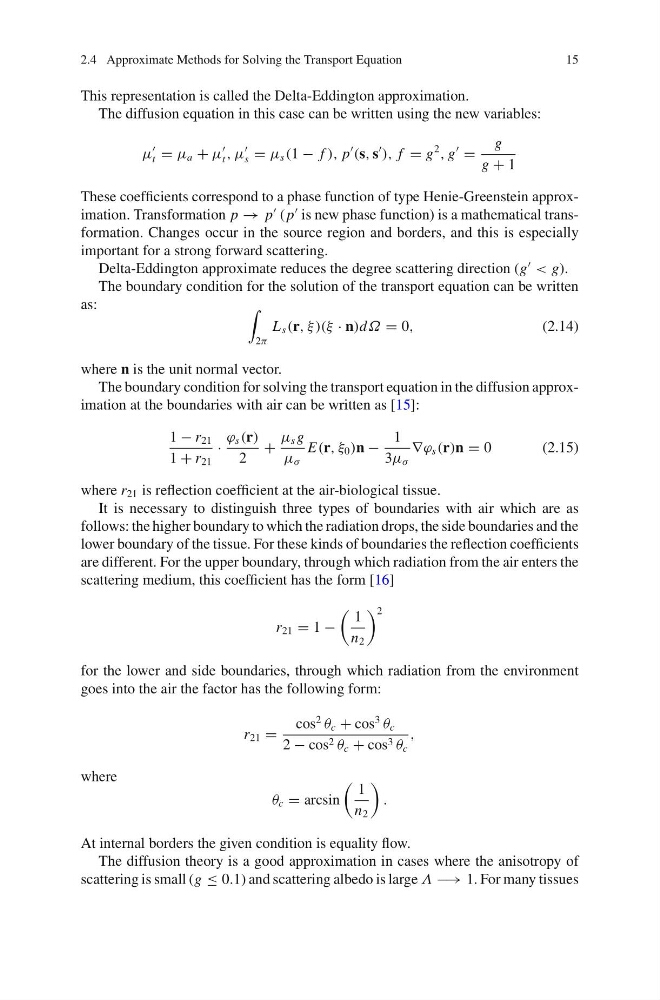
The diffusion equation in this case can be written using the new variables:
μ
t = μ a + μ
t , μ
s = μ s (1 − f ), p
(s, s
), f = g
2
, g
=
g
g + 1
These coefficients correspond to a phase function of type Henie-Greenstein approximation. Transformation p → p
( p
is new phase function) is a mathematical transformation. Changes occur in the source region and borders, and this is especially
important for a strong forward scattering.
Delta-Eddington approximate reduces the degree scattering direction (g
< g).
The boundary condition for the solution of the transport equation can be written
as:
2π
L s (r, ξ )(ξ · n)dΩ = 0,
(2.14)
where n is the unit normal vector.
The boundary condition for solving the transport equation in the diffusion approximation at the boundaries with air can be written as [15]:
1 − r 21
1 + r 21
·
ϕ s (r)
2
+
μ s g
μ σ
E(r, ξ 0 )n −
1
3μ σ
∇ϕ s (r)n = 0
(2.15)
where r 21 is reflection coefficient at the air-biological tissue.
It is necessary to distinguish three types of boundaries with air which are as
follows: the higher boundary to which the radiation drops, the side boundaries and the
lower boundary of the tissue. For these kinds of boundaries the reflection coefficients
are different. For the upper boundary, through which radiation from the air enters the
scattering medium, this coefficient has the form [16]
r 21 = 1 −
1
n 2
2
for the lower and side boundaries, through which radiation from the environment
goes into the air the factor has the following form:
r 21 =
cos
2
θ c + cos
3
θ c
2 − cos 2 θ c + cos 3 θ c
,
where
θ c = arcsin
1
n 2
.
At internal borders the given condition is equality flow.
The diffusion theory is a good approximation in cases where the anisotropy of
scattering is small (g ≤ 0.1) and scattering albedo is large Λ −→ 1. For many tissues
15
This representation is called the Delta-Eddington approximation.
The diffusion equation in this case can be written using the new variables:
μ
t = μ a + μ
t , μ
s = μ s (1 − f ), p
(s, s
), f = g
2
, g
=
g
g + 1
These coefficients correspond to a phase function of type Henie-Greenstein approximation. Transformation p → p
( p
is new phase function) is a mathematical transformation. Changes occur in the source region and borders, and this is especially
important for a strong forward scattering.
Delta-Eddington approximate reduces the degree scattering direction (g
< g).
The boundary condition for the solution of the transport equation can be written
as:
2π
L s (r, ξ )(ξ · n)dΩ = 0,
(2.14)
where n is the unit normal vector.
The boundary condition for solving the transport equation in the diffusion approximation at the boundaries with air can be written as [15]:
1 − r 21
1 + r 21
·
ϕ s (r)
2
+
μ s g
μ σ
E(r, ξ 0 )n −
1
3μ σ
∇ϕ s (r)n = 0
(2.15)
where r 21 is reflection coefficient at the air-biological tissue.
It is necessary to distinguish three types of boundaries with air which are as
follows: the higher boundary to which the radiation drops, the side boundaries and the
lower boundary of the tissue. For these kinds of boundaries the reflection coefficients
are different. For the upper boundary, through which radiation from the air enters the
scattering medium, this coefficient has the form [16]
r 21 = 1 −
1
n 2
2
for the lower and side boundaries, through which radiation from the environment
goes into the air the factor has the following form:
r 21 =
cos
2
θ c + cos
3
θ c
2 − cos 2 θ c + cos 3 θ c
,
where
θ c = arcsin
1
n 2
.
At internal borders the given condition is equality flow.
The diffusion theory is a good approximation in cases where the anisotropy of
scattering is small (g ≤ 0.1) and scattering albedo is large Λ −→ 1. For many tissues