

176
11 Simulation of the Thermal Processes
the simulated biological tissue and its components that are induced by nonpolarized
monochromatic radiation flow.
The following effect obtained in the model experiment is of interest. We got a
linear relation between the temperature field distribution of the incident radiation and
the refractive indices of the simulated biological tissue. As a result, this model can be
used to predict changes in the electrophysical properties of the biological structure
subjected to laser radiation for the case in vivo.
Our model can vary the composition, the electrophysical parameters, the thermophysical characteristics, and the characteristic layer thickness of biological objects,
as well as the characteristic sizes of the biological structure under study, in one apparatus in order to analyze the biophysical processes related to the thermal action of
laser radiation on the upper skin layers.
Using such a simulation, we can both find the preliminary parameters of the laser
radiation field and reveal the effects of the responses to laser irradiation at various
levels of organization of living matter.
On the whole, the results of simulating the thermal fields of laser radiation can
be used to improve laser thermotherapy and biostimulation methods and can serve
as the basis for the mathematical support of the experimental determination of the
optical and thermophysical parameters.
11.4 The Mathematical Model of Thermo-chemical
Denaturation of Biological Structure
The results of calculations of the temperature field in a simulated biological structure
can be used to assess the kinetics of denaturation of tissue. Note that the models of
thermo-chemical denaturation of biological structures such as corneal tissue and
skin was considered in [11, 12]. The correct solution to estimate the kinetics of
thermal decomposition of biological structures is difficult, because the biochemical
composition of the cells is complex. However, the necessary practical estimates
accuracy could be achieved with the introduction of a number of assumptions [13].
The basis of biochemical reactions stimulated by heat, are such processes as break
chemical bonds, the conformational transition. This class includes reactions and
thermal denaturation of proteins and lipids, enzymes, etc.
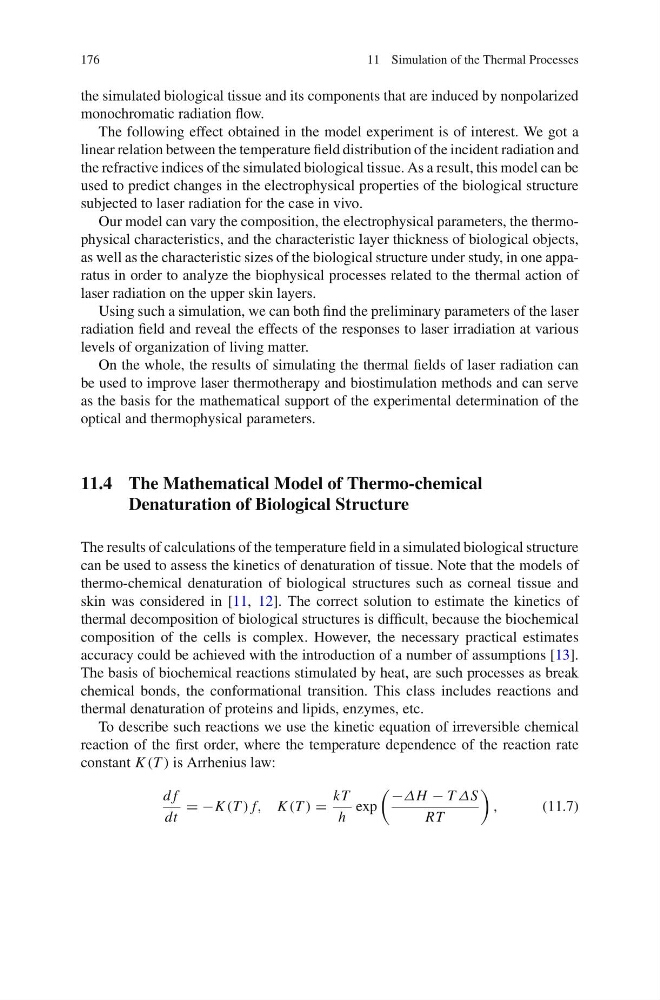
To describe such reactions we use the kinetic equation of irreversible chemical
reaction of the first order, where the temperature dependence of the reaction rate
constant K (T ) is Arrhenius law:
d f
dt
= −K (T ) f, K (T ) =
kT
h
exp
−ΔH − T ΔS
RT
,
(11.7)
11 Simulation of the Thermal Processes
the simulated biological tissue and its components that are induced by nonpolarized
monochromatic radiation flow.
The following effect obtained in the model experiment is of interest. We got a
linear relation between the temperature field distribution of the incident radiation and
the refractive indices of the simulated biological tissue. As a result, this model can be
used to predict changes in the electrophysical properties of the biological structure
subjected to laser radiation for the case in vivo.
Our model can vary the composition, the electrophysical parameters, the thermophysical characteristics, and the characteristic layer thickness of biological objects,
as well as the characteristic sizes of the biological structure under study, in one apparatus in order to analyze the biophysical processes related to the thermal action of
laser radiation on the upper skin layers.
Using such a simulation, we can both find the preliminary parameters of the laser
radiation field and reveal the effects of the responses to laser irradiation at various
levels of organization of living matter.
On the whole, the results of simulating the thermal fields of laser radiation can
be used to improve laser thermotherapy and biostimulation methods and can serve
as the basis for the mathematical support of the experimental determination of the
optical and thermophysical parameters.
11.4 The Mathematical Model of Thermo-chemical
Denaturation of Biological Structure
The results of calculations of the temperature field in a simulated biological structure
can be used to assess the kinetics of denaturation of tissue. Note that the models of
thermo-chemical denaturation of biological structures such as corneal tissue and
skin was considered in [11, 12]. The correct solution to estimate the kinetics of
thermal decomposition of biological structures is difficult, because the biochemical
composition of the cells is complex. However, the necessary practical estimates
accuracy could be achieved with the introduction of a number of assumptions [13].
The basis of biochemical reactions stimulated by heat, are such processes as break
chemical bonds, the conformational transition. This class includes reactions and
thermal denaturation of proteins and lipids, enzymes, etc.
To describe such reactions we use the kinetic equation of irreversible chemical
reaction of the first order, where the temperature dependence of the reaction rate
constant K (T ) is Arrhenius law:
d f
dt
= −K (T ) f, K (T ) =
kT
h
exp
−ΔH − T ΔS
RT
,
(11.7)