

11.4 The Mathematical Model of Thermo-chemical Denaturation of Biological Structure
177
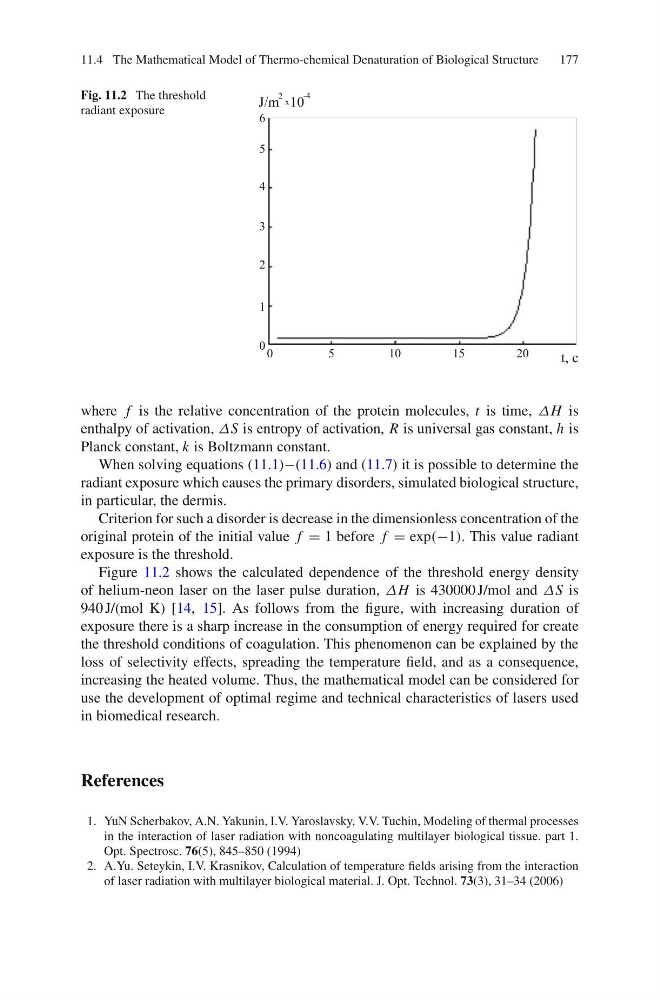
Fig. 11.2 The threshold
radiant exposure
0
5
10
15
20
0
1
2
3
4
5
6
x
-4
2
where f is the relative concentration of the protein molecules, t is time, ΔH is
enthalpy of activation, ΔS is entropy of activation, R is universal gas constant, h is
Planck constant, k is Boltzmann constant.
When solving equations (11.1)−(11.6) and (11.7) it is possible to determine the
radiant exposure which causes the primary disorders, simulated biological structure,
in particular, the dermis.
Criterion for such a disorder is decrease in the dimensionless concentration of the
original protein of the initial value f = 1 before f = exp(−1). This value radiant
exposure is the threshold.
Figure 11.2 shows the calculated dependence of the threshold energy density
of helium-neon laser on the laser pulse duration, ΔH is 430000 J/mol and ΔS is
940 J/(mol K) [14, 15]. As follows from the figure, with increasing duration of
exposure there is a sharp increase in the consumption of energy required for create
the threshold conditions of coagulation. This phenomenon can be explained by the
loss of selectivity effects, spreading the temperature field, and as a consequence,
increasing the heated volume. Thus, the mathematical model can be considered for
use the development of optimal regime and technical characteristics of lasers used
in biomedical research.
References
1. YuN Scherbakov, A.N. Yakunin, I.V. Yaroslavsky, V.V. Tuchin, Modeling of thermal processes
in the interaction of laser radiation with noncoagulating multilayer biological tissue. part 1.
Opt. Spectrosc. 76(5), 845–850 (1994)
2. A.Yu. Seteykin, I.V. Krasnikov, Calculation of temperature fields arising from the interaction
of laser radiation with multilayer biological material. J. Opt. Technol. 73(3), 31–34 (2006)
177
Fig. 11.2 The threshold
radiant exposure
0
5
10
15
20
0
1
2
3
4
5
6
x
-4
2
where f is the relative concentration of the protein molecules, t is time, ΔH is
enthalpy of activation, ΔS is entropy of activation, R is universal gas constant, h is
Planck constant, k is Boltzmann constant.
When solving equations (11.1)−(11.6) and (11.7) it is possible to determine the
radiant exposure which causes the primary disorders, simulated biological structure,
in particular, the dermis.
Criterion for such a disorder is decrease in the dimensionless concentration of the
original protein of the initial value f = 1 before f = exp(−1). This value radiant
exposure is the threshold.
Figure 11.2 shows the calculated dependence of the threshold energy density
of helium-neon laser on the laser pulse duration, ΔH is 430000 J/mol and ΔS is
940 J/(mol K) [14, 15]. As follows from the figure, with increasing duration of
exposure there is a sharp increase in the consumption of energy required for create
the threshold conditions of coagulation. This phenomenon can be explained by the
loss of selectivity effects, spreading the temperature field, and as a consequence,
increasing the heated volume. Thus, the mathematical model can be considered for
use the development of optimal regime and technical characteristics of lasers used
in biomedical research.
References
1. YuN Scherbakov, A.N. Yakunin, I.V. Yaroslavsky, V.V. Tuchin, Modeling of thermal processes
in the interaction of laser radiation with noncoagulating multilayer biological tissue. part 1.
Opt. Spectrosc. 76(5), 845–850 (1994)
2. A.Yu. Seteykin, I.V. Krasnikov, Calculation of temperature fields arising from the interaction
of laser radiation with multilayer biological material. J. Opt. Technol. 73(3), 31–34 (2006)