

11.3 Numerical Calculations Using a Model Medium and Conclusions
175
0
5
10
15
20
25
0
10
20
30
0
5
10
15
Oz
t,c
0
5
10
15
20
25
0
10
20
30
0
5
10
15
20
25
t,c
Oz
(a)
(b)
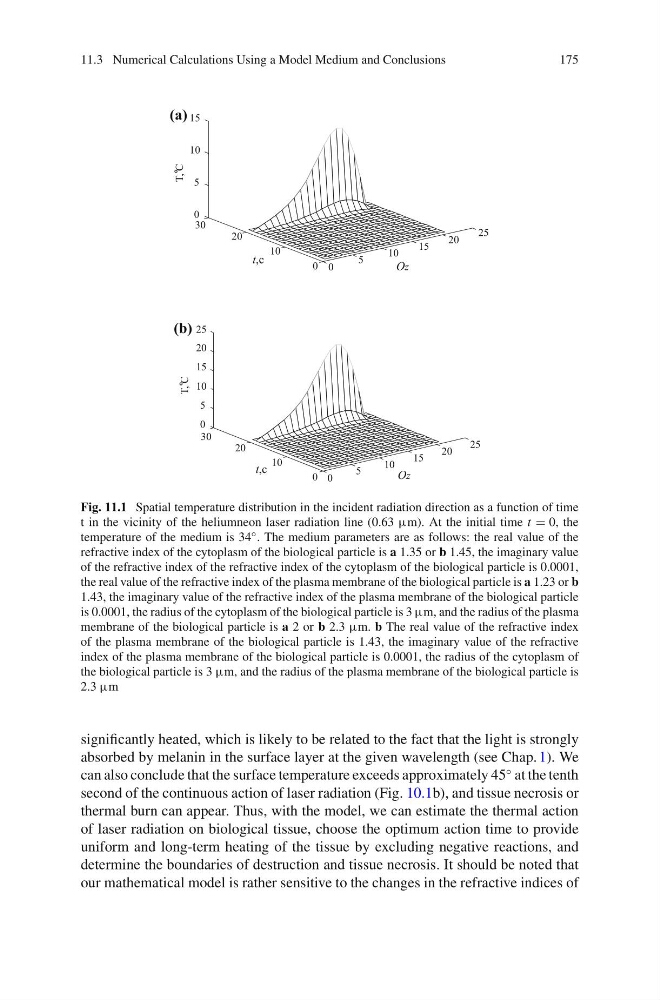
Fig. 11.1 Spatial temperature distribution in the incident radiation direction as a function of time
t in the vicinity of the heliumneon laser radiation line (0.63 µm). At the initial time t = 0, the
temperature of the medium is 34 ◦ . The medium parameters are as follows: the real value of the
refractive index of the cytoplasm of the biological particle is a 1.35 or b 1.45, the imaginary value
of the refractive index of the refractive index of the cytoplasm of the biological particle is 0.0001,
the real value of the refractive index of the plasma membrane of the biological particle is a 1.23 or b
1.43, the imaginary value of the refractive index of the plasma membrane of the biological particle
is 0.0001, the radius of the cytoplasm of the biological particle is 3 µm, and the radius of the plasma
membrane of the biological particle is a 2 or b 2.3 µm. b The real value of the refractive index
of the plasma membrane of the biological particle is 1.43, the imaginary value of the refractive
index of the plasma membrane of the biological particle is 0.0001, the radius of the cytoplasm of
the biological particle is 3 µm, and the radius of the plasma membrane of the biological particle is
2.3 µm
significantly heated, which is likely to be related to the fact that the light is strongly
absorbed by melanin in the surface layer at the given wavelength (see Chap. 1). We
can also conclude that the surface temperature exceeds approximately 45
◦ at the tenth
second of the continuous action of laser radiation (Fig. 10.1b), and tissue necrosis or
thermal burn can appear. Thus, with the model, we can estimate the thermal action
of laser radiation on biological tissue, choose the optimum action time to provide
uniform and long-term heating of the tissue by excluding negative reactions, and
determine the boundaries of destruction and tissue necrosis. It should be noted that
our mathematical model is rather sensitive to the changes in the refractive indices of
175
0
5
10
15
20
25
0
10
20
30
0
5
10
15
Oz
t,c
0
5
10
15
20
25
0
10
20
30
0
5
10
15
20
25
t,c
Oz
(a)
(b)
Fig. 11.1 Spatial temperature distribution in the incident radiation direction as a function of time
t in the vicinity of the heliumneon laser radiation line (0.63 µm). At the initial time t = 0, the
temperature of the medium is 34 ◦ . The medium parameters are as follows: the real value of the
refractive index of the cytoplasm of the biological particle is a 1.35 or b 1.45, the imaginary value
of the refractive index of the refractive index of the cytoplasm of the biological particle is 0.0001,
the real value of the refractive index of the plasma membrane of the biological particle is a 1.23 or b
1.43, the imaginary value of the refractive index of the plasma membrane of the biological particle
is 0.0001, the radius of the cytoplasm of the biological particle is 3 µm, and the radius of the plasma
membrane of the biological particle is a 2 or b 2.3 µm. b The real value of the refractive index
of the plasma membrane of the biological particle is 1.43, the imaginary value of the refractive
index of the plasma membrane of the biological particle is 0.0001, the radius of the cytoplasm of
the biological particle is 3 µm, and the radius of the plasma membrane of the biological particle is
2.3 µm
significantly heated, which is likely to be related to the fact that the light is strongly
absorbed by melanin in the surface layer at the given wavelength (see Chap. 1). We
can also conclude that the surface temperature exceeds approximately 45
◦ at the tenth
second of the continuous action of laser radiation (Fig. 10.1b), and tissue necrosis or
thermal burn can appear. Thus, with the model, we can estimate the thermal action
of laser radiation on biological tissue, choose the optimum action time to provide
uniform and long-term heating of the tissue by excluding negative reactions, and
determine the boundaries of destruction and tissue necrosis. It should be noted that
our mathematical model is rather sensitive to the changes in the refractive indices of