

168
10 Study of the Optical Characteristics of Thin Layer of the Biological Sample
H (x, y) = c sin(ax + by), a, b and c are certain arbitrarily defined constant, such
that a 1, b 1, c 1.
Let us suppose that a plane s- or p- polarized wave is incident on the layer at an
angle θ . We consider only the case of the p polarization. We must find the reflected
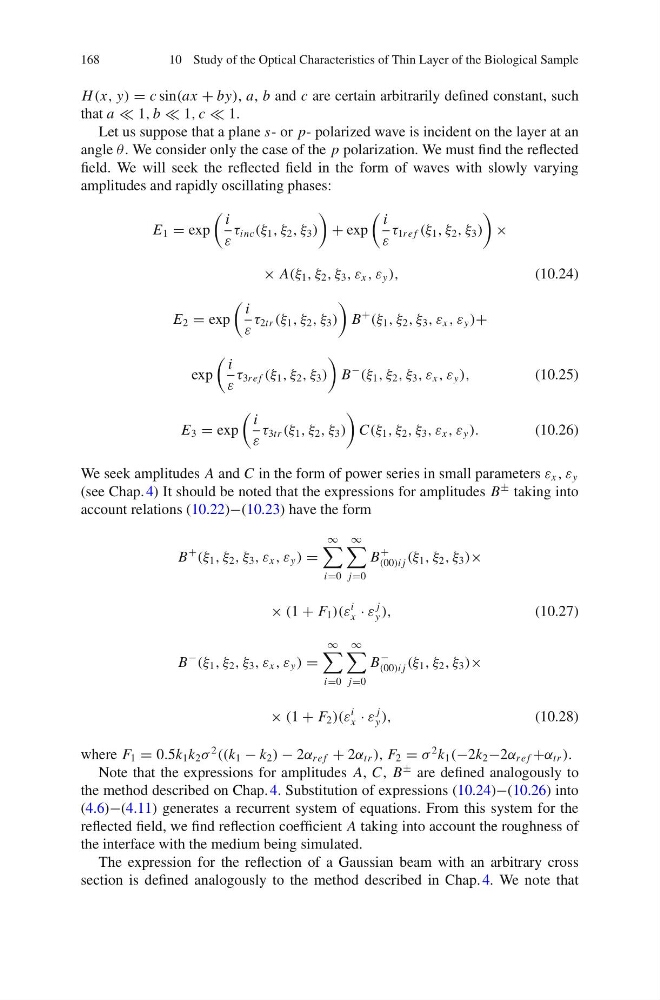
field. We will seek the reflected field in the form of waves with slowly varying
amplitudes and rapidly oscillating phases:
E 1 = exp
i
ε
τ inc (ξ 1 , ξ 2 , ξ 3 )
+ exp
i
ε
τ 1re f (ξ 1 , ξ 2 , ξ 3 )
×
× A(ξ 1 , ξ 2 , ξ 3 , ε x , ε y ),
(10.24)
E 2 = exp
i
ε
τ 2tr (ξ 1 , ξ 2 , ξ 3 )
B
+
(ξ 1 , ξ 2 , ξ 3 , ε x , ε y )+
exp
i
ε
τ 3re f (ξ 1 , ξ 2 , ξ 3 )
B
−
(ξ 1 , ξ 2 , ξ 3 , ε x , ε y ),
(10.25)
E 3 = exp
i
ε
τ 3tr (ξ 1 , ξ 2 , ξ 3 )
C(ξ 1 , ξ 2 , ξ 3 , ε x , ε y ).
(10.26)
We seek amplitudes A and C in the form of power series in small parameters ε x , ε y
(see Chap. 4) It should be noted that the expressions for amplitudes B
± taking into
account relations (10.22)−(10.23) have the form
B
+
(ξ 1 , ξ 2 , ξ 3 , ε x , ε y ) =
∞
i=0
∞
j=0
B
+
(00)i j (ξ 1 , ξ 2 , ξ 3 )×
× (1 + F 1 )(ε
i
x · ε
j
y ),
(10.27)
B
−
(ξ 1 , ξ 2 , ξ 3 , ε x , ε y ) =
∞
i=0
∞
j=0
B
−
(00)i j (ξ 1 , ξ 2 , ξ 3 )×
× (1 + F 2 )(ε
i
x · ε
j
y ),
(10.28)
where F 1 = 0.5k 1 k 2 σ
2
((k 1 − k 2 ) − 2α re f + 2α tr ), F 2 = σ
2 k 1 (−2k 2 −2α re f +α tr ).
Note that the expressions for amplitudes A, C, B
± are defined analogously to
the method described on Chap. 4. Substitution of expressions (10.24)−(10.26) into
(4.6)−(4.11) generates a recurrent system of equations. From this system for the
reflected field, we find reflection coefficient A taking into account the roughness of
the interface with the medium being simulated.
The expression for the reflection of a Gaussian beam with an arbitrary cross
section is defined analogously to the method described in Chap. 4. We note that
10 Study of the Optical Characteristics of Thin Layer of the Biological Sample
H (x, y) = c sin(ax + by), a, b and c are certain arbitrarily defined constant, such
that a 1, b 1, c 1.
Let us suppose that a plane s- or p- polarized wave is incident on the layer at an
angle θ . We consider only the case of the p polarization. We must find the reflected
field. We will seek the reflected field in the form of waves with slowly varying
amplitudes and rapidly oscillating phases:
E 1 = exp
i
ε
τ inc (ξ 1 , ξ 2 , ξ 3 )
+ exp
i
ε
τ 1re f (ξ 1 , ξ 2 , ξ 3 )
×
× A(ξ 1 , ξ 2 , ξ 3 , ε x , ε y ),
(10.24)
E 2 = exp
i
ε
τ 2tr (ξ 1 , ξ 2 , ξ 3 )
B
+
(ξ 1 , ξ 2 , ξ 3 , ε x , ε y )+
exp
i
ε
τ 3re f (ξ 1 , ξ 2 , ξ 3 )
B
−
(ξ 1 , ξ 2 , ξ 3 , ε x , ε y ),
(10.25)
E 3 = exp
i
ε
τ 3tr (ξ 1 , ξ 2 , ξ 3 )
C(ξ 1 , ξ 2 , ξ 3 , ε x , ε y ).
(10.26)
We seek amplitudes A and C in the form of power series in small parameters ε x , ε y
(see Chap. 4) It should be noted that the expressions for amplitudes B
± taking into
account relations (10.22)−(10.23) have the form
B
+
(ξ 1 , ξ 2 , ξ 3 , ε x , ε y ) =
∞
i=0
∞
j=0
B
+
(00)i j (ξ 1 , ξ 2 , ξ 3 )×
× (1 + F 1 )(ε
i
x · ε
j
y ),
(10.27)
B
−
(ξ 1 , ξ 2 , ξ 3 , ε x , ε y ) =
∞
i=0
∞
j=0
B
−
(00)i j (ξ 1 , ξ 2 , ξ 3 )×
× (1 + F 2 )(ε
i
x · ε
j
y ),
(10.28)
where F 1 = 0.5k 1 k 2 σ
2
((k 1 − k 2 ) − 2α re f + 2α tr ), F 2 = σ
2 k 1 (−2k 2 −2α re f +α tr ).
Note that the expressions for amplitudes A, C, B
± are defined analogously to
the method described on Chap. 4. Substitution of expressions (10.24)−(10.26) into
(4.6)−(4.11) generates a recurrent system of equations. From this system for the
reflected field, we find reflection coefficient A taking into account the roughness of
the interface with the medium being simulated.
The expression for the reflection of a Gaussian beam with an arbitrary cross
section is defined analogously to the method described in Chap. 4. We note that