

10.2 Scattering of a Plane Wave from a Rough Surface
167
where
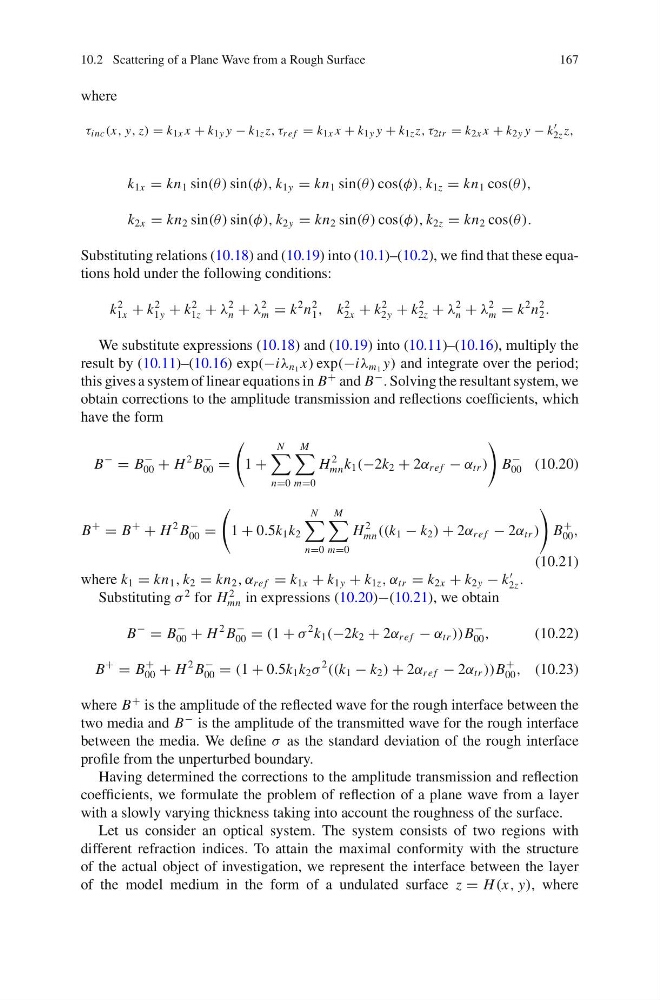
τ inc (x, y, z) = k 1x x + k 1y y − k 1z z, τ re f = k 1x x + k 1y y + k 1z z, τ 2tr = k 2x x + k 2y y − k
2z z,
k 1x = kn 1 sin(θ ) sin(φ), k 1y = kn 1 sin(θ ) cos(φ), k 1z = kn 1 cos(θ ),
k 2x = kn 2 sin(θ ) sin(φ), k 2y = kn 2 sin(θ ) cos(φ), k 2z = kn 2 cos(θ ).
Substituting relations (10.18) and (10.19) into (10.1)–(10.2), we find that these equations hold under the following conditions:
k
2
1x + k
2
1y + k
2
1z + λ
2
n + λ
2
m = k
2 n
2
1 , k
2
2x + k
2
2y + k
2
2z + λ
2
n + λ
2
m = k
2 n
2
2 .
We substitute expressions (10.18) and (10.19) into (10.11)–(10.16), multiply the
result by (10.11)–(10.16) exp(−iλ n 1 x) exp(−iλ m 1 y) and integrate over the period;
this gives a system of linear equations in B
+ and B
− . Solving the resultant system, we
obtain corrections to the amplitude transmission and reflections coefficients, which
have the form
B
−
= B
−
00 + H
2 B
−
00 =
1 +
N
n=0
M
m=0
H
2
mn k 1 (−2k 2 + 2α re f − α tr )
B
−
00 (10.20)
B
+
= B
+
+ H
2 B
−
00 =
1 + 0.5k 1 k 2
N
n=0
M
m=0
H
2
mn ((k 1 − k 2 ) + 2α re f − 2α tr )
B
+
00 ,
(10.21)
where k 1 = kn 1 , k 2 = kn 2 , α re f = k 1x + k 1y + k 1z , α tr = k 2x + k 2y − k
2z .
Substituting σ
2 for H
2
mn in expressions (10.20)−(10.21), we obtain
B
−
= B
−
00 + H
2 B
−
00 = (1 + σ
2 k 1 (−2k 2 + 2α re f − α tr ))B
−
00 ,
(10.22)
B
+
= B
+
00 + H
2 B
−
00 = (1 + 0.5k 1 k 2 σ
2
((k 1 − k 2 ) + 2α re f − 2α tr ))B
+
00 , (10.23)
where B
+ is the amplitude of the reflected wave for the rough interface between the
two media and B
− is the amplitude of the transmitted wave for the rough interface
between the media. We define σ as the standard deviation of the rough interface
profile from the unperturbed boundary.
Having determined the corrections to the amplitude transmission and reflection
coefficients, we formulate the problem of reflection of a plane wave from a layer
with a slowly varying thickness taking into account the roughness of the surface.
Let us consider an optical system. The system consists of two regions with
different refraction indices. To attain the maximal conformity with the structure
of the actual object of investigation, we represent the interface between the layer
of the model medium in the form of a undulated surface z = H (x, y), where
167
where
τ inc (x, y, z) = k 1x x + k 1y y − k 1z z, τ re f = k 1x x + k 1y y + k 1z z, τ 2tr = k 2x x + k 2y y − k
2z z,
k 1x = kn 1 sin(θ ) sin(φ), k 1y = kn 1 sin(θ ) cos(φ), k 1z = kn 1 cos(θ ),
k 2x = kn 2 sin(θ ) sin(φ), k 2y = kn 2 sin(θ ) cos(φ), k 2z = kn 2 cos(θ ).
Substituting relations (10.18) and (10.19) into (10.1)–(10.2), we find that these equations hold under the following conditions:
k
2
1x + k
2
1y + k
2
1z + λ
2
n + λ
2
m = k
2 n
2
1 , k
2
2x + k
2
2y + k
2
2z + λ
2
n + λ
2
m = k
2 n
2
2 .
We substitute expressions (10.18) and (10.19) into (10.11)–(10.16), multiply the
result by (10.11)–(10.16) exp(−iλ n 1 x) exp(−iλ m 1 y) and integrate over the period;
this gives a system of linear equations in B
+ and B
− . Solving the resultant system, we
obtain corrections to the amplitude transmission and reflections coefficients, which
have the form
B
−
= B
−
00 + H
2 B
−
00 =
1 +
N
n=0
M
m=0
H
2
mn k 1 (−2k 2 + 2α re f − α tr )
B
−
00 (10.20)
B
+
= B
+
+ H
2 B
−
00 =
1 + 0.5k 1 k 2
N
n=0
M
m=0
H
2
mn ((k 1 − k 2 ) + 2α re f − 2α tr )
B
+
00 ,
(10.21)
where k 1 = kn 1 , k 2 = kn 2 , α re f = k 1x + k 1y + k 1z , α tr = k 2x + k 2y − k
2z .
Substituting σ
2 for H
2
mn in expressions (10.20)−(10.21), we obtain
B
−
= B
−
00 + H
2 B
−
00 = (1 + σ
2 k 1 (−2k 2 + 2α re f − α tr ))B
−
00 ,
(10.22)
B
+
= B
+
00 + H
2 B
−
00 = (1 + 0.5k 1 k 2 σ
2
((k 1 − k 2 ) + 2α re f − 2α tr ))B
+
00 , (10.23)
where B
+ is the amplitude of the reflected wave for the rough interface between the
two media and B
− is the amplitude of the transmitted wave for the rough interface
between the media. We define σ as the standard deviation of the rough interface
profile from the unperturbed boundary.
Having determined the corrections to the amplitude transmission and reflection
coefficients, we formulate the problem of reflection of a plane wave from a layer
with a slowly varying thickness taking into account the roughness of the surface.
Let us consider an optical system. The system consists of two regions with
different refraction indices. To attain the maximal conformity with the structure
of the actual object of investigation, we represent the interface between the layer
of the model medium in the form of a undulated surface z = H (x, y), where