

166
10 Study of the Optical Characteristics of Thin Layer of the Biological Sample
+
1
n
2
1
H
∂
2 E inc
∂ x∂z
+
∂
2 E
1
01
∂ x∂z
z=0
·
∂ H
∂ x
− H
∂
2 E inc
∂ y∂z
+
∂
2 E
1
01
∂ y∂z
z=0
·
∂ H
∂ y
+
+
1
n
2
1
∂ E inc
∂z
+
∂ E
1
01
∂z
z=0
(∇ H )
2
2
+
H
2
2
∂
3 E inc
∂z 3 +
∂
3 E
1
01
∂z 3
z=0
=
=
1
n
2
2
∂ E
2
02
∂z
z=0
−
∂ E
1
02
∂ x
z=0
∂ H
∂ x
−
∂ E
1
02
∂ y
z=0
∂ H
∂ y
+ H
∂
2 E
1
02
∂z 2
z=0
+
1
n
2
2
H
∂
2 E
1
02
∂ x∂z
z=0
·
∂ H
∂ x
− H
∂
2 E
1
02
∂ y∂z
z=0
·
∂ H
∂ y
+
∂ E
1
01
∂z
z=0
(∇ H )
2
2
+
+
1
n
2
2
H
2
2
∂
3 E
1
01
∂z 3
z=0
.
(10.16)
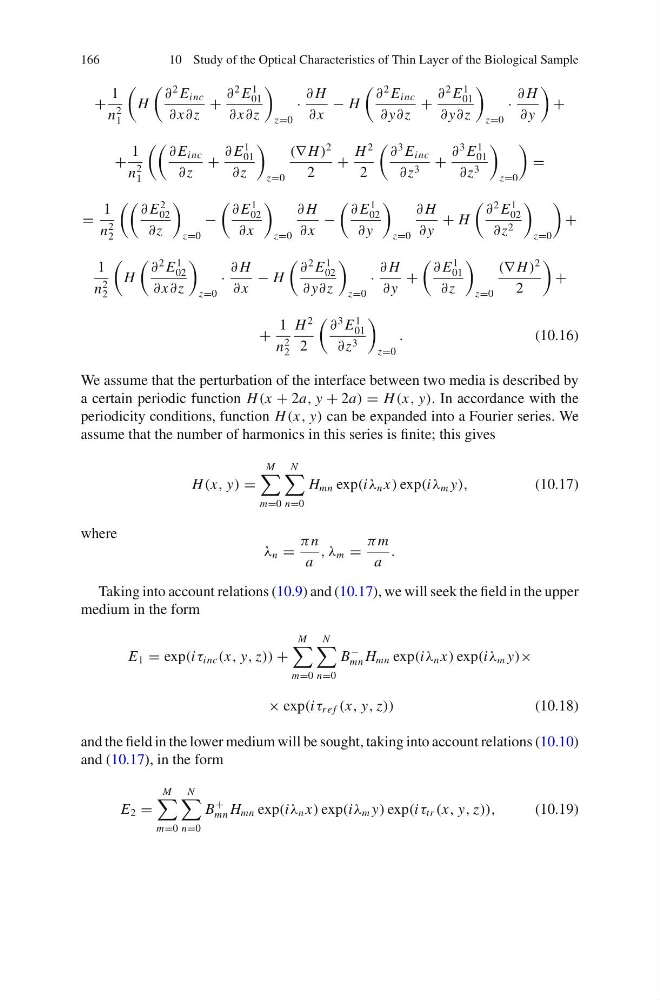
We assume that the perturbation of the interface between two media is described by
a certain periodic function H (x + 2a, y + 2a) = H (x, y). In accordance with the
periodicity conditions, function H (x, y) can be expanded into a Fourier series. We
assume that the number of harmonics in this series is finite; this gives
H (x, y) =
M
m=0
N
n=0
H mn exp(iλ n x) exp(iλ m y),
(10.17)
where
λ n =
π n
a
, λ m =
π m
a
.
Taking into account relations (10.9) and (10.17), we will seek the field in the upper
medium in the form
E 1 = exp(iτ inc (x, y, z)) +
M
m=0
N
n=0
B
−
mn H mn exp(iλ n x) exp(iλ m y)×
× exp(iτ re f (x, y, z))
(10.18)
and the field in the lower medium will be sought, taking into account relations (10.10)
and (10.17), in the form
E 2 =
M
m=0
N
n=0
B
+
mn H mn exp(iλ n x) exp(iλ m y) exp(iτ tr (x, y, z)),
(10.19)
10 Study of the Optical Characteristics of Thin Layer of the Biological Sample
+
1
n
2
1
H
∂
2 E inc
∂ x∂z
+
∂
2 E
1
01
∂ x∂z
z=0
·
∂ H
∂ x
− H
∂
2 E inc
∂ y∂z
+
∂
2 E
1
01
∂ y∂z
z=0
·
∂ H
∂ y
+
+
1
n
2
1
∂ E inc
∂z
+
∂ E
1
01
∂z
z=0
(∇ H )
2
2
+
H
2
2
∂
3 E inc
∂z 3 +
∂
3 E
1
01
∂z 3
z=0
=
=
1
n
2
2
∂ E
2
02
∂z
z=0
−
∂ E
1
02
∂ x
z=0
∂ H
∂ x
−
∂ E
1
02
∂ y
z=0
∂ H
∂ y
+ H
∂
2 E
1
02
∂z 2
z=0
+
1
n
2
2
H
∂
2 E
1
02
∂ x∂z
z=0
·
∂ H
∂ x
− H
∂
2 E
1
02
∂ y∂z
z=0
·
∂ H
∂ y
+
∂ E
1
01
∂z
z=0
(∇ H )
2
2
+
+
1
n
2
2
H
2
2
∂
3 E
1
01
∂z 3
z=0
.
(10.16)
We assume that the perturbation of the interface between two media is described by
a certain periodic function H (x + 2a, y + 2a) = H (x, y). In accordance with the
periodicity conditions, function H (x, y) can be expanded into a Fourier series. We
assume that the number of harmonics in this series is finite; this gives
H (x, y) =
M
m=0
N
n=0
H mn exp(iλ n x) exp(iλ m y),
(10.17)
where
λ n =
π n
a
, λ m =
π m
a
.
Taking into account relations (10.9) and (10.17), we will seek the field in the upper
medium in the form
E 1 = exp(iτ inc (x, y, z)) +
M
m=0
N
n=0
B
−
mn H mn exp(iλ n x) exp(iλ m y)×
× exp(iτ re f (x, y, z))
(10.18)
and the field in the lower medium will be sought, taking into account relations (10.10)
and (10.17), in the form
E 2 =
M
m=0
N
n=0
B
+
mn H mn exp(iλ n x) exp(iλ m y) exp(iτ tr (x, y, z)),
(10.19)