

9.3 Numerical Calculations for a Model Medium and Conclusions
157
b 1 y), H 2 (x, y) = c 2 sin(a 2 x + b 2 y), H 3 (x, y) = c 3 sin(a 3 x + b 3 y), c 1 , a 1 , b 1 , c 2 , a 2 ,
b 2 , c 3 , a 3 , b 3 are some arbitrary constants. The arbitrarily preset constants are:
a 1 = −0.0024, b 1 = 0.020, a 2 = 0.021, b 2 = 0.030, a 3 = 0.041, b 3 = 0.051, c 1 =
c 2 = c 3 = 10
−2 . The values of parameters a 1 , b 1 , a 2 , b 2 , a 3 , b 3 , c 1 , c 2 , c 3 are selected
for the interfaces between the layers so that the shape of the surface matches as close
as possible to the interface between the corresponding layers in the structure of the
normal human derma. All calculations were carried out for the principal transverse
mode.
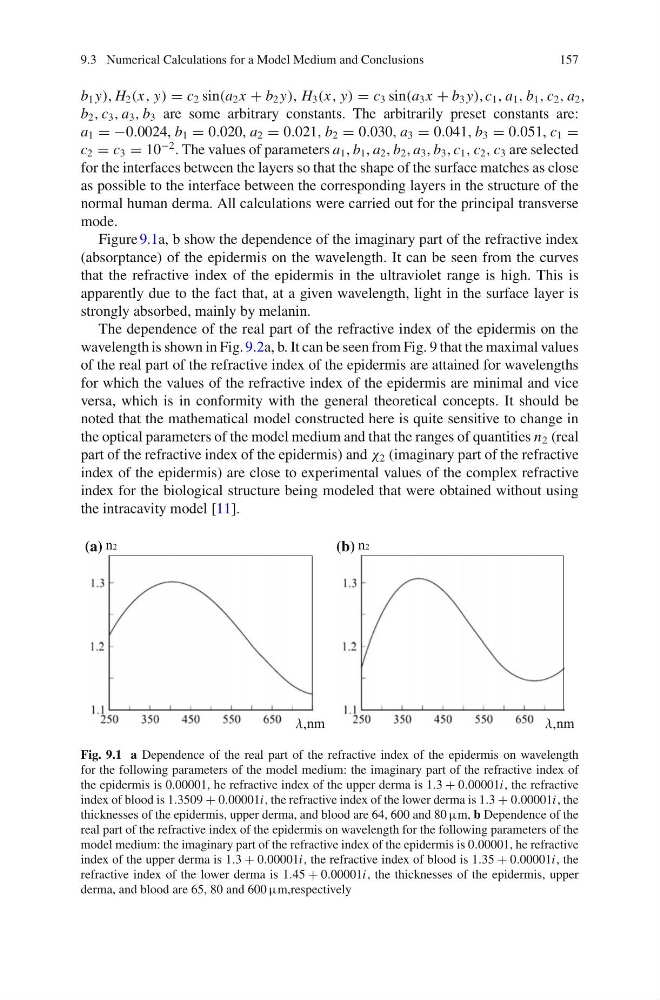
Figure 9.1a, b show the dependence of the imaginary part of the refractive index
(absorptance) of the epidermis on the wavelength. It can be seen from the curves
that the refractive index of the epidermis in the ultraviolet range is high. This is
apparently due to the fact that, at a given wavelength, light in the surface layer is
strongly absorbed, mainly by melanin.
The dependence of the real part of the refractive index of the epidermis on the
wavelength is shown in Fig. 9.2a, b. It can be seen from Fig. 9 that the maximal values
of the real part of the refractive index of the epidermis are attained for wavelengths
for which the values of the refractive index of the epidermis are minimal and vice
versa, which is in conformity with the general theoretical concepts. It should be
noted that the mathematical model constructed here is quite sensitive to change in
the optical parameters of the model medium and that the ranges of quantities n 2 (real
part of the refractive index of the epidermis) and χ 2 (imaginary part of the refractive
index of the epidermis) are close to experimental values of the complex refractive
index for the biological structure being modeled that were obtained without using
the intracavity model [11].
nm
nm
n2
n2
(a)
(b)
Fig. 9.1 a Dependence of the real part of the refractive index of the epidermis on wavelength
for the following parameters of the model medium: the imaginary part of the refractive index of
the epidermis is 0.00001, he refractive index of the upper derma is 1.3 + 0.00001i, the refractive
index of blood is 1.3509 + 0.00001i, the refractive index of the lower derma is 1.3 + 0.00001i, the
thicknesses of the epidermis, upper derma, and blood are 64, 600 and 80 µm, b Dependence of the
real part of the refractive index of the epidermis on wavelength for the following parameters of the
model medium: the imaginary part of the refractive index of the epidermis is 0.00001, he refractive
index of the upper derma is 1.3 + 0.00001i, the refractive index of blood is 1.35 + 0.00001i, the
refractive index of the lower derma is 1.45 + 0.00001i, the thicknesses of the epidermis, upper
derma, and blood are 65, 80 and 600 µm,respectively
157
b 1 y), H 2 (x, y) = c 2 sin(a 2 x + b 2 y), H 3 (x, y) = c 3 sin(a 3 x + b 3 y), c 1 , a 1 , b 1 , c 2 , a 2 ,
b 2 , c 3 , a 3 , b 3 are some arbitrary constants. The arbitrarily preset constants are:
a 1 = −0.0024, b 1 = 0.020, a 2 = 0.021, b 2 = 0.030, a 3 = 0.041, b 3 = 0.051, c 1 =
c 2 = c 3 = 10
−2 . The values of parameters a 1 , b 1 , a 2 , b 2 , a 3 , b 3 , c 1 , c 2 , c 3 are selected
for the interfaces between the layers so that the shape of the surface matches as close
as possible to the interface between the corresponding layers in the structure of the
normal human derma. All calculations were carried out for the principal transverse
mode.
Figure 9.1a, b show the dependence of the imaginary part of the refractive index
(absorptance) of the epidermis on the wavelength. It can be seen from the curves
that the refractive index of the epidermis in the ultraviolet range is high. This is
apparently due to the fact that, at a given wavelength, light in the surface layer is
strongly absorbed, mainly by melanin.
The dependence of the real part of the refractive index of the epidermis on the
wavelength is shown in Fig. 9.2a, b. It can be seen from Fig. 9 that the maximal values
of the real part of the refractive index of the epidermis are attained for wavelengths
for which the values of the refractive index of the epidermis are minimal and vice
versa, which is in conformity with the general theoretical concepts. It should be
noted that the mathematical model constructed here is quite sensitive to change in
the optical parameters of the model medium and that the ranges of quantities n 2 (real
part of the refractive index of the epidermis) and χ 2 (imaginary part of the refractive
index of the epidermis) are close to experimental values of the complex refractive
index for the biological structure being modeled that were obtained without using
the intracavity model [11].
nm
nm
n2
n2
(a)
(b)
Fig. 9.1 a Dependence of the real part of the refractive index of the epidermis on wavelength
for the following parameters of the model medium: the imaginary part of the refractive index of
the epidermis is 0.00001, he refractive index of the upper derma is 1.3 + 0.00001i, the refractive
index of blood is 1.3509 + 0.00001i, the refractive index of the lower derma is 1.3 + 0.00001i, the
thicknesses of the epidermis, upper derma, and blood are 64, 600 and 80 µm, b Dependence of the
real part of the refractive index of the epidermis on wavelength for the following parameters of the
model medium: the imaginary part of the refractive index of the epidermis is 0.00001, he refractive
index of the upper derma is 1.3 + 0.00001i, the refractive index of blood is 1.35 + 0.00001i, the
refractive index of the lower derma is 1.45 + 0.00001i, the thicknesses of the epidermis, upper
derma, and blood are 65, 80 and 600 µm,respectively