

9.2 Integral Equation for Natural Oscillations of Field in a Resonator
155
γ = ψ 1 + εϕ 11 + O(ε
2
)
(9.3)
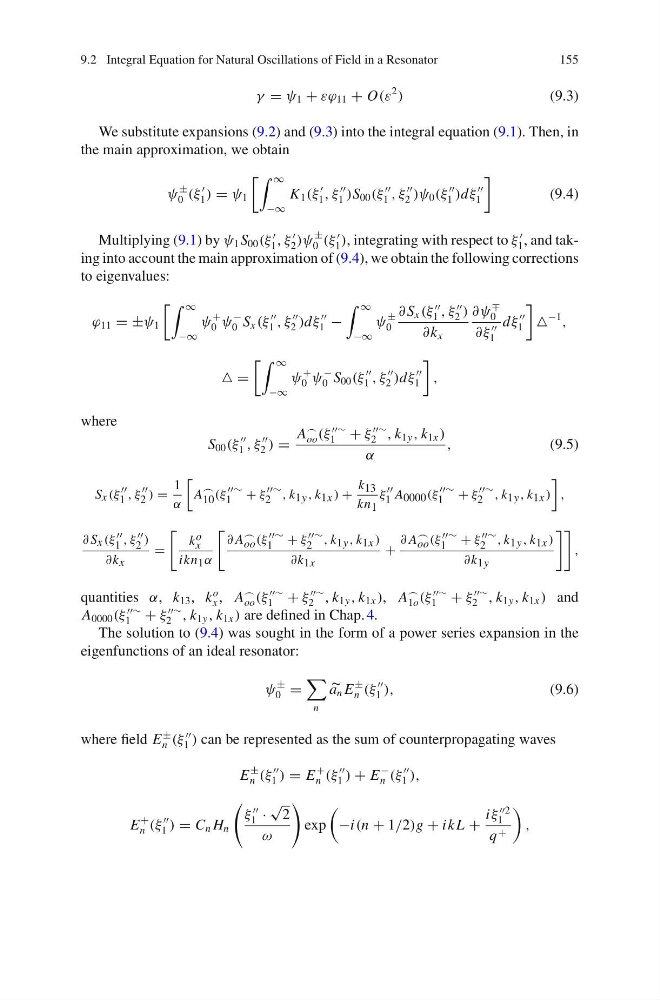
We substitute expansions (9.2) and (9.3) into the integral equation (9.1). Then, in
the main approximation, we obtain
ψ
±
0 (ξ
1 ) = ψ 1
∞
−∞
K 1 (ξ
1 , ξ
1 )S 00 (ξ
1 , ξ
2 )ψ 0 (ξ
1 )dξ
1
(9.4)
Multiplying (9.1) by ψ 1 S 00 (ξ
1 , ξ
2 )ψ
±
0 (ξ
1 ), integrating with respect to ξ
1 , and taking into account the main approximation of (9.4), we obtain the following corrections
to eigenvalues:
ϕ 11 = ±ψ 1
∞
−∞
ψ
+
0 ψ
−
0 S x (ξ
1 , ξ
2 )dξ
1 −
∞
−∞
ψ
±
0
∂ S x (ξ
1 , ξ
2 )
∂k x
∂ψ
∓
0
∂ξ
1
dξ
1
−1
,
=
∞
−∞
ψ
+
0 ψ
−
0 S 00 (ξ
1 , ξ
2 )dξ
1
,
where
S 00 (ξ
1 , ξ
2 ) =
A
oo (ξ
∼
1 + ξ
∼
2 , k 1y , k 1x )
α
,
(9.5)
S x (ξ
1 , ξ
2 ) =
1
α
A
10 (ξ ∼
1 + ξ ∼
2 , k 1y , k 1x ) +
k 13
kn 1
ξ
1 A 0000 (ξ ∼
1 + ξ ∼
2 , k 1y , k 1x )
,
∂ S x (ξ
1 , ξ
2 )
∂k x
=
k o
x
ikn 1 α
∂ A
oo (ξ ∼
1 + ξ ∼
2 , k 1y , k 1x )
∂k 1x
+
∂ A
oo (ξ ∼
1 + ξ ∼
2 , k 1y , k 1x )
∂k 1y
,
quantities α, k 13 , k
o
x , A
oo (ξ
∼
1 + ξ
∼
2 , k 1y , k 1x ), A
1o (ξ
∼
1 + ξ
∼
2 , k 1y , k 1x ) and
A 0000 (ξ
∼
1 + ξ
∼
2 , k 1y , k 1x ) are defined in Chap. 4.
The solution to (9.4) was sought in the form of a power series expansion in the
eigenfunctions of an ideal resonator:
ψ
±
0 =
n
a n E
±
n (ξ
1 ),
(9.6)
where field E
±
n (ξ
1 ) can be represented as the sum of counterpropagating waves
E
±
n (ξ
1 ) = E
+
n (ξ
1 ) + E
−
n (ξ
1 ),
E
+
n (ξ
1 ) = C n H n
ξ
1 ·
√
2
ω
exp
−i(n + 1/2)g + ik L +
iξ
2
1
q +
,
155
γ = ψ 1 + εϕ 11 + O(ε
2
)
(9.3)
We substitute expansions (9.2) and (9.3) into the integral equation (9.1). Then, in
the main approximation, we obtain
ψ
±
0 (ξ
1 ) = ψ 1
∞
−∞
K 1 (ξ
1 , ξ
1 )S 00 (ξ
1 , ξ
2 )ψ 0 (ξ
1 )dξ
1
(9.4)
Multiplying (9.1) by ψ 1 S 00 (ξ
1 , ξ
2 )ψ
±
0 (ξ
1 ), integrating with respect to ξ
1 , and taking into account the main approximation of (9.4), we obtain the following corrections
to eigenvalues:
ϕ 11 = ±ψ 1
∞
−∞
ψ
+
0 ψ
−
0 S x (ξ
1 , ξ
2 )dξ
1 −
∞
−∞
ψ
±
0
∂ S x (ξ
1 , ξ
2 )
∂k x
∂ψ
∓
0
∂ξ
1
dξ
1
−1
,
=
∞
−∞
ψ
+
0 ψ
−
0 S 00 (ξ
1 , ξ
2 )dξ
1
,
where
S 00 (ξ
1 , ξ
2 ) =
A
oo (ξ
∼
1 + ξ
∼
2 , k 1y , k 1x )
α
,
(9.5)
S x (ξ
1 , ξ
2 ) =
1
α
A
10 (ξ ∼
1 + ξ ∼
2 , k 1y , k 1x ) +
k 13
kn 1
ξ
1 A 0000 (ξ ∼
1 + ξ ∼
2 , k 1y , k 1x )
,
∂ S x (ξ
1 , ξ
2 )
∂k x
=
k o
x
ikn 1 α
∂ A
oo (ξ ∼
1 + ξ ∼
2 , k 1y , k 1x )
∂k 1x
+
∂ A
oo (ξ ∼
1 + ξ ∼
2 , k 1y , k 1x )
∂k 1y
,
quantities α, k 13 , k
o
x , A
oo (ξ
∼
1 + ξ
∼
2 , k 1y , k 1x ), A
1o (ξ
∼
1 + ξ
∼
2 , k 1y , k 1x ) and
A 0000 (ξ
∼
1 + ξ
∼
2 , k 1y , k 1x ) are defined in Chap. 4.
The solution to (9.4) was sought in the form of a power series expansion in the
eigenfunctions of an ideal resonator:
ψ
±
0 =
n
a n E
±
n (ξ
1 ),
(9.6)
where field E
±
n (ξ
1 ) can be represented as the sum of counterpropagating waves
E
±
n (ξ
1 ) = E
+
n (ξ
1 ) + E
−
n (ξ
1 ),
E
+
n (ξ
1 ) = C n H n
ξ
1 ·
√
2
ω
exp
−i(n + 1/2)g + ik L +
iξ
2
1
q +
,