

7.2 Scattering on a Parallel Cylinders
137
or in the matrix form
δ jk δ ns + (1 − δ jk )G
jn
ks a
j
n
I
(1 − δ jk )G
jn
ks a
j
n
I I
(1 − δ jk )G
jn
ks b
j
n
I
δ jk δ ns + (1 − δ jk )G
jn
ks b
j
n
I I
a
k
s
b
k
s
=
(7.28)
= e
−ikz sin θ e
inϕ
αa
j
n
I + (1 − α)a
j
n
I I
αb
j
n
I + (1 − α)b
j
n
I I
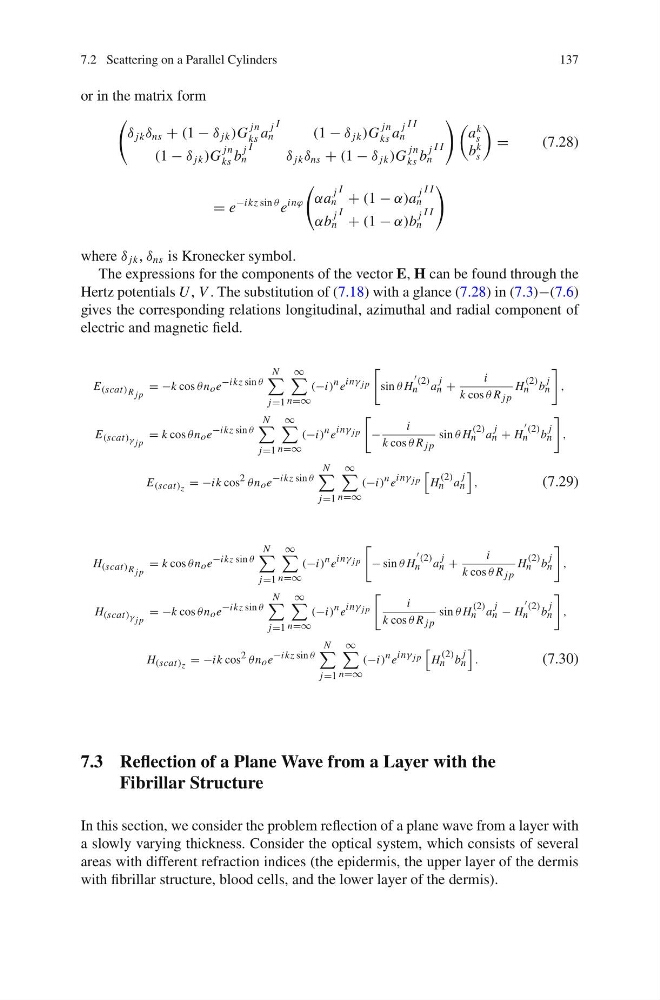
where δ jk , δ ns is Kronecker symbol.
The expressions for the components of the vector E, H can be found through the
Hertz potentials U , V . The substitution of (7.18) with a glance (7.28) in (7.3)−(7.6)
gives the corresponding relations longitudinal, azimuthal and radial component of
electric and magnetic field.
E (scat) R j p
= −k cos θ n o e −ikz sin θ
N
j=1
∞
n=∞
(−i) n e
inγ j p
sin θ H
(2)
n a
j
n +
i
k cos θ R j p
H
(2)
n b
j
n
,
E (scat) γ j p
= k cos θ n o e −ikz sin θ
N
j=1
∞
n=∞
(−i) n e
inγ j p
−
i
k cos θ R j p
sin θ H
(2)
n a
j
n + H
(2)
n b
j
n
,
E (scat) z = −ik cos 2 θ n o e −ikz sin θ
N
j=1
∞
n=∞
(−i) n e
inγ j p
H
(2)
n a
j
n
,
(7.29)
H (scat) R j p
= k cos θ n o e −ikz sin θ
N
j=1
∞
n=∞
(−i) n e
inγ j p
− sin θ H
(2)
n a
j
n +
i
k cos θ R j p
H
(2)
n b
j
n
,
H (scat) γ j p
= −k cos θ n o e −ikz sin θ
N
j=1
∞
n=∞
(−i) n e
inγ j p
i
k cos θ R j p
sin θ H
(2)
n a
j
n − H
(2)
n b
j
n
,
H (scat) z = −ik cos 2 θ n o e −ikz sin θ
N
j=1
∞
n=∞
(−i) n e
inγ j p
H
(2)
n b
j
n
.
(7.30)
7.3 Reflection of a Plane Wave from a Layer with the
Fibrillar Structure
In this section, we consider the problem reflection of a plane wave from a layer with
a slowly varying thickness. Consider the optical system, which consists of several
areas with different refraction indices (the epidermis, the upper layer of the dermis
with fibrillar structure, blood cells, and the lower layer of the dermis).
137
or in the matrix form
δ jk δ ns + (1 − δ jk )G
jn
ks a
j
n
I
(1 − δ jk )G
jn
ks a
j
n
I I
(1 − δ jk )G
jn
ks b
j
n
I
δ jk δ ns + (1 − δ jk )G
jn
ks b
j
n
I I
a
k
s
b
k
s
=
(7.28)
= e
−ikz sin θ e
inϕ
αa
j
n
I + (1 − α)a
j
n
I I
αb
j
n
I + (1 − α)b
j
n
I I
where δ jk , δ ns is Kronecker symbol.
The expressions for the components of the vector E, H can be found through the
Hertz potentials U , V . The substitution of (7.18) with a glance (7.28) in (7.3)−(7.6)
gives the corresponding relations longitudinal, azimuthal and radial component of
electric and magnetic field.
E (scat) R j p
= −k cos θ n o e −ikz sin θ
N
j=1
∞
n=∞
(−i) n e
inγ j p
sin θ H
(2)
n a
j
n +
i
k cos θ R j p
H
(2)
n b
j
n
,
E (scat) γ j p
= k cos θ n o e −ikz sin θ
N
j=1
∞
n=∞
(−i) n e
inγ j p
−
i
k cos θ R j p
sin θ H
(2)
n a
j
n + H
(2)
n b
j
n
,
E (scat) z = −ik cos 2 θ n o e −ikz sin θ
N
j=1
∞
n=∞
(−i) n e
inγ j p
H
(2)
n a
j
n
,
(7.29)
H (scat) R j p
= k cos θ n o e −ikz sin θ
N
j=1
∞
n=∞
(−i) n e
inγ j p
− sin θ H
(2)
n a
j
n +
i
k cos θ R j p
H
(2)
n b
j
n
,
H (scat) γ j p
= −k cos θ n o e −ikz sin θ
N
j=1
∞
n=∞
(−i) n e
inγ j p
i
k cos θ R j p
sin θ H
(2)
n a
j
n − H
(2)
n b
j
n
,
H (scat) z = −ik cos 2 θ n o e −ikz sin θ
N
j=1
∞
n=∞
(−i) n e
inγ j p
H
(2)
n b
j
n
.
(7.30)
7.3 Reflection of a Plane Wave from a Layer with the
Fibrillar Structure
In this section, we consider the problem reflection of a plane wave from a layer with
a slowly varying thickness. Consider the optical system, which consists of several
areas with different refraction indices (the epidermis, the upper layer of the dermis
with fibrillar structure, blood cells, and the lower layer of the dermis).