

136
7 Modeling of the Optical Characteristics Fibrillar Structure
V
k
scat (R kp ) = −e
−ikz sin θ
N
k = j
∞
s=−∞
∞
n=−∞
(−i)
s e
inγ jp e
in(s−n)γ kj H
2
s−n (kR jk cos θ n o )×
× J n (kR j p cos θ n o )b
k
s
(7.22)
or
U
j
scat (R kp )
V
j
scat (R kp )
= −e
−ikz sin θ
N
k = j
∞
s=−∞
∞
n=−∞
(−i)
s e
inγ jp G
jn
ks ×
× J n (kR j p cos θ n o )
a
k
s
b
k
s
(7.23)
where
G
jn
ks = e
in(s−n)γ kj H
2
s−n (kR jk cos θ n o ).
(7.24)
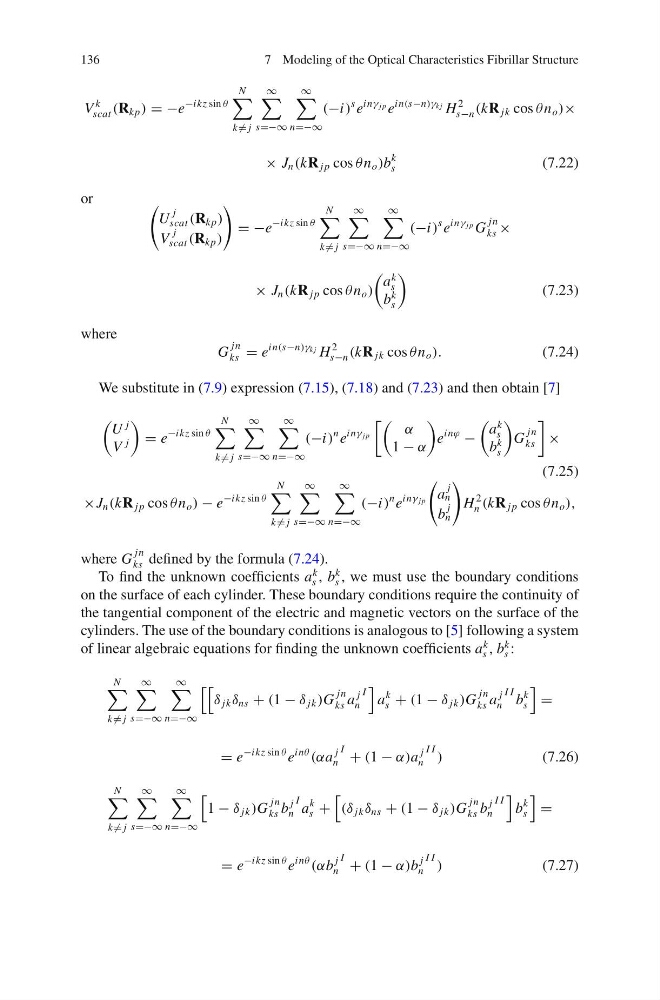
We substitute in (7.9) expression (7.15), (7.18) and (7.23) and then obtain [7]
U
j
V
j
= e
−ikz sin θ
N
k = j
∞
s=−∞
∞
n=−∞
(−i)
n e
inγ jp
α
1 − α
e
inϕ
−
a
k
s
b
k
s
G
jn
ks
×
(7.25)
×J n (kR j p cos θ n o ) − e
−ikz sin θ
N
k = j
∞
s=−∞
∞
n=−∞
(−i)
n e
inγ jp
a
j
n
b
j
n
H
2
n (kR j p cos θ n o ),
where G
jn
ks defined by the formula (7.24).
To find the unknown coefficients a
k
s , b
k
s , we must use the boundary conditions
on the surface of each cylinder. These boundary conditions require the continuity of
the tangential component of the electric and magnetic vectors on the surface of the
cylinders. The use of the boundary conditions is analogous to [5] following a system
of linear algebraic equations for finding the unknown coefficients a
k
s , b
k
s :
N
k = j
∞
s=−∞
∞
n=−∞
δ jk δ ns + (1 − δ jk )G
jn
ks a
j
n
I
a
k
s + (1 − δ jk )G
jn
ks a
j
n
I I b
k
s
=
= e
−ikz sin θ e
inθ
(αa
j
n
I + (1 − α)a
j
n
I I )
(7.26)
N
k = j
∞
s=−∞
∞
n=−∞
1 − δ jk )G
jn
ks b
j
n
I a
k
s +
(δ jk δ ns + (1 − δ jk )G
jn
ks b
j
n
I I
b
k
s
=
= e
−ikz sin θ e
inθ
(αb
j
n
I + (1 − α)b
j
n
I I )
(7.27)
7 Modeling of the Optical Characteristics Fibrillar Structure
V
k
scat (R kp ) = −e
−ikz sin θ
N
k = j
∞
s=−∞
∞
n=−∞
(−i)
s e
inγ jp e
in(s−n)γ kj H
2
s−n (kR jk cos θ n o )×
× J n (kR j p cos θ n o )b
k
s
(7.22)
or
U
j
scat (R kp )
V
j
scat (R kp )
= −e
−ikz sin θ
N
k = j
∞
s=−∞
∞
n=−∞
(−i)
s e
inγ jp G
jn
ks ×
× J n (kR j p cos θ n o )
a
k
s
b
k
s
(7.23)
where
G
jn
ks = e
in(s−n)γ kj H
2
s−n (kR jk cos θ n o ).
(7.24)
We substitute in (7.9) expression (7.15), (7.18) and (7.23) and then obtain [7]
U
j
V
j
= e
−ikz sin θ
N
k = j
∞
s=−∞
∞
n=−∞
(−i)
n e
inγ jp
α
1 − α
e
inϕ
−
a
k
s
b
k
s
G
jn
ks
×
(7.25)
×J n (kR j p cos θ n o ) − e
−ikz sin θ
N
k = j
∞
s=−∞
∞
n=−∞
(−i)
n e
inγ jp
a
j
n
b
j
n
H
2
n (kR j p cos θ n o ),
where G
jn
ks defined by the formula (7.24).
To find the unknown coefficients a
k
s , b
k
s , we must use the boundary conditions
on the surface of each cylinder. These boundary conditions require the continuity of
the tangential component of the electric and magnetic vectors on the surface of the
cylinders. The use of the boundary conditions is analogous to [5] following a system
of linear algebraic equations for finding the unknown coefficients a
k
s , b
k
s :
N
k = j
∞
s=−∞
∞
n=−∞
δ jk δ ns + (1 − δ jk )G
jn
ks a
j
n
I
a
k
s + (1 − δ jk )G
jn
ks a
j
n
I I b
k
s
=
= e
−ikz sin θ e
inθ
(αa
j
n
I + (1 − α)a
j
n
I I )
(7.26)
N
k = j
∞
s=−∞
∞
n=−∞
1 − δ jk )G
jn
ks b
j
n
I a
k
s +
(δ jk δ ns + (1 − δ jk )G
jn
ks b
j
n
I I
b
k
s
=
= e
−ikz sin θ e
inθ
(αb
j
n
I + (1 − α)b
j
n
I I )
(7.27)