

7.2 Scattering on a Parallel Cylinders
135
U
j
inc (R j p )
V
j
inc (R j p )
=
α
1 − α
e
−ikz sin θ
∞
n=∞
(−i)
n J n (kR j p cos θ n o )e
inϕ e
inγ jp , (7.15)
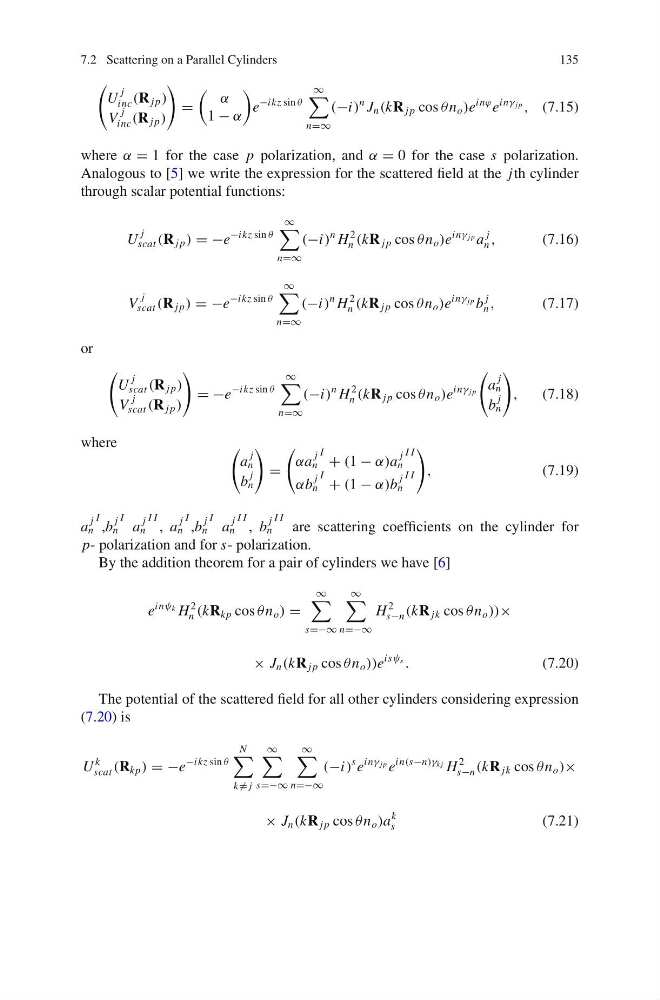
where α = 1 for the case p polarization, and α = 0 for the case s polarization.
Analogous to [5] we write the expression for the scattered field at the jth cylinder
through scalar potential functions:
U
j
scat (R j p ) = −e
−ikz sin θ
∞
n=∞
(−i)
n H
2
n (kR j p cos θ n o )e
inγ jp a
j
n ,
(7.16)
V
j
scat (R j p ) = −e
−ikz sin θ
∞
n=∞
(−i)
n H
2
n (kR j p cos θ n o )e
inγ jp b
j
n ,
(7.17)
or
U
j
scat (R j p )
V
j
scat (R j p )
= −e
−ikz sin θ
∞
n=∞
(−i)
n H
2
n (kR j p cos θ n o )e
inγ jp
a
j
n
b
j
n
,
(7.18)
where
a
j
n
b
j
n
=
αa
j
n
I + (1 − α)a
j
n
I I
αb
j
n
I + (1 − α)b
j
n
I I
,
(7.19)
a
j
n
I
,b
j
n
I
a
j
n
I I
, a
j
n
I
,b
j
n
I
a
j
n
I I
, b
j
n
I I
are scattering coefficients on the cylinder for
p- polarization and for s- polarization.
By the addition theorem for a pair of cylinders we have [6]
e
inψ k H
2
n (kR kp cos θ n o ) =
∞
s=−∞
∞
n=−∞
H
2
s−n (kR jk cos θ n o ))×
× J n (kR j p cos θ n o ))e
isψ s .
(7.20)
The potential of the scattered field for all other cylinders considering expression
(7.20) is
U
k
scat (R kp ) = −e
−ikz sin θ
N
k = j
∞
s=−∞
∞
n=−∞
(−i)
s e
inγ jp e
in(s−n)γ kj H
2
s−n (kR jk cos θ n o )×
× J n (kR j p cos θ n o )a
k
s
(7.21)
135
U
j
inc (R j p )
V
j
inc (R j p )
=
α
1 − α
e
−ikz sin θ
∞
n=∞
(−i)
n J n (kR j p cos θ n o )e
inϕ e
inγ jp , (7.15)
where α = 1 for the case p polarization, and α = 0 for the case s polarization.
Analogous to [5] we write the expression for the scattered field at the jth cylinder
through scalar potential functions:
U
j
scat (R j p ) = −e
−ikz sin θ
∞
n=∞
(−i)
n H
2
n (kR j p cos θ n o )e
inγ jp a
j
n ,
(7.16)
V
j
scat (R j p ) = −e
−ikz sin θ
∞
n=∞
(−i)
n H
2
n (kR j p cos θ n o )e
inγ jp b
j
n ,
(7.17)
or
U
j
scat (R j p )
V
j
scat (R j p )
= −e
−ikz sin θ
∞
n=∞
(−i)
n H
2
n (kR j p cos θ n o )e
inγ jp
a
j
n
b
j
n
,
(7.18)
where
a
j
n
b
j
n
=
αa
j
n
I + (1 − α)a
j
n
I I
αb
j
n
I + (1 − α)b
j
n
I I
,
(7.19)
a
j
n
I
,b
j
n
I
a
j
n
I I
, a
j
n
I
,b
j
n
I
a
j
n
I I
, b
j
n
I I
are scattering coefficients on the cylinder for
p- polarization and for s- polarization.
By the addition theorem for a pair of cylinders we have [6]
e
inψ k H
2
n (kR kp cos θ n o ) =
∞
s=−∞
∞
n=−∞
H
2
s−n (kR jk cos θ n o ))×
× J n (kR j p cos θ n o ))e
isψ s .
(7.20)
The potential of the scattered field for all other cylinders considering expression
(7.20) is
U
k
scat (R kp ) = −e
−ikz sin θ
N
k = j
∞
s=−∞
∞
n=−∞
(−i)
s e
inγ jp e
in(s−n)γ kj H
2
s−n (kR jk cos θ n o )×
× J n (kR j p cos θ n o )a
k
s
(7.21)