

6.4 Matrix Formulation of Scattering for the jth Bilayer Particle of an Arbitrary Shape
121
a
j
b
j
= T
j
2
⎡
⎣
p
j 0 , j
q
j 0 , j
+
l = j
A(l, j) B(l, j)
B(l, j) A(l, j)
a
j
b
j
⎤
⎦ ,
(6.72)
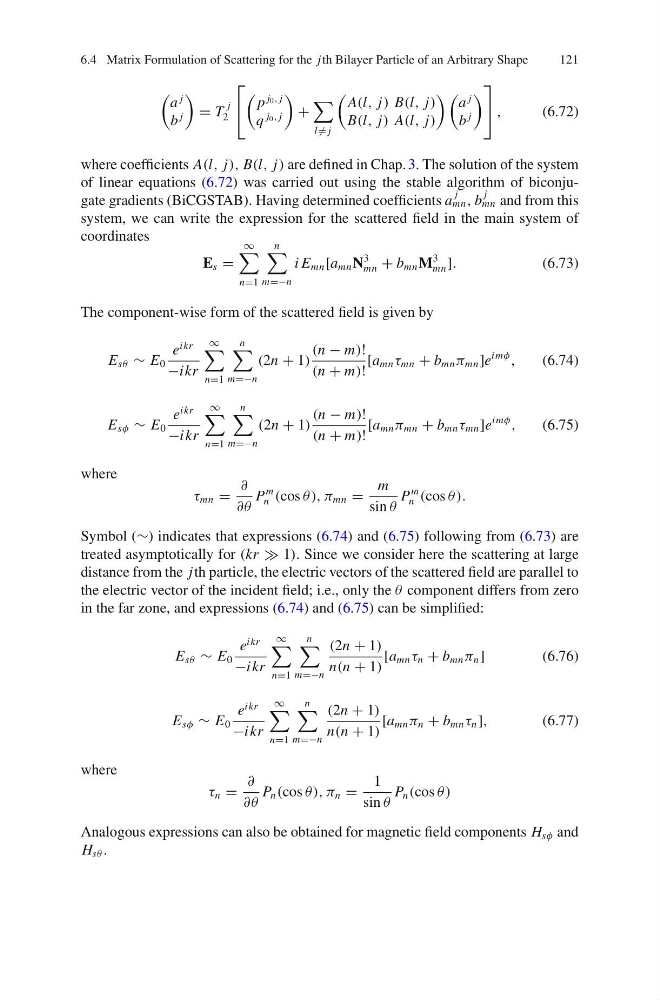
where coefficients A(l, j), B(l, j) are defined in Chap. 3. The solution of the system
of linear equations (6.72) was carried out using the stable algorithm of biconjugate gradients (BiCGSTAB). Having determined coefficients a
j
mn , b
j
mn and from this
system, we can write the expression for the scattered field in the main system of
coordinates
E s =
∞
n=1
n
m=−n
i E mn [a mn N
3
mn + b mn M
3
mn ].
(6.73)
The component-wise form of the scattered field is given by
E sθ ∼ E 0
e
ikr
−ikr
∞
n=1
n
m=−n
(2n + 1)
(n − m)!
(n + m)!
[a mn τ mn + b mn π mn ]e
imφ
,
(6.74)
E sφ ∼ E 0
e
ikr
−ikr
∞
n=1
n
m=−n
(2n + 1)
(n − m)!
(n + m)!
[a mn π mn + b mn τ mn ]e
imφ
,
(6.75)
where
τ mn =
∂
∂θ
P
m
n (cos θ), π mn =
m
sin θ
P
m
n (cos θ).
Symbol (∼) indicates that expressions (6.74) and (6.75) following from (6.73) are
treated asymptotically for (kr 1). Since we consider here the scattering at large
distance from the jth particle, the electric vectors of the scattered field are parallel to
the electric vector of the incident field; i.e., only the θ component differs from zero
in the far zone, and expressions (6.74) and (6.75) can be simplified:
E sθ ∼ E 0
e
ikr
−ikr
∞
n=1
n
m=−n
(2n + 1)
n(n + 1)
[a mn τ n + b mn π n ]
(6.76)
E sφ ∼ E 0
e
ikr
−ikr
∞
n=1
n
m=−n
(2n + 1)
n(n + 1)
[a mn π n + b mn τ n ],
(6.77)
where
τ n =
∂
∂θ
P n (cos θ), π n =
1
sin θ
P n (cos θ)
Analogous expressions can also be obtained for magnetic field components H sφ and
H sθ .
121
a
j
b
j
= T
j
2
⎡
⎣
p
j 0 , j
q
j 0 , j
+
l = j
A(l, j) B(l, j)
B(l, j) A(l, j)
a
j
b
j
⎤
⎦ ,
(6.72)
where coefficients A(l, j), B(l, j) are defined in Chap. 3. The solution of the system
of linear equations (6.72) was carried out using the stable algorithm of biconjugate gradients (BiCGSTAB). Having determined coefficients a
j
mn , b
j
mn and from this
system, we can write the expression for the scattered field in the main system of
coordinates
E s =
∞
n=1
n
m=−n
i E mn [a mn N
3
mn + b mn M
3
mn ].
(6.73)
The component-wise form of the scattered field is given by
E sθ ∼ E 0
e
ikr
−ikr
∞
n=1
n
m=−n
(2n + 1)
(n − m)!
(n + m)!
[a mn τ mn + b mn π mn ]e
imφ
,
(6.74)
E sφ ∼ E 0
e
ikr
−ikr
∞
n=1
n
m=−n
(2n + 1)
(n − m)!
(n + m)!
[a mn π mn + b mn τ mn ]e
imφ
,
(6.75)
where
τ mn =
∂
∂θ
P
m
n (cos θ), π mn =
m
sin θ
P
m
n (cos θ).
Symbol (∼) indicates that expressions (6.74) and (6.75) following from (6.73) are
treated asymptotically for (kr 1). Since we consider here the scattering at large
distance from the jth particle, the electric vectors of the scattered field are parallel to
the electric vector of the incident field; i.e., only the θ component differs from zero
in the far zone, and expressions (6.74) and (6.75) can be simplified:
E sθ ∼ E 0
e
ikr
−ikr
∞
n=1
n
m=−n
(2n + 1)
n(n + 1)
[a mn τ n + b mn π n ]
(6.76)
E sφ ∼ E 0
e
ikr
−ikr
∞
n=1
n
m=−n
(2n + 1)
n(n + 1)
[a mn π n + b mn τ n ],
(6.77)
where
τ n =
∂
∂θ
P n (cos θ), π n =
1
sin θ
P n (cos θ)
Analogous expressions can also be obtained for magnetic field components H sφ and
H sθ .