

122
6 Light Scattering by Dielectric Bodies of Irregular …
6.5 Reflection of a Plane Wave from a Layer
with a Slowly Varying Thickness
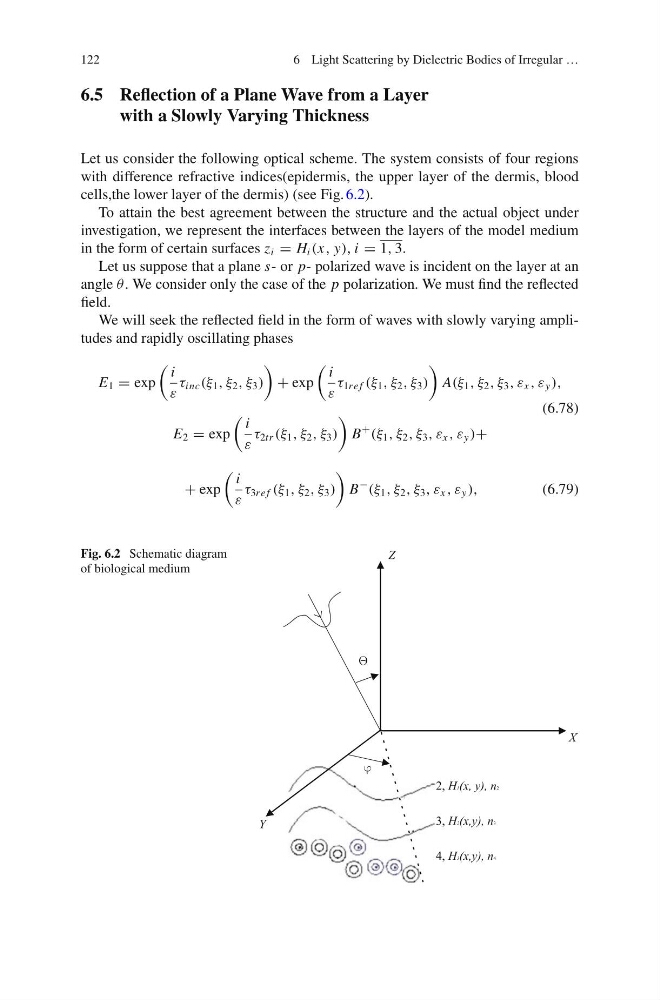
Let us consider the following optical scheme. The system consists of four regions
with difference refractive indices(epidermis, the upper layer of the dermis, blood
cells,the lower layer of the dermis) (see Fig. 6.2).
To attain the best agreement between the structure and the actual object under
investigation, we represent the interfaces between the layers of the model medium
in the form of certain surfaces z i = H i (x, y), i = 1, 3.
Let us suppose that a plane s- or p- polarized wave is incident on the layer at an
angle θ . We consider only the case of the p polarization. We must find the reflected
field.
We will seek the reflected field in the form of waves with slowly varying amplitudes and rapidly oscillating phases
E 1 = exp
i
ε
τ inc (ξ 1 , ξ 2 , ξ 3 )
+ exp
i
ε
τ 1re f (ξ 1 , ξ 2 , ξ 3 )
A(ξ 1 , ξ 2 , ξ 3 , ε x , ε y ),
(6.78)
E 2 = exp
i
ε
τ 2tr (ξ 1 , ξ 2 , ξ 3 )
B
+
(ξ 1 , ξ 2 , ξ 3 , ε x , ε y )+
+ exp
i
ε
τ 3re f (ξ 1 , ξ 2 , ξ 3 )
B
−
(ξ 1 , ξ 2 , ξ 3 , ε x , ε y ),
(6.79)
Fig. 6.2 Schematic diagram
of biological medium
Z
X
Y
2, H (
1
2
3
4
3,
4,
2
3
6 Light Scattering by Dielectric Bodies of Irregular …
6.5 Reflection of a Plane Wave from a Layer
with a Slowly Varying Thickness
Let us consider the following optical scheme. The system consists of four regions
with difference refractive indices(epidermis, the upper layer of the dermis, blood
cells,the lower layer of the dermis) (see Fig. 6.2).
To attain the best agreement between the structure and the actual object under
investigation, we represent the interfaces between the layers of the model medium
in the form of certain surfaces z i = H i (x, y), i = 1, 3.
Let us suppose that a plane s- or p- polarized wave is incident on the layer at an
angle θ . We consider only the case of the p polarization. We must find the reflected
field.
We will seek the reflected field in the form of waves with slowly varying amplitudes and rapidly oscillating phases
E 1 = exp
i
ε
τ inc (ξ 1 , ξ 2 , ξ 3 )
+ exp
i
ε
τ 1re f (ξ 1 , ξ 2 , ξ 3 )
A(ξ 1 , ξ 2 , ξ 3 , ε x , ε y ),
(6.78)
E 2 = exp
i
ε
τ 2tr (ξ 1 , ξ 2 , ξ 3 )
B
+
(ξ 1 , ξ 2 , ξ 3 , ε x , ε y )+
+ exp
i
ε
τ 3re f (ξ 1 , ξ 2 , ξ 3 )
B
−
(ξ 1 , ξ 2 , ξ 3 , ε x , ε y ),
(6.79)
Fig. 6.2 Schematic diagram
of biological medium
Z
X
Y
2, H (
1
2
3
4
3,
4,
2
3