

120
6 Light Scattering by Dielectric Bodies of Irregular …
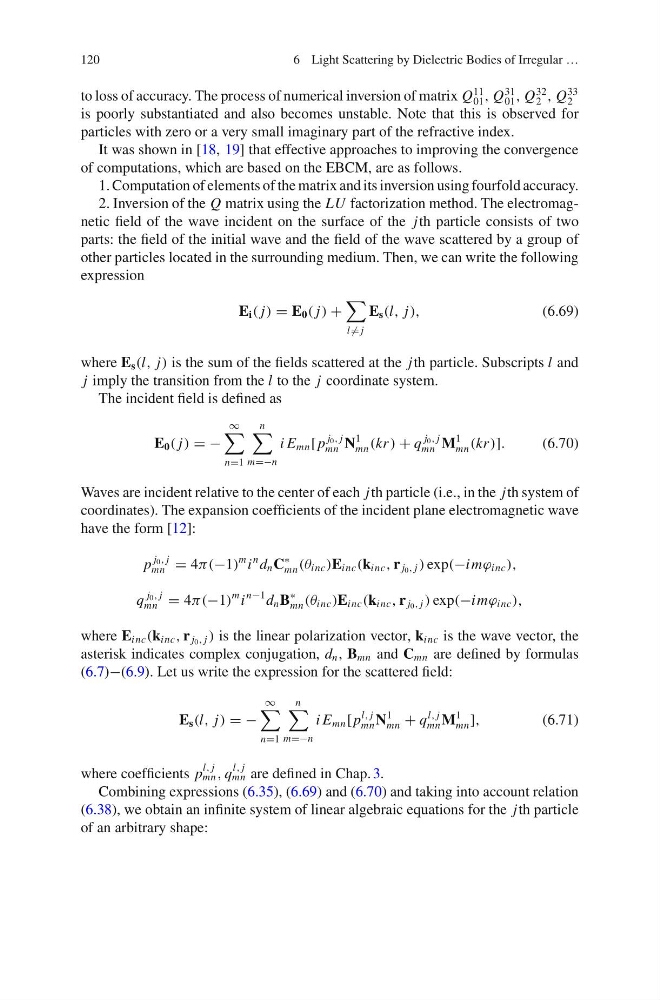
to loss of accuracy. The process of numerical inversion of matrix Q
11
01 , Q
31
01 , Q
32
2 , Q
33
2
is poorly substantiated and also becomes unstable. Note that this is observed for
particles with zero or a very small imaginary part of the refractive index.
It was shown in [18, 19] that effective approaches to improving the convergence
of computations, which are based on the EBCM, are as follows.
1. Computation of elements of the matrix and its inversion using fourfold accuracy.
2. Inversion of the Q matrix using the LU factorization method. The electromagnetic field of the wave incident on the surface of the jth particle consists of two
parts: the field of the initial wave and the field of the wave scattered by a group of
other particles located in the surrounding medium. Then, we can write the following
expression
E i ( j) = E 0 ( j) +
l = j
E s (l, j),
(6.69)
where E s (l, j) is the sum of the fields scattered at the jth particle. Subscripts l and
j imply the transition from the l to the j coordinate system.
The incident field is defined as
E 0 ( j) = −
∞
n=1
n
m=−n
i E mn [ p
j 0 , j
mn N
1
mn (kr) + q
j 0 , j
mn M
1
mn (kr)].
(6.70)
Waves are incident relative to the center of each jth particle (i.e., in the jth system of
coordinates). The expansion coefficients of the incident plane electromagnetic wave
have the form [12]:
p
j 0 , j
mn = 4π(−1)
m i
n d n C
∗
mn (θ inc )E inc (k inc , r j 0 , j ) exp(−imϕ inc ),
q
j 0 , j
mn = 4π(−1)
m i
n−1 d n B
∗
mn (θ inc )E inc (k inc , r j 0 , j ) exp(−imϕ inc ),
where E inc (k inc , r j 0 , j ) is the linear polarization vector, k inc is the wave vector, the
asterisk indicates complex conjugation, d n , B mn and C mn are defined by formulas
(6.7)−(6.9). Let us write the expression for the scattered field:
E s (l, j) = −
∞
n=1
n
m=−n
i E mn [ p
l, j
mn N
1
mn + q
l, j
mn M
1
mn ],
(6.71)
where coefficients p
l, j
mn , q
l, j
mn are defined in Chap. 3.
Combining expressions (6.35), (6.69) and (6.70) and taking into account relation
(6.38), we obtain an infinite system of linear algebraic equations for the jth particle
of an arbitrary shape:
6 Light Scattering by Dielectric Bodies of Irregular …
to loss of accuracy. The process of numerical inversion of matrix Q
11
01 , Q
31
01 , Q
32
2 , Q
33
2
is poorly substantiated and also becomes unstable. Note that this is observed for
particles with zero or a very small imaginary part of the refractive index.
It was shown in [18, 19] that effective approaches to improving the convergence
of computations, which are based on the EBCM, are as follows.
1. Computation of elements of the matrix and its inversion using fourfold accuracy.
2. Inversion of the Q matrix using the LU factorization method. The electromagnetic field of the wave incident on the surface of the jth particle consists of two
parts: the field of the initial wave and the field of the wave scattered by a group of
other particles located in the surrounding medium. Then, we can write the following
expression
E i ( j) = E 0 ( j) +
l = j
E s (l, j),
(6.69)
where E s (l, j) is the sum of the fields scattered at the jth particle. Subscripts l and
j imply the transition from the l to the j coordinate system.
The incident field is defined as
E 0 ( j) = −
∞
n=1
n
m=−n
i E mn [ p
j 0 , j
mn N
1
mn (kr) + q
j 0 , j
mn M
1
mn (kr)].
(6.70)
Waves are incident relative to the center of each jth particle (i.e., in the jth system of
coordinates). The expansion coefficients of the incident plane electromagnetic wave
have the form [12]:
p
j 0 , j
mn = 4π(−1)
m i
n d n C
∗
mn (θ inc )E inc (k inc , r j 0 , j ) exp(−imϕ inc ),
q
j 0 , j
mn = 4π(−1)
m i
n−1 d n B
∗
mn (θ inc )E inc (k inc , r j 0 , j ) exp(−imϕ inc ),
where E inc (k inc , r j 0 , j ) is the linear polarization vector, k inc is the wave vector, the
asterisk indicates complex conjugation, d n , B mn and C mn are defined by formulas
(6.7)−(6.9). Let us write the expression for the scattered field:
E s (l, j) = −
∞
n=1
n
m=−n
i E mn [ p
l, j
mn N
1
mn + q
l, j
mn M
1
mn ],
(6.71)
where coefficients p
l, j
mn , q
l, j
mn are defined in Chap. 3.
Combining expressions (6.35), (6.69) and (6.70) and taking into account relation
(6.38), we obtain an infinite system of linear algebraic equations for the jth particle
of an arbitrary shape: