

6.4 Matrix Formulation of Scattering for the jth Bilayer …
119
D
n 1
m 1 m
1
(αβγ )D
n 2
m 2 m
2
(αβγ ) =
n 1 +n 2
n 3 =|n 1 −n 2 |
C
n 3 m 1 +m 2
n 1 m 1 n 2 m 2
D
n 3
m 1 +m 2 m
1 +m
2
(αβγ )C
n 3 m
1 +m
2
n 1 m
1 n 2 m
2
.
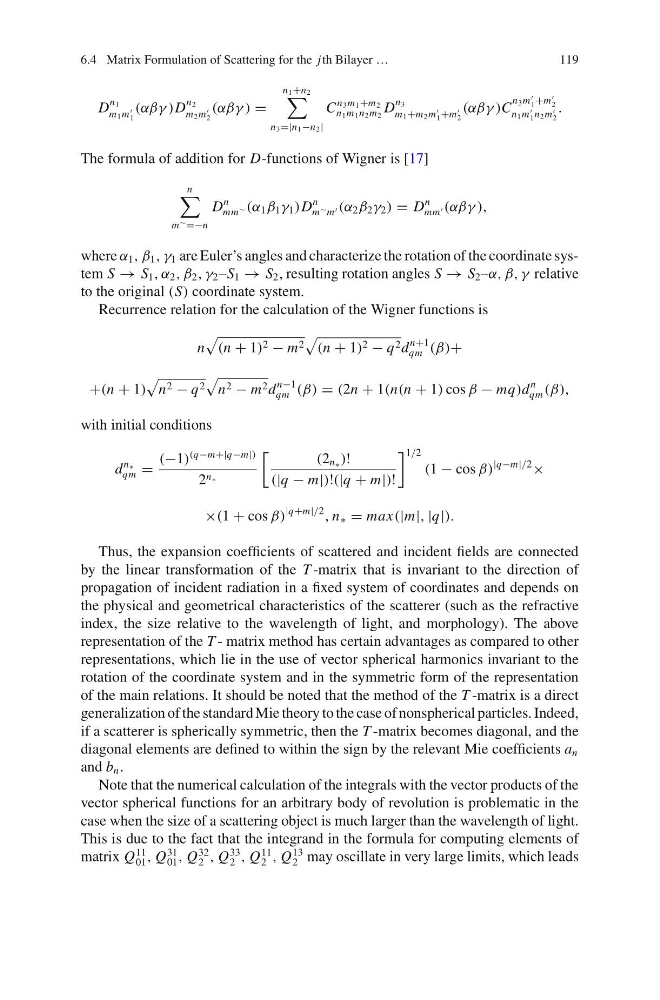
The formula of addition for D-functions of Wigner is [17]
n
m ∼ =−n
D
n
mm ∼ (α 1 β 1 γ 1 )D
n
m ∼ m (α 2 β 2 γ 2 ) = D
n
mm (αβγ ),
where α 1 , β 1 , γ 1 are Euler’s angles and characterize the rotation of the coordinate system S → S 1 , α 2 , β 2 , γ 2 –S 1 → S 2 , resulting rotation angles S → S 2 –α, β, γ relative
to the original (S) coordinate system.
Recurrence relation for the calculation of the Wigner functions is
n
(n + 1) 2 − m 2
(n + 1) 2 − q 2 d
n+1
qm (β)+
+(n + 1)
n 2 − q 2
n 2 − m 2 d
n−1
qm (β) = (2n + 1(n(n + 1) cos β − mq)d
n
qm (β),
with initial conditions
d
n ∗
qm =
(−1)
(q−m+|q−m|)
2 n ∗
(2 n ∗ )!
(|q − m|)!(|q + m|)!
1/2
(1 − cos β)
|q−m|/2
×
×(1 + cos β)
|q+m|/2
, n ∗ = max(|m|, |q|).
Thus, the expansion coefficients of scattered and incident fields are connected
by the linear transformation of the T -matrix that is invariant to the direction of
propagation of incident radiation in a fixed system of coordinates and depends on
the physical and geometrical characteristics of the scatterer (such as the refractive
index, the size relative to the wavelength of light, and morphology). The above
representation of the T - matrix method has certain advantages as compared to other
representations, which lie in the use of vector spherical harmonics invariant to the
rotation of the coordinate system and in the symmetric form of the representation
of the main relations. It should be noted that the method of the T -matrix is a direct
generalization of the standard Mie theory to the case of nonspherical particles. Indeed,
if a scatterer is spherically symmetric, then the T -matrix becomes diagonal, and the
diagonal elements are defined to within the sign by the relevant Mie coefficients a n
and b n .
Note that the numerical calculation of the integrals with the vector products of the
vector spherical functions for an arbitrary body of revolution is problematic in the
case when the size of a scattering object is much larger than the wavelength of light.
This is due to the fact that the integrand in the formula for computing elements of
matrix Q
11
01 , Q
31
01 , Q
32
2 , Q
33
2 , Q
11
2 , Q
13
2 may oscillate in very large limits, which leads
119
D
n 1
m 1 m
1
(αβγ )D
n 2
m 2 m
2
(αβγ ) =
n 1 +n 2
n 3 =|n 1 −n 2 |
C
n 3 m 1 +m 2
n 1 m 1 n 2 m 2
D
n 3
m 1 +m 2 m
1 +m
2
(αβγ )C
n 3 m
1 +m
2
n 1 m
1 n 2 m
2
.
The formula of addition for D-functions of Wigner is [17]
n
m ∼ =−n
D
n
mm ∼ (α 1 β 1 γ 1 )D
n
m ∼ m (α 2 β 2 γ 2 ) = D
n
mm (αβγ ),
where α 1 , β 1 , γ 1 are Euler’s angles and characterize the rotation of the coordinate system S → S 1 , α 2 , β 2 , γ 2 –S 1 → S 2 , resulting rotation angles S → S 2 –α, β, γ relative
to the original (S) coordinate system.
Recurrence relation for the calculation of the Wigner functions is
n
(n + 1) 2 − m 2
(n + 1) 2 − q 2 d
n+1
qm (β)+
+(n + 1)
n 2 − q 2
n 2 − m 2 d
n−1
qm (β) = (2n + 1(n(n + 1) cos β − mq)d
n
qm (β),
with initial conditions
d
n ∗
qm =
(−1)
(q−m+|q−m|)
2 n ∗
(2 n ∗ )!
(|q − m|)!(|q + m|)!
1/2
(1 − cos β)
|q−m|/2
×
×(1 + cos β)
|q+m|/2
, n ∗ = max(|m|, |q|).
Thus, the expansion coefficients of scattered and incident fields are connected
by the linear transformation of the T -matrix that is invariant to the direction of
propagation of incident radiation in a fixed system of coordinates and depends on
the physical and geometrical characteristics of the scatterer (such as the refractive
index, the size relative to the wavelength of light, and morphology). The above
representation of the T - matrix method has certain advantages as compared to other
representations, which lie in the use of vector spherical harmonics invariant to the
rotation of the coordinate system and in the symmetric form of the representation
of the main relations. It should be noted that the method of the T -matrix is a direct
generalization of the standard Mie theory to the case of nonspherical particles. Indeed,
if a scatterer is spherically symmetric, then the T -matrix becomes diagonal, and the
diagonal elements are defined to within the sign by the relevant Mie coefficients a n
and b n .
Note that the numerical calculation of the integrals with the vector products of the
vector spherical functions for an arbitrary body of revolution is problematic in the
case when the size of a scattering object is much larger than the wavelength of light.
This is due to the fact that the integrand in the formula for computing elements of
matrix Q
11
01 , Q
31
01 , Q
32
2 , Q
33
2 , Q
11
2 , Q
13
2 may oscillate in very large limits, which leads