

96
5 Study of the Optical Characteristics of a Biotissue …
× exp
c 2 i K 2
N −1
n=0
q
n
M
m=1
u nm b 2 y sin
2π m
M 2
+ q y y
exp
i
N −1
n=0
M
m=1
u nm ϕ nm
.
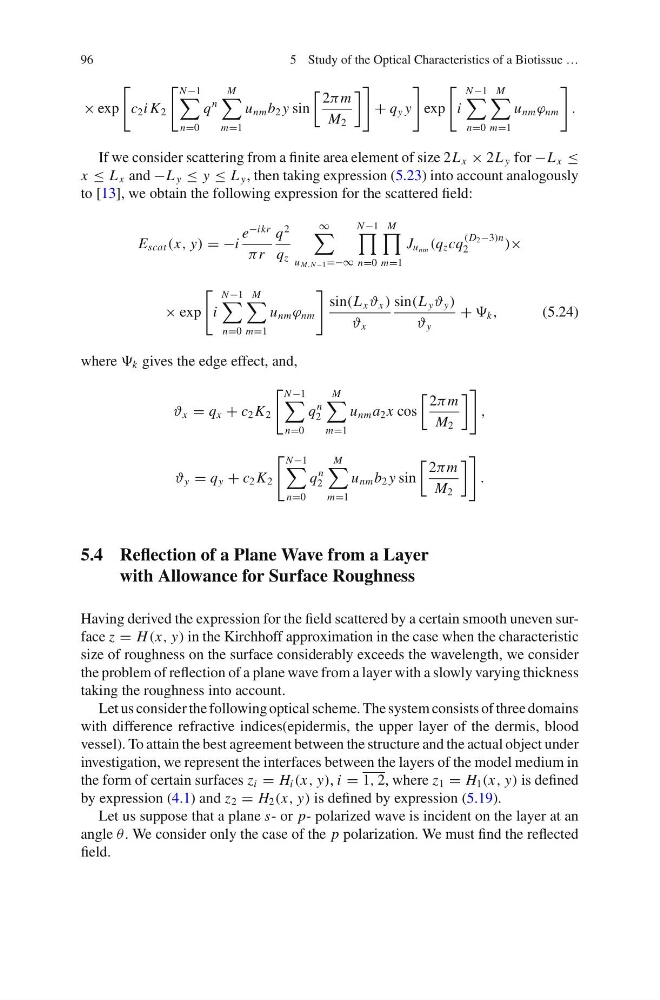
If we consider scattering from a finite area element of size 2L x × 2L y for −L x ≤
x ≤ L x and −L y ≤ y ≤ L y , then taking expression (5.23) into account analogously
to [13], we obtain the following expression for the scattered field:
E scat (x, y) = −i
e
−ikr
πr
q
2
q z
∞
u M,N −1 =−∞
N −1
n=0
M
m=1
J u nm (q z cq
(D 2 −3)n
2
)×
× exp
i
N −1
n=0
M
m=1
u nm ϕ nm
sin(L x ϑ x )
ϑ x
sin(L y ϑ y )
ϑ y
+ k ,
(5.24)
where k gives the edge effect, and,
ϑ x = q x + c 2 K 2
N −1
n=0
q
n
2
M
m=1
u nm a 2 x cos
2π m
M 2
,
ϑ y = q y + c 2 K 2
N −1
n=0
q
n
2
M
m=1
u nm b 2 y sin
2π m
M 2
.
5.4 Reflection of a Plane Wave from a Layer
with Allowance for Surface Roughness
Having derived the expression for the field scattered by a certain smooth uneven surface z = H (x, y) in the Kirchhoff approximation in the case when the characteristic
size of roughness on the surface considerably exceeds the wavelength, we consider
the problem of reflection of a plane wave from a layer with a slowly varying thickness
taking the roughness into account.
Let us consider the following optical scheme. The system consists of three domains
with difference refractive indices(epidermis, the upper layer of the dermis, blood
vessel). To attain the best agreement between the structure and the actual object under
investigation, we represent the interfaces between the layers of the model medium in
the form of certain surfaces z i = H i (x, y), i = 1, 2, where z 1 = H 1 (x, y) is defined
by expression (4.1) and z 2 = H 2 (x, y) is defined by expression (5.19).
Let us suppose that a plane s- or p- polarized wave is incident on the layer at an
angle θ . We consider only the case of the p polarization. We must find the reflected
field.
5 Study of the Optical Characteristics of a Biotissue …
× exp
c 2 i K 2
N −1
n=0
q
n
M
m=1
u nm b 2 y sin
2π m
M 2
+ q y y
exp
i
N −1
n=0
M
m=1
u nm ϕ nm
.
If we consider scattering from a finite area element of size 2L x × 2L y for −L x ≤
x ≤ L x and −L y ≤ y ≤ L y , then taking expression (5.23) into account analogously
to [13], we obtain the following expression for the scattered field:
E scat (x, y) = −i
e
−ikr
πr
q
2
q z
∞
u M,N −1 =−∞
N −1
n=0
M
m=1
J u nm (q z cq
(D 2 −3)n
2
)×
× exp
i
N −1
n=0
M
m=1
u nm ϕ nm
sin(L x ϑ x )
ϑ x
sin(L y ϑ y )
ϑ y
+ k ,
(5.24)
where k gives the edge effect, and,
ϑ x = q x + c 2 K 2
N −1
n=0
q
n
2
M
m=1
u nm a 2 x cos
2π m
M 2
,
ϑ y = q y + c 2 K 2
N −1
n=0
q
n
2
M
m=1
u nm b 2 y sin
2π m
M 2
.
5.4 Reflection of a Plane Wave from a Layer
with Allowance for Surface Roughness
Having derived the expression for the field scattered by a certain smooth uneven surface z = H (x, y) in the Kirchhoff approximation in the case when the characteristic
size of roughness on the surface considerably exceeds the wavelength, we consider
the problem of reflection of a plane wave from a layer with a slowly varying thickness
taking the roughness into account.
Let us consider the following optical scheme. The system consists of three domains
with difference refractive indices(epidermis, the upper layer of the dermis, blood
vessel). To attain the best agreement between the structure and the actual object under
investigation, we represent the interfaces between the layers of the model medium in
the form of certain surfaces z i = H i (x, y), i = 1, 2, where z 1 = H 1 (x, y) is defined
by expression (4.1) and z 2 = H 2 (x, y) is defined by expression (5.19).
Let us suppose that a plane s- or p- polarized wave is incident on the layer at an
angle θ . We consider only the case of the p polarization. We must find the reflected
field.