

5.3 The Scattered Field on the Fractal Surface
95
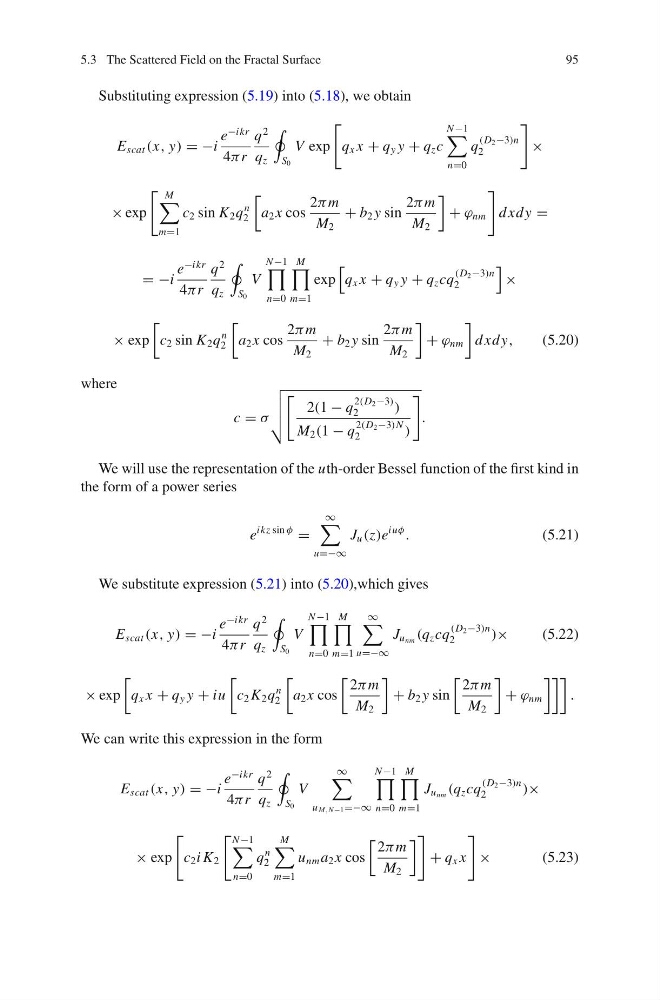
Substituting expression (5.19) into (5.18), we obtain
E scat (x, y) = −i
e
−ikr
4πr
q
2
q z
S 0
V exp
q x x + q y y + q z c
N −1
n=0
q
(D 2 −3)n
2
×
× exp
M
m=1
c 2 sin K 2 q
n
2
a 2 x cos
2π m
M 2
+ b 2 y sin
2π m
M 2
+ ϕ nm
dxdy =
= −i
e
−ikr
4πr
q
2
q z
S 0
V
N −1
n=0
M
m=1
exp
q x x + q y y + q z cq
(D 2 −3)n
2
×
× exp
c 2 sin K 2 q
n
2
a 2 x cos
2π m
M 2
+ b 2 y sin
2π m
M 2
+ ϕ nm
dxdy,
(5.20)
where
c = σ
2(1 − q
2(D 2 −3)
2
)
M 2 (1 − q
2(D 2 −3)N
2
)
.
We will use the representation of the uth-order Bessel function of the first kind in
the form of a power series
e
ikz sin φ
=
∞
u=−∞
J u (z)e
iuφ
.
(5.21)
We substitute expression (5.21) into (5.20),which gives
E scat (x, y) = −i
e
−ikr
4πr
q
2
q z
S 0
V
N −1
n=0
M
m=1
∞
u=−∞
J u nm (q z cq
(D 2 −3)n
2
)×
(5.22)
× exp
q x x + q y y + iu
c 2 K 2 q
n
2
a 2 x cos
2π m
M 2
+ b 2 y sin
2π m
M 2
+ ϕ nm
.
We can write this expression in the form
E scat (x, y) = −i
e
−ikr
4πr
q
2
q z
S 0
V
∞
u M,N −1 =−∞
N −1
n=0
M
m=1
J u nm (q z cq
(D 2 −3)n
2
)×
× exp
c 2 i K 2
N −1
n=0
q
n
2
M
m=1
u nm a 2 x cos
2π m
M 2
+ q x x
×
(5.23)
95
Substituting expression (5.19) into (5.18), we obtain
E scat (x, y) = −i
e
−ikr
4πr
q
2
q z
S 0
V exp
q x x + q y y + q z c
N −1
n=0
q
(D 2 −3)n
2
×
× exp
M
m=1
c 2 sin K 2 q
n
2
a 2 x cos
2π m
M 2
+ b 2 y sin
2π m
M 2
+ ϕ nm
dxdy =
= −i
e
−ikr
4πr
q
2
q z
S 0
V
N −1
n=0
M
m=1
exp
q x x + q y y + q z cq
(D 2 −3)n
2
×
× exp
c 2 sin K 2 q
n
2
a 2 x cos
2π m
M 2
+ b 2 y sin
2π m
M 2
+ ϕ nm
dxdy,
(5.20)
where
c = σ
2(1 − q
2(D 2 −3)
2
)
M 2 (1 − q
2(D 2 −3)N
2
)
.
We will use the representation of the uth-order Bessel function of the first kind in
the form of a power series
e
ikz sin φ
=
∞
u=−∞
J u (z)e
iuφ
.
(5.21)
We substitute expression (5.21) into (5.20),which gives
E scat (x, y) = −i
e
−ikr
4πr
q
2
q z
S 0
V
N −1
n=0
M
m=1
∞
u=−∞
J u nm (q z cq
(D 2 −3)n
2
)×
(5.22)
× exp
q x x + q y y + iu
c 2 K 2 q
n
2
a 2 x cos
2π m
M 2
+ b 2 y sin
2π m
M 2
+ ϕ nm
.
We can write this expression in the form
E scat (x, y) = −i
e
−ikr
4πr
q
2
q z
S 0
V
∞
u M,N −1 =−∞
N −1
n=0
M
m=1
J u nm (q z cq
(D 2 −3)n
2
)×
× exp
c 2 i K 2
N −1
n=0
q
n
2
M
m=1
u nm a 2 x cos
2π m
M 2
+ q x x
×
(5.23)