

94
5 Study of the Optical Characteristics of a Biotissue …
5.3 The Scattered Field on the Fractal Surface
It should be noted that many biological tissues (in particular, dermis) exhibit optical
inhomogeneity [10, 11]; in this case, the surface of the outer dermis of the biological structure being modeled can be described by the following 2D range-limited
Weierstrass function:
H 2 (x, y) = σ
2(1 − q
2(D 2 −3)
2
)
M 2 (1 − q
2(D 2 −3)N
2
)
×
(5.19)
×
N −1
n=0
q
(D 2 −3)n
2
M
m=1
c 2 sin
K 2 q
n
2
a 2 x cos
2π m
M 2
+ b 2 y sin
2π m
M 2
+ ϕ nm
,
where a 2 , b 2 , c 2 are arbitrary constants obeying the conditions a 2 1, b 2 1,
c 2 1.
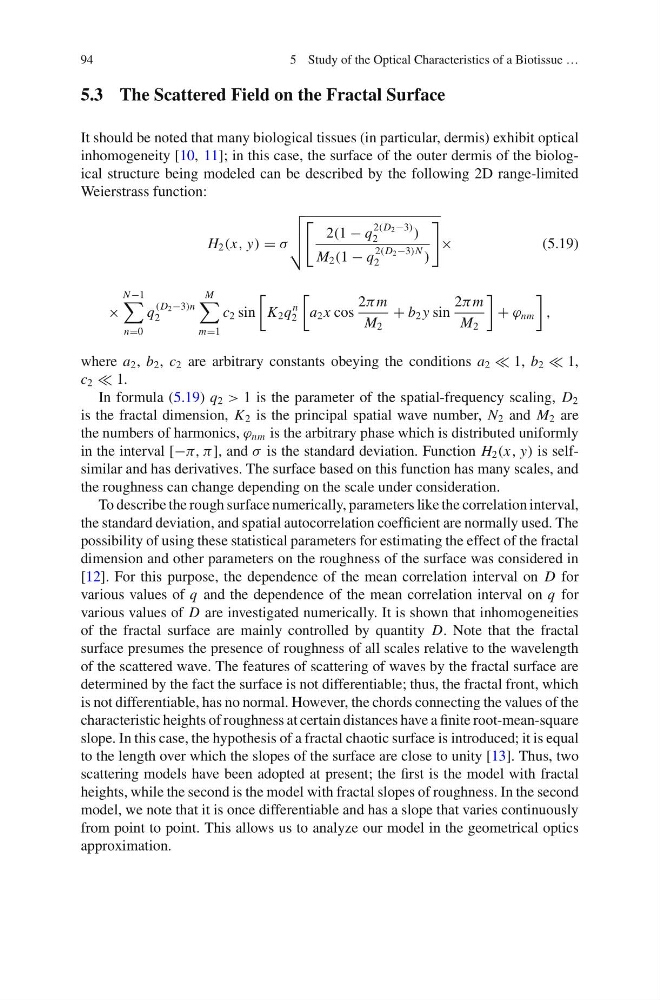
In formula (5.19) q 2 > 1 is the parameter of the spatial-frequency scaling, D 2
is the fractal dimension, K 2 is the principal spatial wave number, N 2 and M 2 are
the numbers of harmonics, ϕ nm is the arbitrary phase which is distributed uniformly
in the interval [−π, π], and σ is the standard deviation. Function H 2 (x, y) is selfsimilar and has derivatives. The surface based on this function has many scales, and
the roughness can change depending on the scale under consideration.
To describe the rough surface numerically, parameters like the correlation interval,
the standard deviation, and spatial autocorrelation coefficient are normally used. The
possibility of using these statistical parameters for estimating the effect of the fractal
dimension and other parameters on the roughness of the surface was considered in
[12]. For this purpose, the dependence of the mean correlation interval on D for
various values of q and the dependence of the mean correlation interval on q for
various values of D are investigated numerically. It is shown that inhomogeneities
of the fractal surface are mainly controlled by quantity D. Note that the fractal
surface presumes the presence of roughness of all scales relative to the wavelength
of the scattered wave. The features of scattering of waves by the fractal surface are
determined by the fact the surface is not differentiable; thus, the fractal front, which
is not differentiable, has no normal. However, the chords connecting the values of the
characteristic heights of roughness at certain distances have a finite root-mean-square
slope. In this case, the hypothesis of a fractal chaotic surface is introduced; it is equal
to the length over which the slopes of the surface are close to unity [13]. Thus, two
scattering models have been adopted at present; the first is the model with fractal
heights, while the second is the model with fractal slopes of roughness. In the second
model, we note that it is once differentiable and has a slope that varies continuously
from point to point. This allows us to analyze our model in the geometrical optics
approximation.
5 Study of the Optical Characteristics of a Biotissue …
5.3 The Scattered Field on the Fractal Surface
It should be noted that many biological tissues (in particular, dermis) exhibit optical
inhomogeneity [10, 11]; in this case, the surface of the outer dermis of the biological structure being modeled can be described by the following 2D range-limited
Weierstrass function:
H 2 (x, y) = σ
2(1 − q
2(D 2 −3)
2
)
M 2 (1 − q
2(D 2 −3)N
2
)
×
(5.19)
×
N −1
n=0
q
(D 2 −3)n
2
M
m=1
c 2 sin
K 2 q
n
2
a 2 x cos
2π m
M 2
+ b 2 y sin
2π m
M 2
+ ϕ nm
,
where a 2 , b 2 , c 2 are arbitrary constants obeying the conditions a 2 1, b 2 1,
c 2 1.
In formula (5.19) q 2 > 1 is the parameter of the spatial-frequency scaling, D 2
is the fractal dimension, K 2 is the principal spatial wave number, N 2 and M 2 are
the numbers of harmonics, ϕ nm is the arbitrary phase which is distributed uniformly
in the interval [−π, π], and σ is the standard deviation. Function H 2 (x, y) is selfsimilar and has derivatives. The surface based on this function has many scales, and
the roughness can change depending on the scale under consideration.
To describe the rough surface numerically, parameters like the correlation interval,
the standard deviation, and spatial autocorrelation coefficient are normally used. The
possibility of using these statistical parameters for estimating the effect of the fractal
dimension and other parameters on the roughness of the surface was considered in
[12]. For this purpose, the dependence of the mean correlation interval on D for
various values of q and the dependence of the mean correlation interval on q for
various values of D are investigated numerically. It is shown that inhomogeneities
of the fractal surface are mainly controlled by quantity D. Note that the fractal
surface presumes the presence of roughness of all scales relative to the wavelength
of the scattered wave. The features of scattering of waves by the fractal surface are
determined by the fact the surface is not differentiable; thus, the fractal front, which
is not differentiable, has no normal. However, the chords connecting the values of the
characteristic heights of roughness at certain distances have a finite root-mean-square
slope. In this case, the hypothesis of a fractal chaotic surface is introduced; it is equal
to the length over which the slopes of the surface are close to unity [13]. Thus, two
scattering models have been adopted at present; the first is the model with fractal
heights, while the second is the model with fractal slopes of roughness. In the second
model, we note that it is once differentiable and has a slope that varies continuously
from point to point. This allows us to analyze our model in the geometrical optics
approximation.