

5.2 Scattering of a Plane Wave from the Rough Surface
93
where
q = k − k 1 , d S =
dxdy
α
, n =
α
∂ H
∂ x
, α
∂ H
∂ y
, −α
,
(5.12)
α =
1
(1 + (
∂ H
∂ x
) 2 + (
∂ H
∂ y
) 2
.
This gives
nd S =
∂ H
∂ x
,
∂ H
∂ y
, −1
dxdy, (q, r) = q x x + q y y + q z H (x, y),
(5.13)
∂e
i(q,r)
∂ x
= i
q x + q z
∂ H
∂ x
e
i(q,r)
,
(5.14)
∂e
i(q,r)
∂ y
= i
q y + q z
∂ H
∂ y
e
i(q,r)
,
(5.15)
ne
i(q,r) d S =
∂e
i(q,r)
i∂ x
− q x e
i(q,r)
,
∂e
i(q,r)
i∂ y
− q y e
i(q,r)
, −q z e
i(q,r)
dxdy
q z
. (5.16)
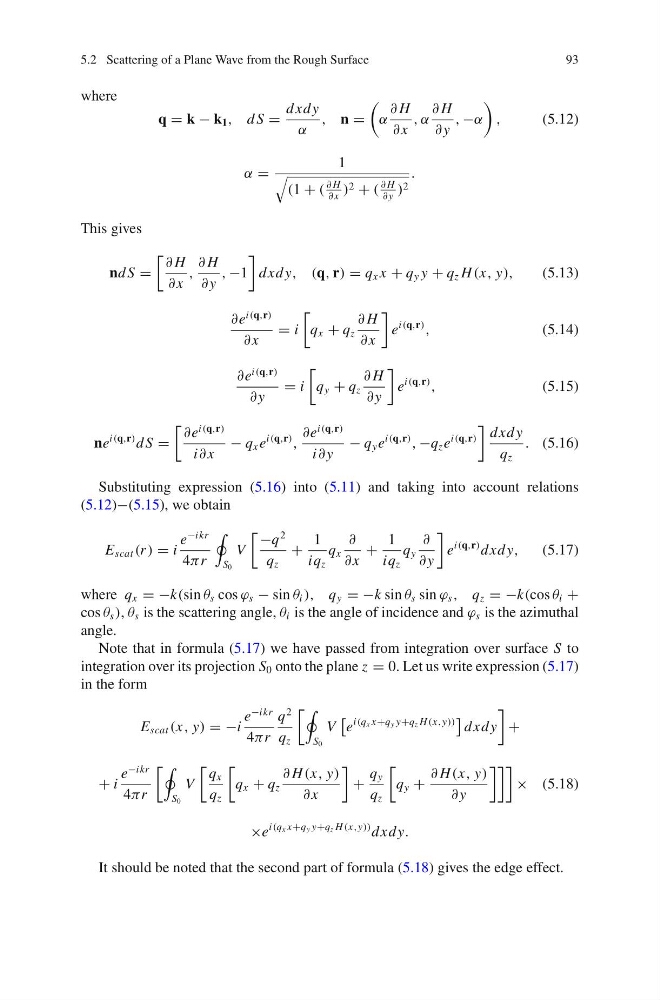
Substituting expression (5.16) into (5.11) and taking into account relations
(5.12)−(5.15), we obtain
E scat (r ) = i
e
−ikr
4πr
S 0
V
−q
2
q z
+
1
iq z
q x
∂
∂ x
+
1
iq z
q y
∂
∂ y
e
i(q,r) dxdy,
(5.17)
where q x = −k(sin θ s cos ϕ s − sin θ i ), q y = −k sin θ s sin ϕ s , q z = −k(cos θ i +
cos θ s ), θ s is the scattering angle, θ i is the angle of incidence and ϕ s is the azimuthal
angle.
Note that in formula (5.17) we have passed from integration over surface S to
integration over its projection S 0 onto the plane z = 0. Let us write expression (5.17)
in the form
E scat (x, y) = −i
e
−ikr
4πr
q
2
q z
S 0
V
e
i(q x x+q y y+q z H (x,y))
dxdy
+
+ i
e
−ikr
4πr
S 0
V
q x
q z
q x + q z
∂ H (x, y)
∂ x
+
q y
q z
q y +
∂ H (x, y)
∂ y
× (5.18)
×e
i(q x x+q y y+q z H (x,y)) dxdy.
It should be noted that the second part of formula (5.18) gives the edge effect.
93
where
q = k − k 1 , d S =
dxdy
α
, n =
α
∂ H
∂ x
, α
∂ H
∂ y
, −α
,
(5.12)
α =
1
(1 + (
∂ H
∂ x
) 2 + (
∂ H
∂ y
) 2
.
This gives
nd S =
∂ H
∂ x
,
∂ H
∂ y
, −1
dxdy, (q, r) = q x x + q y y + q z H (x, y),
(5.13)
∂e
i(q,r)
∂ x
= i
q x + q z
∂ H
∂ x
e
i(q,r)
,
(5.14)
∂e
i(q,r)
∂ y
= i
q y + q z
∂ H
∂ y
e
i(q,r)
,
(5.15)
ne
i(q,r) d S =
∂e
i(q,r)
i∂ x
− q x e
i(q,r)
,
∂e
i(q,r)
i∂ y
− q y e
i(q,r)
, −q z e
i(q,r)
dxdy
q z
. (5.16)
Substituting expression (5.16) into (5.11) and taking into account relations
(5.12)−(5.15), we obtain
E scat (r ) = i
e
−ikr
4πr
S 0
V
−q
2
q z
+
1
iq z
q x
∂
∂ x
+
1
iq z
q y
∂
∂ y
e
i(q,r) dxdy,
(5.17)
where q x = −k(sin θ s cos ϕ s − sin θ i ), q y = −k sin θ s sin ϕ s , q z = −k(cos θ i +
cos θ s ), θ s is the scattering angle, θ i is the angle of incidence and ϕ s is the azimuthal
angle.
Note that in formula (5.17) we have passed from integration over surface S to
integration over its projection S 0 onto the plane z = 0. Let us write expression (5.17)
in the form
E scat (x, y) = −i
e
−ikr
4πr
q
2
q z
S 0
V
e
i(q x x+q y y+q z H (x,y))
dxdy
+
+ i
e
−ikr
4πr
S 0
V
q x
q z
q x + q z
∂ H (x, y)
∂ x
+
q y
q z
q y +
∂ H (x, y)
∂ y
× (5.18)
×e
i(q x x+q y y+q z H (x,y)) dxdy.
It should be noted that the second part of formula (5.18) gives the edge effect.