

5 EEG Source Imaging and Multimodal Neuroimaging
89
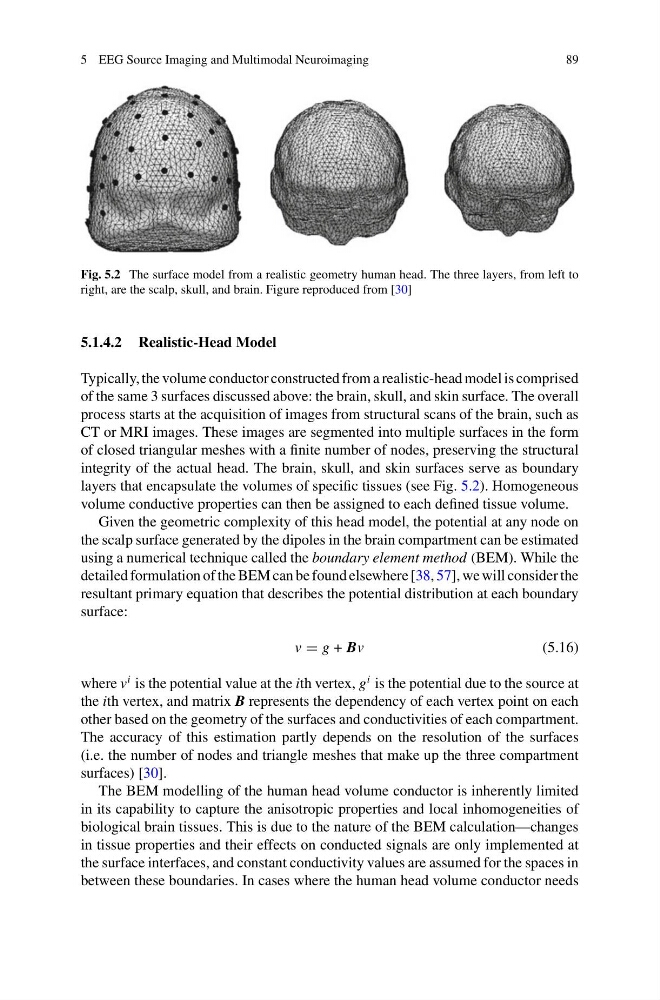
Fig. 5.2 The surface model from a realistic geometry human head. The three layers, from left to
right, are the scalp, skull, and brain. Figure reproduced from [30]
5.1.4.2 Realistic-Head Model
Typically, the volume conductor constructed from a realistic-head model is comprised
of the same 3 surfaces discussed above: the brain, skull, and skin surface. The overall
process starts at the acquisition of images from structural scans of the brain, such as
CT or MRI images. These images are segmented into multiple surfaces in the form
of closed triangular meshes with a finite number of nodes, preserving the structural
integrity of the actual head. The brain, skull, and skin surfaces serve as boundary
layers that encapsulate the volumes of specific tissues (see Fig. 5.2). Homogeneous
volume conductive properties can then be assigned to each defined tissue volume.
Given the geometric complexity of this head model, the potential at any node on
the scalp surface generated by the dipoles in the brain compartment can be estimated
using a numerical technique called the boundary element method (BEM). While the
detailed formulation of the BEM can be found elsewhere [38, 57], we will consider the
resultant primary equation that describes the potential distribution at each boundary
surface:
v g + Bv
(5.16)
where v
i is the potential value at the ith vertex, g
i is the potential due to the source at
the ith vertex, and matrix B represents the dependency of each vertex point on each
other based on the geometry of the surfaces and conductivities of each compartment.
The accuracy of this estimation partly depends on the resolution of the surfaces
(i.e. the number of nodes and triangle meshes that make up the three compartment
surfaces) [30].
The BEM modelling of the human head volume conductor is inherently limited
in its capability to capture the anisotropic properties and local inhomogeneities of
biological brain tissues. This is due to the nature of the BEM calculation—changes
in tissue properties and their effects on conducted signals are only implemented at
the surface interfaces, and constant conductivity values are assumed for the spaces in
between these boundaries. In cases where the human head volume conductor needs
89
Fig. 5.2 The surface model from a realistic geometry human head. The three layers, from left to
right, are the scalp, skull, and brain. Figure reproduced from [30]
5.1.4.2 Realistic-Head Model
Typically, the volume conductor constructed from a realistic-head model is comprised
of the same 3 surfaces discussed above: the brain, skull, and skin surface. The overall
process starts at the acquisition of images from structural scans of the brain, such as
CT or MRI images. These images are segmented into multiple surfaces in the form
of closed triangular meshes with a finite number of nodes, preserving the structural
integrity of the actual head. The brain, skull, and skin surfaces serve as boundary
layers that encapsulate the volumes of specific tissues (see Fig. 5.2). Homogeneous
volume conductive properties can then be assigned to each defined tissue volume.
Given the geometric complexity of this head model, the potential at any node on
the scalp surface generated by the dipoles in the brain compartment can be estimated
using a numerical technique called the boundary element method (BEM). While the
detailed formulation of the BEM can be found elsewhere [38, 57], we will consider the
resultant primary equation that describes the potential distribution at each boundary
surface:
v g + Bv
(5.16)
where v
i is the potential value at the ith vertex, g
i is the potential due to the source at
the ith vertex, and matrix B represents the dependency of each vertex point on each
other based on the geometry of the surfaces and conductivities of each compartment.
The accuracy of this estimation partly depends on the resolution of the surfaces
(i.e. the number of nodes and triangle meshes that make up the three compartment
surfaces) [30].
The BEM modelling of the human head volume conductor is inherently limited
in its capability to capture the anisotropic properties and local inhomogeneities of
biological brain tissues. This is due to the nature of the BEM calculation—changes
in tissue properties and their effects on conducted signals are only implemented at
the surface interfaces, and constant conductivity values are assumed for the spaces in
between these boundaries. In cases where the human head volume conductor needs