

88
Y. Zhang
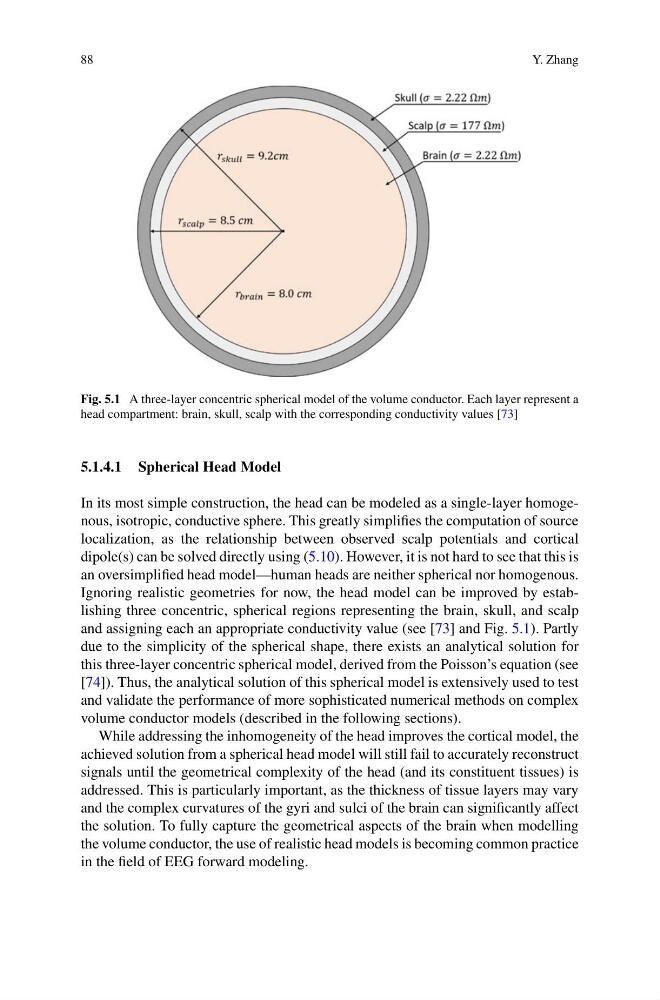
Fig. 5.1 A three-layer concentric spherical model of the volume conductor. Each layer represent a
head compartment: brain, skull, scalp with the corresponding conductivity values [73]
5.1.4.1 Spherical Head Model
In its most simple construction, the head can be modeled as a single-layer homogenous, isotropic, conductive sphere. This greatly simplifies the computation of source
localization, as the relationship between observed scalp potentials and cortical
dipole(s) can be solved directly using (5.10). However, it is not hard to see that this is
an oversimplified head model—human heads are neither spherical nor homogenous.
Ignoring realistic geometries for now, the head model can be improved by establishing three concentric, spherical regions representing the brain, skull, and scalp
and assigning each an appropriate conductivity value (see [73] and Fig. 5.1). Partly
due to the simplicity of the spherical shape, there exists an analytical solution for
this three-layer concentric spherical model, derived from the Poisson’s equation (see
[74]). Thus, the analytical solution of this spherical model is extensively used to test
and validate the performance of more sophisticated numerical methods on complex
volume conductor models (described in the following sections).
While addressing the inhomogeneity of the head improves the cortical model, the
achieved solution from a spherical head model will still fail to accurately reconstruct
signals until the geometrical complexity of the head (and its constituent tissues) is
addressed. This is particularly important, as the thickness of tissue layers may vary
and the complex curvatures of the gyri and sulci of the brain can significantly affect
the solution. To fully capture the geometrical aspects of the brain when modelling
the volume conductor, the use of realistic head models is becoming common practice
in the field of EEG forward modeling.
Y. Zhang
Fig. 5.1 A three-layer concentric spherical model of the volume conductor. Each layer represent a
head compartment: brain, skull, scalp with the corresponding conductivity values [73]
5.1.4.1 Spherical Head Model
In its most simple construction, the head can be modeled as a single-layer homogenous, isotropic, conductive sphere. This greatly simplifies the computation of source
localization, as the relationship between observed scalp potentials and cortical
dipole(s) can be solved directly using (5.10). However, it is not hard to see that this is
an oversimplified head model—human heads are neither spherical nor homogenous.
Ignoring realistic geometries for now, the head model can be improved by establishing three concentric, spherical regions representing the brain, skull, and scalp
and assigning each an appropriate conductivity value (see [73] and Fig. 5.1). Partly
due to the simplicity of the spherical shape, there exists an analytical solution for
this three-layer concentric spherical model, derived from the Poisson’s equation (see
[74]). Thus, the analytical solution of this spherical model is extensively used to test
and validate the performance of more sophisticated numerical methods on complex
volume conductor models (described in the following sections).
While addressing the inhomogeneity of the head improves the cortical model, the
achieved solution from a spherical head model will still fail to accurately reconstruct
signals until the geometrical complexity of the head (and its constituent tissues) is
addressed. This is particularly important, as the thickness of tissue layers may vary
and the complex curvatures of the gyri and sulci of the brain can significantly affect
the solution. To fully capture the geometrical aspects of the brain when modelling
the volume conductor, the use of realistic head models is becoming common practice
in the field of EEG forward modeling.