

68
M. Congedo
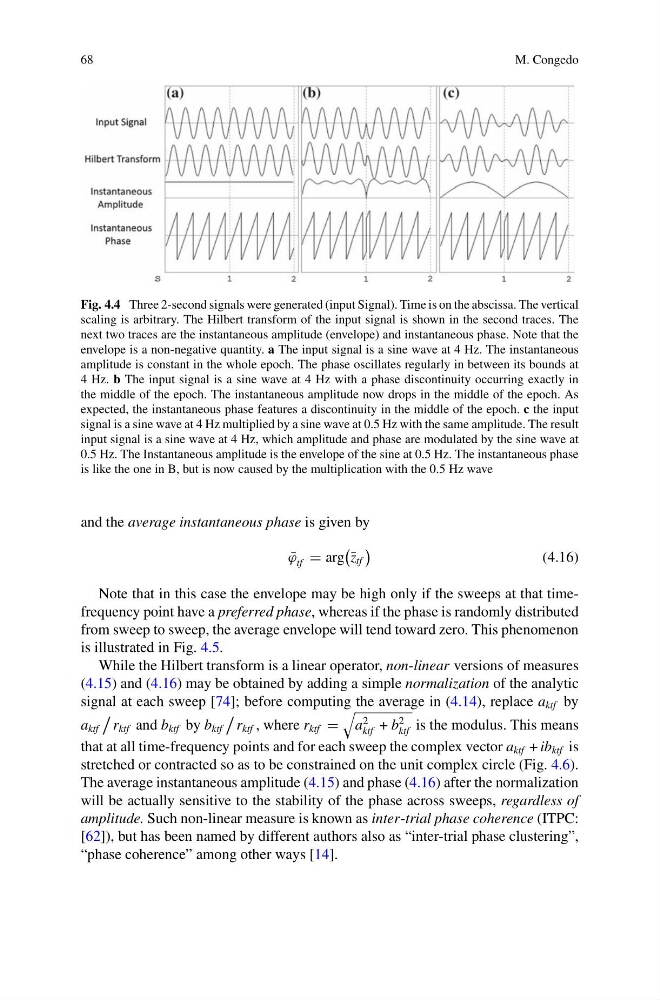
Fig. 4.4 Three 2-second signals were generated (input Signal). Time is on the abscissa. The vertical
scaling is arbitrary. The Hilbert transform of the input signal is shown in the second traces. The
next two traces are the instantaneous amplitude (envelope) and instantaneous phase. Note that the
envelope is a non-negative quantity. a The input signal is a sine wave at 4 Hz. The instantaneous
amplitude is constant in the whole epoch. The phase oscillates regularly in between its bounds at
4 Hz. b The input signal is a sine wave at 4 Hz with a phase discontinuity occurring exactly in
the middle of the epoch. The instantaneous amplitude now drops in the middle of the epoch. As
expected, the instantaneous phase features a discontinuity in the middle of the epoch. c the input
signal is a sine wave at 4 Hz multiplied by a sine wave at 0.5 Hz with the same amplitude. The result
input signal is a sine wave at 4 Hz, which amplitude and phase are modulated by the sine wave at
0.5 Hz. The Instantaneous amplitude is the envelope of the sine at 0.5 Hz. The instantaneous phase
is like the one in B, but is now caused by the multiplication with the 0.5 Hz wave
and the average instantaneous phase is given by
¯
ϕ tf arg
¯
z tf
(4.16)
Note that in this case the envelope may be high only if the sweeps at that timefrequency point have a preferred phase, whereas if the phase is randomly distributed
from sweep to sweep, the average envelope will tend toward zero. This phenomenon
is illustrated in Fig. 4.5.
While the Hilbert transform is a linear operator, non-linear versions of measures
(4.15) and (4.16) may be obtained by adding a simple normalization of the analytic
signal at each sweep [74]; before computing the average in (4.14), replace a ktf by
a ktf
r ktf and b ktf by b ktf
r ktf , where r ktf
a
2
ktf + b
2
ktf is the modulus. This means
that at all time-frequency points and for each sweep the complex vector a ktf + ib ktf is
stretched or contracted so as to be constrained on the unit complex circle (Fig. 4.6).
The average instantaneous amplitude (4.15) and phase (4.16) after the normalization
will be actually sensitive to the stability of the phase across sweeps, regardless of
amplitude. Such non-linear measure is known as inter-trial phase coherence (ITPC:
[62]), but has been named by different authors also as “inter-trial phase clustering”,
“phase coherence” among other ways [14].
M. Congedo
Fig. 4.4 Three 2-second signals were generated (input Signal). Time is on the abscissa. The vertical
scaling is arbitrary. The Hilbert transform of the input signal is shown in the second traces. The
next two traces are the instantaneous amplitude (envelope) and instantaneous phase. Note that the
envelope is a non-negative quantity. a The input signal is a sine wave at 4 Hz. The instantaneous
amplitude is constant in the whole epoch. The phase oscillates regularly in between its bounds at
4 Hz. b The input signal is a sine wave at 4 Hz with a phase discontinuity occurring exactly in
the middle of the epoch. The instantaneous amplitude now drops in the middle of the epoch. As
expected, the instantaneous phase features a discontinuity in the middle of the epoch. c the input
signal is a sine wave at 4 Hz multiplied by a sine wave at 0.5 Hz with the same amplitude. The result
input signal is a sine wave at 4 Hz, which amplitude and phase are modulated by the sine wave at
0.5 Hz. The Instantaneous amplitude is the envelope of the sine at 0.5 Hz. The instantaneous phase
is like the one in B, but is now caused by the multiplication with the 0.5 Hz wave
and the average instantaneous phase is given by
¯
ϕ tf arg
¯
z tf
(4.16)
Note that in this case the envelope may be high only if the sweeps at that timefrequency point have a preferred phase, whereas if the phase is randomly distributed
from sweep to sweep, the average envelope will tend toward zero. This phenomenon
is illustrated in Fig. 4.5.
While the Hilbert transform is a linear operator, non-linear versions of measures
(4.15) and (4.16) may be obtained by adding a simple normalization of the analytic
signal at each sweep [74]; before computing the average in (4.14), replace a ktf by
a ktf
r ktf and b ktf by b ktf
r ktf , where r ktf
a
2
ktf + b
2
ktf is the modulus. This means
that at all time-frequency points and for each sweep the complex vector a ktf + ib ktf is
stretched or contracted so as to be constrained on the unit complex circle (Fig. 4.6).
The average instantaneous amplitude (4.15) and phase (4.16) after the normalization
will be actually sensitive to the stability of the phase across sweeps, regardless of
amplitude. Such non-linear measure is known as inter-trial phase coherence (ITPC:
[62]), but has been named by different authors also as “inter-trial phase clustering”,
“phase coherence” among other ways [14].