

4 The Analysis of Event-Related Potentials
59
4.3.2 Ensemble Average Estimations
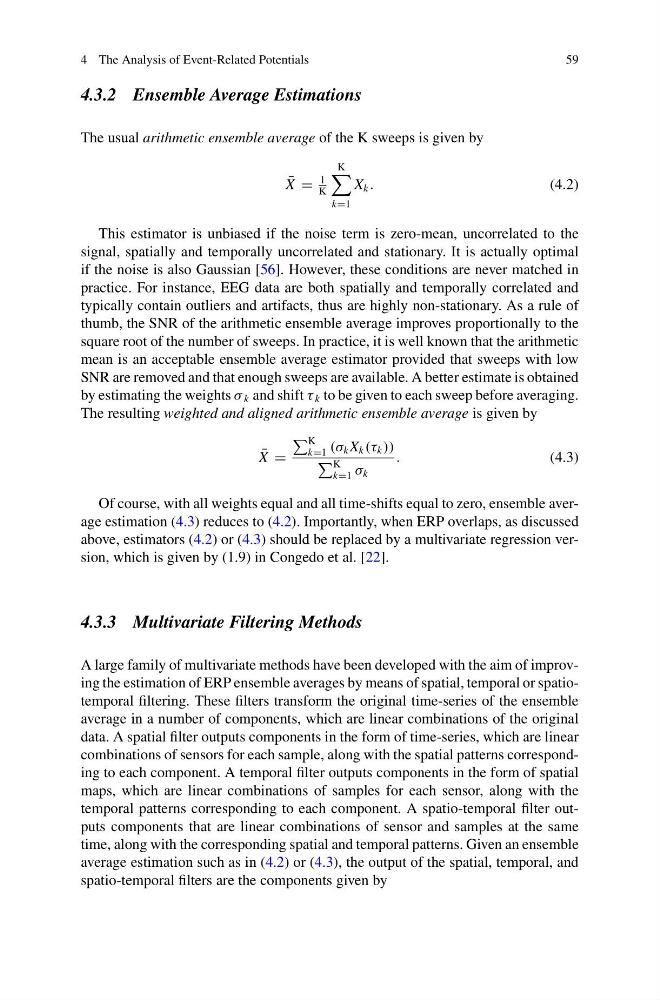
The usual arithmetic ensemble average of the K sweeps is given by
¯
X
1
K
K
k1
X k .
(4.2)
This estimator is unbiased if the noise term is zero-mean, uncorrelated to the
signal, spatially and temporally uncorrelated and stationary. It is actually optimal
if the noise is also Gaussian [56]. However, these conditions are never matched in
practice. For instance, EEG data are both spatially and temporally correlated and
typically contain outliers and artifacts, thus are highly non-stationary. As a rule of
thumb, the SNR of the arithmetic ensemble average improves proportionally to the
square root of the number of sweeps. In practice, it is well known that the arithmetic
mean is an acceptable ensemble average estimator provided that sweeps with low
SNR are removed and that enough sweeps are available. A better estimate is obtained
by estimating the weights σ k and shift τ k to be given to each sweep before averaging.
The resulting weighted and aligned arithmetic ensemble average is given by
¯
X
K
k1 (σ k X k (τ k ))
K
k1 σ k
.
(4.3)
Of course, with all weights equal and all time-shifts equal to zero, ensemble average estimation (4.3) reduces to (4.2). Importantly, when ERP overlaps, as discussed
above, estimators (4.2) or (4.3) should be replaced by a multivariate regression version, which is given by (1.9) in Congedo et al. [22].
4.3.3 Multivariate Filtering Methods
A large family of multivariate methods have been developed with the aim of improving the estimation of ERP ensemble averages by means of spatial, temporal or spatiotemporal filtering. These filters transform the original time-series of the ensemble
average in a number of components, which are linear combinations of the original
data. A spatial filter outputs components in the form of time-series, which are linear
combinations of sensors for each sample, along with the spatial patterns corresponding to each component. A temporal filter outputs components in the form of spatial
maps, which are linear combinations of samples for each sensor, along with the
temporal patterns corresponding to each component. A spatio-temporal filter outputs components that are linear combinations of sensor and samples at the same
time, along with the corresponding spatial and temporal patterns. Given an ensemble
average estimation such as in (4.2) or (4.3), the output of the spatial, temporal, and
spatio-temporal filters are the components given by
59
4.3.2 Ensemble Average Estimations
The usual arithmetic ensemble average of the K sweeps is given by
¯
X
1
K
K
k1
X k .
(4.2)
This estimator is unbiased if the noise term is zero-mean, uncorrelated to the
signal, spatially and temporally uncorrelated and stationary. It is actually optimal
if the noise is also Gaussian [56]. However, these conditions are never matched in
practice. For instance, EEG data are both spatially and temporally correlated and
typically contain outliers and artifacts, thus are highly non-stationary. As a rule of
thumb, the SNR of the arithmetic ensemble average improves proportionally to the
square root of the number of sweeps. In practice, it is well known that the arithmetic
mean is an acceptable ensemble average estimator provided that sweeps with low
SNR are removed and that enough sweeps are available. A better estimate is obtained
by estimating the weights σ k and shift τ k to be given to each sweep before averaging.
The resulting weighted and aligned arithmetic ensemble average is given by
¯
X
K
k1 (σ k X k (τ k ))
K
k1 σ k
.
(4.3)
Of course, with all weights equal and all time-shifts equal to zero, ensemble average estimation (4.3) reduces to (4.2). Importantly, when ERP overlaps, as discussed
above, estimators (4.2) or (4.3) should be replaced by a multivariate regression version, which is given by (1.9) in Congedo et al. [22].
4.3.3 Multivariate Filtering Methods
A large family of multivariate methods have been developed with the aim of improving the estimation of ERP ensemble averages by means of spatial, temporal or spatiotemporal filtering. These filters transform the original time-series of the ensemble
average in a number of components, which are linear combinations of the original
data. A spatial filter outputs components in the form of time-series, which are linear
combinations of sensors for each sample, along with the spatial patterns corresponding to each component. A temporal filter outputs components in the form of spatial
maps, which are linear combinations of samples for each sensor, along with the
temporal patterns corresponding to each component. A spatio-temporal filter outputs components that are linear combinations of sensor and samples at the same
time, along with the corresponding spatial and temporal patterns. Given an ensemble
average estimation such as in (4.2) or (4.3), the output of the spatial, temporal, and
spatio-temporal filters are the components given by