

58
M. Congedo
Amplitude/latency inter-sweep variability as well as the occurrence of overlapping ERPs call for specific analysis methods. In general, such methods result in an
improved ensemble average estimation. For a review of such methods, the reader is
referred to Congedo and Lopes da Silva [23].
4.3 Time Domain Analysis
The main goal of the analysis in the time domain is to estimate the ensemble average
of several sweeps and characterize the ERP peaks in terms of amplitude, shape and
latency. Using matrix algebra notation, we will denote by x(t), the column vector
holding the multivariate EEG recording at N electrodes and at time sample t, whereas
N × T matrix X k will denote a data epoch holding the kth observed sweep for a given
class of ERP signals. These sweeps last T samples and start at event time ± an offset
that depends on the ERP class. For instance, the ERPs and ERDs/ERSs follow a
visual presentation but precede a button press. The sweep onset must therefore be
set accordingly adjusting the offset. We will assume along this chapter that T > N,
i.e., that the sweeps comprise more samples than sensors. We will index the sweeps
for a given class by k∈{1, …, K}, where K is the number of available sweeps for the
class under analysis.
4.3.1 The Additive Generative Model
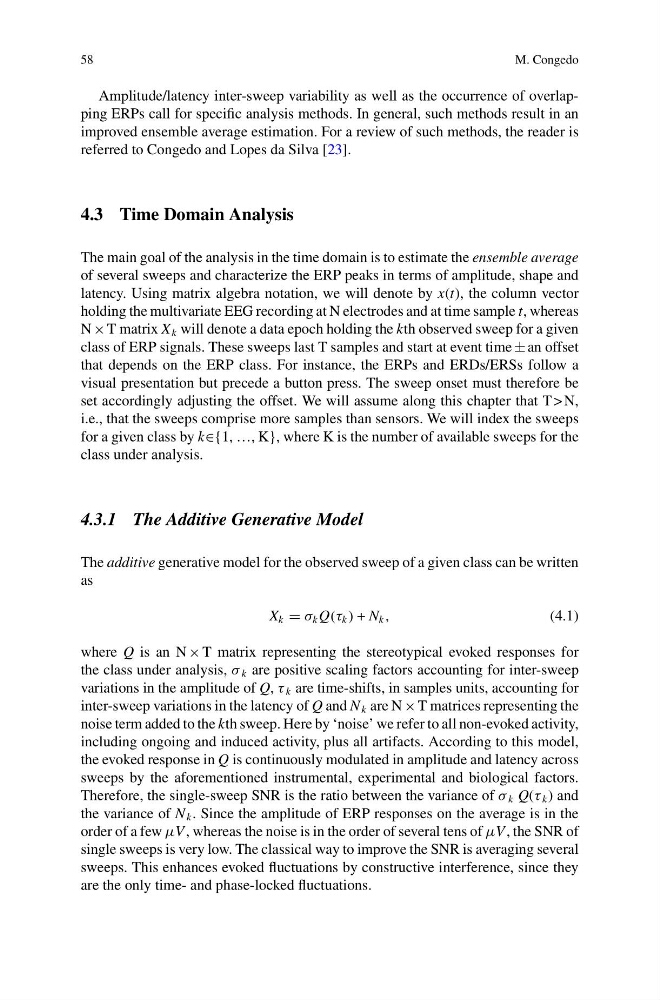
The additive generative model for the observed sweep of a given class can be written
as
X k σ k Q(τ k ) + N k ,
(4.1)
where Q is an N × T matrix representing the stereotypical evoked responses for
the class under analysis, σ k are positive scaling factors accounting for inter-sweep
variations in the amplitude of Q, τ k are time-shifts, in samples units, accounting for
inter-sweep variations in the latency of Q and N k are N × T matrices representing the
noise term added to the kth sweep. Here by ‘noise’ we refer to all non-evoked activity,
including ongoing and induced activity, plus all artifacts. According to this model,
the evoked response in Q is continuously modulated in amplitude and latency across
sweeps by the aforementioned instrumental, experimental and biological factors.
Therefore, the single-sweep SNR is the ratio between the variance of σ k Q(τ k ) and
the variance of N k . Since the amplitude of ERP responses on the average is in the
order of a few μV , whereas the noise is in the order of several tens of μV , the SNR of
single sweeps is very low. The classical way to improve the SNR is averaging several
sweeps. This enhances evoked fluctuations by constructive interference, since they
are the only time- and phase-locked fluctuations.
M. Congedo
Amplitude/latency inter-sweep variability as well as the occurrence of overlapping ERPs call for specific analysis methods. In general, such methods result in an
improved ensemble average estimation. For a review of such methods, the reader is
referred to Congedo and Lopes da Silva [23].
4.3 Time Domain Analysis
The main goal of the analysis in the time domain is to estimate the ensemble average
of several sweeps and characterize the ERP peaks in terms of amplitude, shape and
latency. Using matrix algebra notation, we will denote by x(t), the column vector
holding the multivariate EEG recording at N electrodes and at time sample t, whereas
N × T matrix X k will denote a data epoch holding the kth observed sweep for a given
class of ERP signals. These sweeps last T samples and start at event time ± an offset
that depends on the ERP class. For instance, the ERPs and ERDs/ERSs follow a
visual presentation but precede a button press. The sweep onset must therefore be
set accordingly adjusting the offset. We will assume along this chapter that T > N,
i.e., that the sweeps comprise more samples than sensors. We will index the sweeps
for a given class by k∈{1, …, K}, where K is the number of available sweeps for the
class under analysis.
4.3.1 The Additive Generative Model
The additive generative model for the observed sweep of a given class can be written
as
X k σ k Q(τ k ) + N k ,
(4.1)
where Q is an N × T matrix representing the stereotypical evoked responses for
the class under analysis, σ k are positive scaling factors accounting for inter-sweep
variations in the amplitude of Q, τ k are time-shifts, in samples units, accounting for
inter-sweep variations in the latency of Q and N k are N × T matrices representing the
noise term added to the kth sweep. Here by ‘noise’ we refer to all non-evoked activity,
including ongoing and induced activity, plus all artifacts. According to this model,
the evoked response in Q is continuously modulated in amplitude and latency across
sweeps by the aforementioned instrumental, experimental and biological factors.
Therefore, the single-sweep SNR is the ratio between the variance of σ k Q(τ k ) and
the variance of N k . Since the amplitude of ERP responses on the average is in the
order of a few μV , whereas the noise is in the order of several tens of μV , the SNR of
single sweeps is very low. The classical way to improve the SNR is averaging several
sweeps. This enhances evoked fluctuations by constructive interference, since they
are the only time- and phase-locked fluctuations.