

3 EEG Spectral Analysis
43
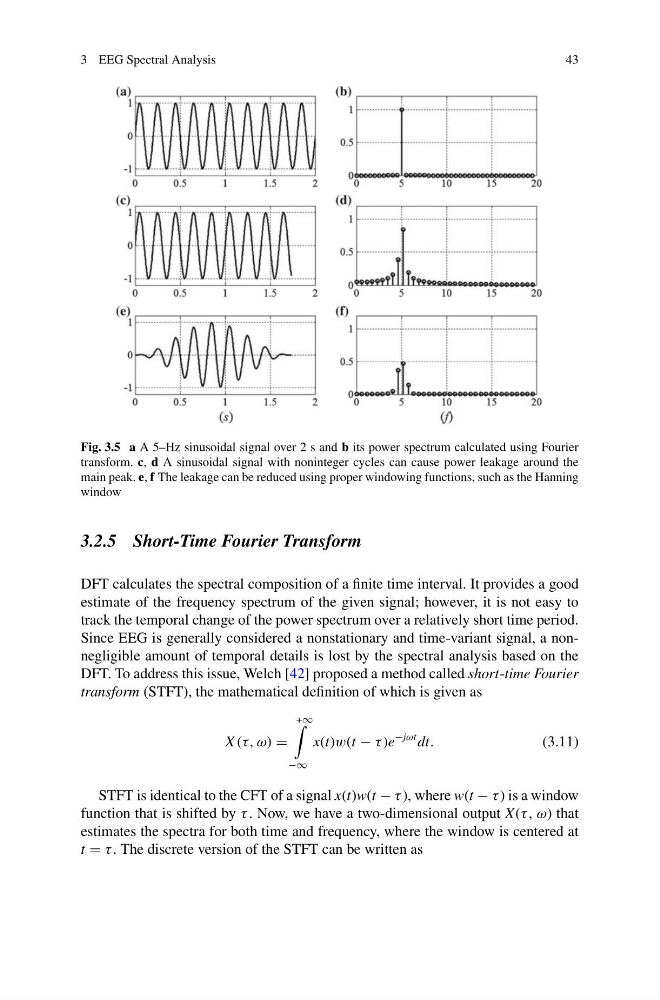
Fig. 3.5 a A 5–Hz sinusoidal signal over 2 s and b its power spectrum calculated using Fourier
transform. c, d A sinusoidal signal with noninteger cycles can cause power leakage around the
main peak. e, f The leakage can be reduced using proper windowing functions, such as the Hanning
window
3.2.5 Short-Time Fourier Transform
DFT calculates the spectral composition of a finite time interval. It provides a good
estimate of the frequency spectrum of the given signal; however, it is not easy to
track the temporal change of the power spectrum over a relatively short time period.
Since EEG is generally considered a nonstationary and time-variant signal, a nonnegligible amount of temporal details is lost by the spectral analysis based on the
DFT. To address this issue, Welch [42] proposed a method called short-time Fourier
transform (STFT), the mathematical definition of which is given as
X (τ, ω)
+∞
−∞
x(t)w(t − τ )e
−jωt dt.
(3.11)
STFT is identical to the CFT of a signal x(t)w(t − τ ), where w(t − τ ) is a window
function that is shifted by τ . Now, we have a two-dimensional output X(τ , ω) that
estimates the spectra for both time and frequency, where the window is centered at
t τ . The discrete version of the STFT can be written as
43
Fig. 3.5 a A 5–Hz sinusoidal signal over 2 s and b its power spectrum calculated using Fourier
transform. c, d A sinusoidal signal with noninteger cycles can cause power leakage around the
main peak. e, f The leakage can be reduced using proper windowing functions, such as the Hanning
window
3.2.5 Short-Time Fourier Transform
DFT calculates the spectral composition of a finite time interval. It provides a good
estimate of the frequency spectrum of the given signal; however, it is not easy to
track the temporal change of the power spectrum over a relatively short time period.
Since EEG is generally considered a nonstationary and time-variant signal, a nonnegligible amount of temporal details is lost by the spectral analysis based on the
DFT. To address this issue, Welch [42] proposed a method called short-time Fourier
transform (STFT), the mathematical definition of which is given as
X (τ, ω)
+∞
−∞
x(t)w(t − τ )e
−jωt dt.
(3.11)
STFT is identical to the CFT of a signal x(t)w(t − τ ), where w(t − τ ) is a window
function that is shifted by τ . Now, we have a two-dimensional output X(τ , ω) that
estimates the spectra for both time and frequency, where the window is centered at
t τ . The discrete version of the STFT can be written as