

42
D.-W. Kim and C.-H. Im
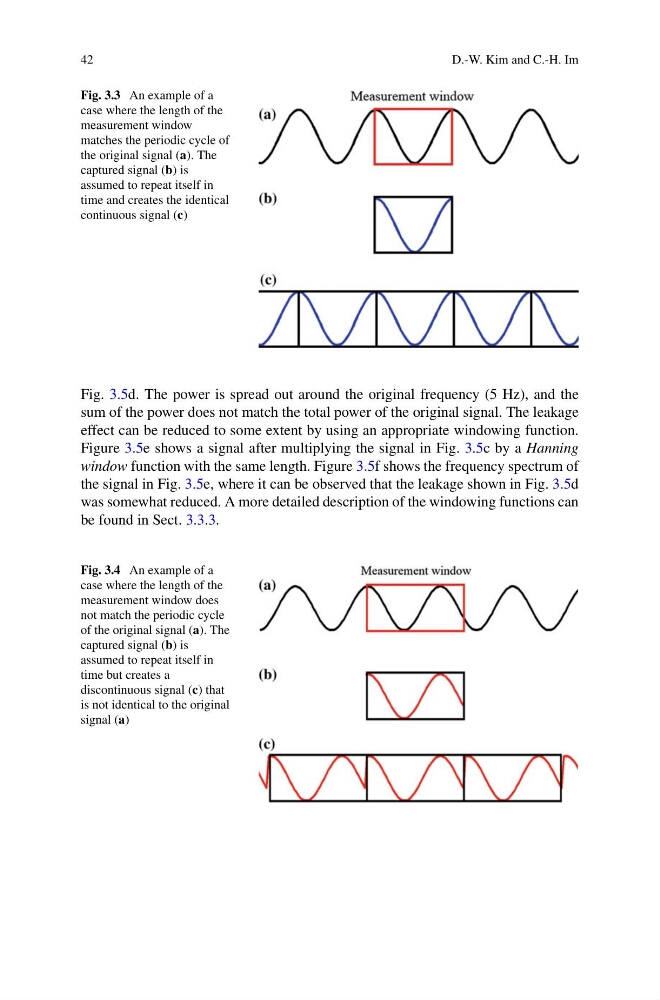
Fig. 3.3 An example of a
case where the length of the
measurement window
matches the periodic cycle of
the original signal (a). The
captured signal (b) is
assumed to repeat itself in
time and creates the identical
continuous signal (c)
Fig. 3.5d. The power is spread out around the original frequency (5 Hz), and the
sum of the power does not match the total power of the original signal. The leakage
effect can be reduced to some extent by using an appropriate windowing function.
Figure 3.5e shows a signal after multiplying the signal in Fig. 3.5c by a Hanning
window function with the same length. Figure 3.5f shows the frequency spectrum of
the signal in Fig. 3.5e, where it can be observed that the leakage shown in Fig. 3.5d
was somewhat reduced. A more detailed description of the windowing functions can
be found in Sect. 3.3.3.
Fig. 3.4 An example of a
case where the length of the
measurement window does
not match the periodic cycle
of the original signal (a). The
captured signal (b) is
assumed to repeat itself in
time but creates a
discontinuous signal (c) that
is not identical to the original
signal (a)
D.-W. Kim and C.-H. Im
Fig. 3.3 An example of a
case where the length of the
measurement window
matches the periodic cycle of
the original signal (a). The
captured signal (b) is
assumed to repeat itself in
time and creates the identical
continuous signal (c)
Fig. 3.5d. The power is spread out around the original frequency (5 Hz), and the
sum of the power does not match the total power of the original signal. The leakage
effect can be reduced to some extent by using an appropriate windowing function.
Figure 3.5e shows a signal after multiplying the signal in Fig. 3.5c by a Hanning
window function with the same length. Figure 3.5f shows the frequency spectrum of
the signal in Fig. 3.5e, where it can be observed that the leakage shown in Fig. 3.5d
was somewhat reduced. A more detailed description of the windowing functions can
be found in Sect. 3.3.3.
Fig. 3.4 An example of a
case where the length of the
measurement window does
not match the periodic cycle
of the original signal (a). The
captured signal (b) is
assumed to repeat itself in
time but creates a
discontinuous signal (c) that
is not identical to the original
signal (a)