

9 Computational EEG Analysis for Brain-Computer Interfaces
209
designates the current target of the user’s attention. This approach has an advantage
over standard spectral analysis, e.g., techniques based on the Fourier Transform, in
that it simultaneously combines spatial and spectral information in the classification
decision and tends to provide more reliable performance. This approach does not
require calibration or training prior to online operation and allows for continuous,
asynchronous operation.
Given two multi-dimensional data sets, X and Y , linear combinations x X
T W x
and y Y
T W y can be found that maximize the correlation between x and y. CCA
finds the weight vectors W x and W y by solving the following optimization problem:
max
W x ,W y
E
W
T
x XY
T W y
E
W T
x X X T W x
E
W T
y Y Y T W y
.
(9.11)
In practice, this can be solved using the singular-value decomposition method to
diagonalize the covariance matrices as the maximum canonical correlation corresponds to the square-root of the largest eigenvalue.
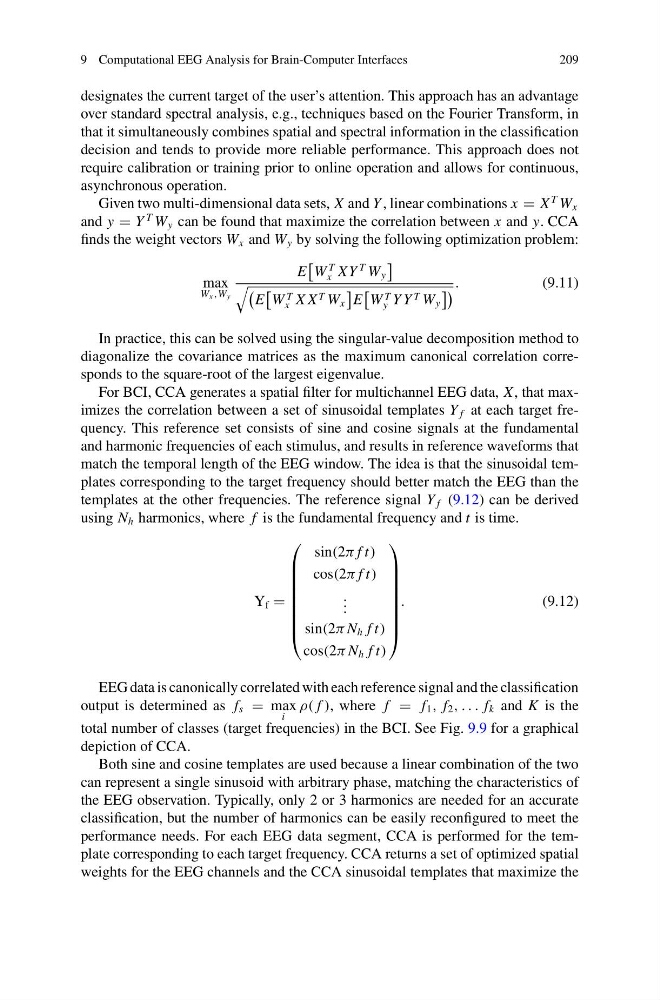
For BCI, CCA generates a spatial filter for multichannel EEG data, X , that maximizes the correlation between a set of sinusoidal templates Y f at each target frequency. This reference set consists of sine and cosine signals at the fundamental
and harmonic frequencies of each stimulus, and results in reference waveforms that
match the temporal length of the EEG window. The idea is that the sinusoidal templates corresponding to the target frequency should better match the EEG than the
templates at the other frequencies. The reference signal Y f (9.12) can be derived
using N h harmonics, where f is the fundamental frequency and t is time.
Y f
⎛
⎜
⎜
⎜
⎜
⎜
⎜
⎜
⎝
sin(2π f t)
cos(2π f t)
. . .
sin(2π N h f t)
cos(2π N h f t)
⎞
⎟
⎟
⎟
⎟
⎟
⎟
⎟
⎠
.
(9.12)
EEG data is canonically correlated with each reference signal and the classification
output is determined as f s max
i
ρ( f ), where f f 1 , f 2 , . . . f k and K is the
total number of classes (target frequencies) in the BCI. See Fig. 9.9 for a graphical
depiction of CCA.
Both sine and cosine templates are used because a linear combination of the two
can represent a single sinusoid with arbitrary phase, matching the characteristics of
the EEG observation. Typically, only 2 or 3 harmonics are needed for an accurate
classification, but the number of harmonics can be easily reconfigured to meet the
performance needs. For each EEG data segment, CCA is performed for the template corresponding to each target frequency. CCA returns a set of optimized spatial
weights for the EEG channels and the CCA sinusoidal templates that maximize the
209
designates the current target of the user’s attention. This approach has an advantage
over standard spectral analysis, e.g., techniques based on the Fourier Transform, in
that it simultaneously combines spatial and spectral information in the classification
decision and tends to provide more reliable performance. This approach does not
require calibration or training prior to online operation and allows for continuous,
asynchronous operation.
Given two multi-dimensional data sets, X and Y , linear combinations x X
T W x
and y Y
T W y can be found that maximize the correlation between x and y. CCA
finds the weight vectors W x and W y by solving the following optimization problem:
max
W x ,W y
E
W
T
x XY
T W y
E
W T
x X X T W x
E
W T
y Y Y T W y
.
(9.11)
In practice, this can be solved using the singular-value decomposition method to
diagonalize the covariance matrices as the maximum canonical correlation corresponds to the square-root of the largest eigenvalue.
For BCI, CCA generates a spatial filter for multichannel EEG data, X , that maximizes the correlation between a set of sinusoidal templates Y f at each target frequency. This reference set consists of sine and cosine signals at the fundamental
and harmonic frequencies of each stimulus, and results in reference waveforms that
match the temporal length of the EEG window. The idea is that the sinusoidal templates corresponding to the target frequency should better match the EEG than the
templates at the other frequencies. The reference signal Y f (9.12) can be derived
using N h harmonics, where f is the fundamental frequency and t is time.
Y f
⎛
⎜
⎜
⎜
⎜
⎜
⎜
⎜
⎝
sin(2π f t)
cos(2π f t)
. . .
sin(2π N h f t)
cos(2π N h f t)
⎞
⎟
⎟
⎟
⎟
⎟
⎟
⎟
⎠
.
(9.12)
EEG data is canonically correlated with each reference signal and the classification
output is determined as f s max
i
ρ( f ), where f f 1 , f 2 , . . . f k and K is the
total number of classes (target frequencies) in the BCI. See Fig. 9.9 for a graphical
depiction of CCA.
Both sine and cosine templates are used because a linear combination of the two
can represent a single sinusoid with arbitrary phase, matching the characteristics of
the EEG observation. Typically, only 2 or 3 harmonics are needed for an accurate
classification, but the number of harmonics can be easily reconfigured to meet the
performance needs. For each EEG data segment, CCA is performed for the template corresponding to each target frequency. CCA returns a set of optimized spatial
weights for the EEG channels and the CCA sinusoidal templates that maximize the